What should you look for when buying?
The type of popcorn mainly determines how much preparation is involved and who controls the ingredients. To compare calories, check the nutritional information for the specific product and consider how much you’ll actually eat.
Popping corn to prepare yourself
A good choice if: You want to control the oil and toppings and decide how much to prepare.
The trade-off: The finished portion depends on what you add, and you’ll still need to prepare and supervise it.
Microwave popcorn
A good choice if: You want to cook a bag according to the packet instructions rather than put the ingredients together yourself.
The trade-off: The recipe and bag size are fixed, and you’ll need to take care of hot steam when opening it.
Ready-popped popcorn
A good choice if: You want a snack that’s ready to eat, with no preparation.
The trade-off: Being ready to eat doesn’t mean it’s lower in calories. The recipe and the amount you serve yourself still matter.
| Criterion | What to check when buying | Who it matters to |
|---|
| Energy and portion size |
kcal per 100 g on a like-for-like basis, as well as the amount you plan to put in each bowl; also check fat and sugar per 100 g. |
I want to be able to gauge how much I actually eat when snacking, rather than relying on the pack size alone. Around 42% of consumers put energy and portion size first. |
| Preparation and handling |
Whether the popcorn is ready to eat or needs cooking; for microwave bags, check the wattage, cooking time and opening instructions. |
When time is short, I want a snack that’s ready without much preparation. For around 33% of consumers, the time involved is the priority. |
| Control over ingredients |
The ingredients list and the amount of sugar, fat and salt per 100 g; if preparing it yourself, consider what you plan to add. |
I want to decide how much oil, sugar or salt goes on my popcorn. This control is the main priority for around 25% of consumers. |
Popping corn at Joybuy
This popping corn is a good fit if you want to prepare it yourself and control the quantity and additions. If calories are a priority when buying, also check the energy value on the specific pack and consider how you plan to prepare it.
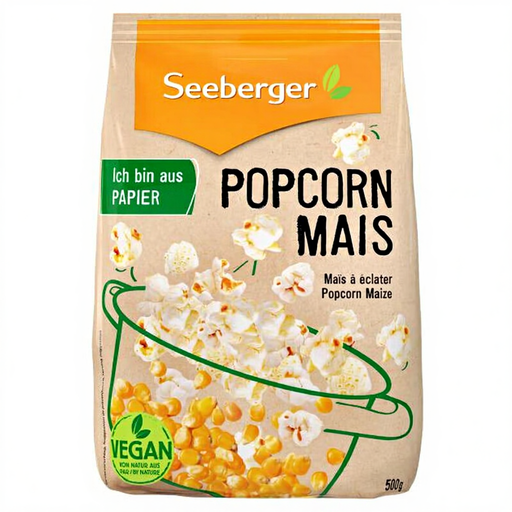 Image unavailable
Seeberger Popcorn Corn Kernels 500g
Popping corn for anyone who wants to decide how much to make and what to add, such as oil or sugar.
The information about the pack size is contradictory, so check the unit on offer before buying. Take extra care if you have allergies: the information about peanuts and nuts is inconsistent. Follow the labelling on the specific pack.
View at Joybuy
Frequently asked questions
How can I spot a popcorn variety with a lower energy value when shopping?
Compare the stated kcal per 100 g on a like-for-like product basis, then decide on your portion. For the products listed, REWE gives 387 kcal per 100 g for XOX sweet microwave popcorn and 480 kcal per 100 g for ready-popped Tise Popcorn knusprig-süß; the different product types are relevant to this comparison.
When is homemade popcorn a good choice?
Popping corn you prepare yourself is a good fit if you want to control the amount of oil, sugar and salt and have time to make it. EDEKA’s air fryer recipe uses 120 g of popping corn and 2 tsp of oil for four portions, and gives 134 kcal per portion. This figure applies to that recipe, not to every homemade version.
What should I look out for with microwave popcorn?
Check the wattage, cooking time and safety instructions on the specific pack. The listed varieties from REWE Beste Wahl and Heimatgut carry a warning about hot steam when opening the bag; some kernels may also remain unpopped in the Heimatgut bag.
What should I check on a popcorn packet if I have a food allergy?
Check the ingredients list and allergen information on the specific pack, even if you’ve bought the product before. Lebensmittelklarheit explains that common allergens deliberately added to a product must be labelled. A possible traces warning is different from an allergen listed as an ingredient.
Can popcorn generally be considered a snack for young children?
No. General advice about snacks can’t establish whether popcorn is suitable for every child. The parenting portal kindergesundheit-info mentions homemade popcorn in relation to children aged 1 to 6 and recommends eating it occasionally and in small amounts. For babies, or if you have individual concerns about swallowing or development, discuss whether it’s suitable with your child’s GP practice.


