If you’re choosing popcorn before a workout to meet a calorie target, compare the energy per 100 g and for the amount you actually plan to eat. Making popcorn from kernels lets you choose how much oil, sugar and salt to add; microwave popcorn saves on preparation, while ready-to-eat popcorn needs no preparation at all. None of these options is low in calories simply because of its name, or right for every workout.
Who should take care when choosing?
People training to a specific calorie target
You’d like something crunchy to eat before your workout and want to choose your portion carefully. The nutritional information per 100 g, your planned portion and the pack size are more useful than the flavour description.
People short on time to prepare food
You want hot popcorn without making it from kernels in a pan. With microwave popcorn, check the instructions for your appliance and take care when handling the hot bag.
People who want to control the ingredients themselves
You want to decide how much oil, sugar or salt goes into your popcorn. You can do this with popcorn kernels, but the recipe and portion size still determine how much energy you consume.
What should you look for when buying?
Make popcorn from kernels
A good fit if: You want to choose the ingredients and the amount you make.
The trade-off: It takes time to prepare, and adding oil or sugar changes the nutritional values.
Microwave popcorn
A good fit if: You want hot popcorn with little preparation and have a suitable microwave.
The trade-off: The recipe and nutritional values are fixed, and you’ll need to open the hot bag carefully.
Ready-to-eat popcorn
A good fit if: You want a snack you can eat without an appliance or preparation time.
The trade-off: For sweet and salty varieties, it’s worth checking the sugar and energy content, as well as how much you’ll actually eat.
| Factor |
What to check before buying |
Who it matters most to |
| Energy and portion size |
Compare kcal per 100 g and work out the figures for the amount you plan to eat. Check the pack size too. |
I want something crunchy before my workout without treating the whole pack as one portion. Around 36% of consumers prioritise keeping track of energy and portion size. |
| Preparation |
For microwave popcorn, check the appliance and preparation instructions on the bag. |
When there’s little time between everyday life and a workout, I want to be able to plan preparation easily. This time factor is a priority for around 29% of consumers. |
| Ingredients |
Read the ingredients list alongside the nutritional information; compare sugar, fat and salt per 100 g. |
I care more about what else is in the recipe besides corn than whether the variety is called sweet or salty. Around 21% of consumers prioritise these ingredients and nutritional values. |
| Protein |
If protein is a deciding factor in your snack choice, compare the amount in your planned portion. |
I want to understand how much protein my portion actually provides. This is the main consideration for around 14% of consumers. |
Which mistakes can you avoid?
-
Assuming all popcorn is low in calories
Examples listed by REWE range from 364 kcal per 100 g for Seeberger salted microwave popcorn to 450 kcal per 100 g for Heimatgut Organic Sweet & Salty Popcorn. So the word ‘popcorn’ alone tells you little about the energy content of a particular portion.
Compare the figures per 100 g and decide how much you want to eat before your workout.
-
Judging nutritional values by whether it’s ‘sweet’ or ‘salty’
According to EDEKA, GUT&GÜNSTIG sweet microwave popcorn contains 16 g of sugar and 12 g of fat per 100 g; the salted variety contains 21 g of fat and 2.5 g of salt per 100 g. The flavour alone is no substitute for comparing nutritional values.
Check sugar, fat and salt using the same serving basis, and read the ingredients list too.
-
Assuming online information matches the pack you receive
EDEKA notes that information on product pages may differ from the details on the product delivered, for example following a change to the recipe or packaging.
Before eating, check the pack for nutritional values, ingredients, allergens and preparation instructions.
-
Preparing every microwave popcorn bag the same way
Power and preparation-time instructions can vary between products. Hot steam may escape when you open a heated bag.
Follow the instructions on the specific bag, keep an eye on it as it cooks and open it away from your face.
Useful brands to help you choose
Seeberger
The salted Seeberger microwave popcorn listed by REWE is one example of popcorn that’s prepared hot.
- For this variety, REWE gives 364 kcal, 16 g of fat and 1.8 g of salt per 100 g.
- Portion size and preparation instructions matter too; these figures don’t apply to all Seeberger products.
Heimatgut
REWE lists both Heimatgut Organic Sweet & Salty ready-to-eat popcorn and salted organic microwave popcorn.
- The two formats give you a choice between eating it straight away and preparing it hot.
- REWE states that the ready-to-eat product contains 450 kcal and 28 g of sugar per 100 g, while the salted microwave product contains 409 kcal and 2 g of salt per 100 g. The organic label doesn’t replace comparing these figures.
Chio
Chio Popcorn sweet and salty is a ready-to-eat sweet and salty popcorn product listed by REWE.
- You can eat this variety without preparing it.
- For this specific product, REWE gives 406 kcal and 51 g of sugar per 100 g. If you want to limit sugar and portion size, check both before choosing.
GUT&GÜNSTIG
EDEKA stocks sweet and salted GUT&GÜNSTIG microwave popcorn in packs of 3 × 100 g.
- EDEKA provides nutritional values per 100 g for both varieties, making it easy to compare the recipes on the same basis.
- For the sweet variety, EDEKA gives 395 kcal and 12 g of fat per 100 g; for the salted variety, it gives 430 kcal and 21 g of fat per 100 g. The flavour alone doesn’t determine how much energy you consume.
Popcorn and popcorn kernels at Joybuy
These products offer two ways to enjoy a snack before your workout: sweet microwave popcorn that takes little preparation, and popcorn kernels you can portion and season yourself. To check how they fit your calorie target, compare the information on each pack.
 No image available
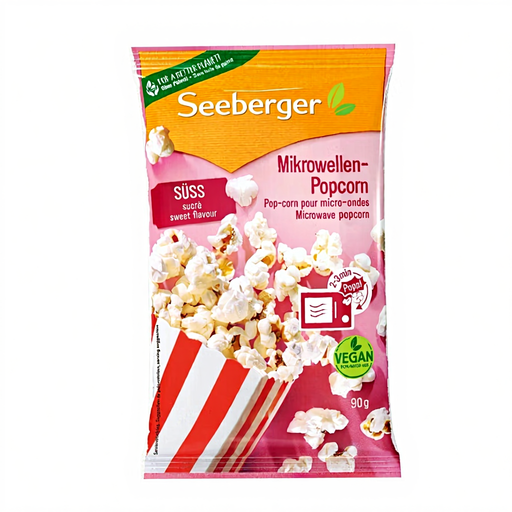
Seeberger Sweet Microwave Popcorn 90 g
A sweet microwave option if you’d like hot popcorn with little preparation.
Pack size: 90 g. Choose your portion using the nutritional information on the pack, and follow the instructions for your appliance and the hot bag when preparing it.
View at Joybuy
 No image available
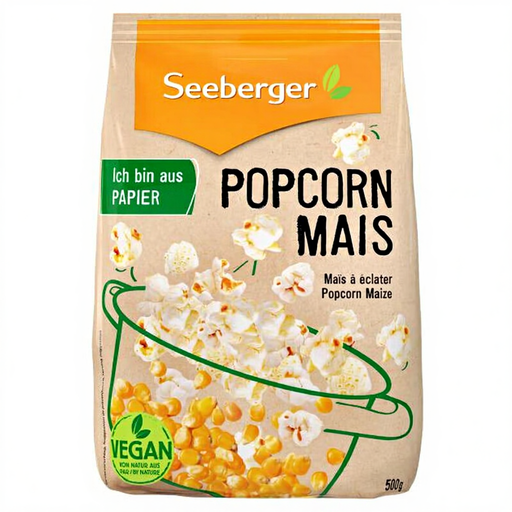
Seeberger popcorn kernels, 500 g variant
Popcorn kernels are a good choice if you want to control the amount you make and how much sugar, salt and fat you add.
You’ll need time and a suitable method to prepare them yourself. Before buying, check the actual pack size and the nutritional information on the specific pack.
View at Joybuy
Frequently asked questions
Is popcorn automatically low in calories?
No. Products listed by REWE include Seeberger salted microwave popcorn at 364 kcal per 100 g and Heimatgut Organic Sweet & Salty Popcorn at 450 kcal per 100 g. The figures for the specific product and your portion size are what matter when deciding how much to snack on.
Which type of popcorn lets me choose the ingredients?
When you make popcorn from kernels, you decide whether to add oil, sugar or salt, and how much. Homemade popcorn isn’t automatically low in calories: the ingredients you use and the amount you eat both count.
What should I bear in mind with microwave popcorn?
Follow the power and preparation-time instructions on the specific bag. Open it carefully after heating, as hot steam may escape and some kernels may remain unpopped.
Which pack details can help me compare products?
Compare energy, sugar, fat and salt per 100 g, and check how much you plan to eat. The ingredients list and allergen information on the pack you receive are important too; EDEKA notes that online product information may differ from the details on the pack.


