If you want a snack straight away and to compare kcal
Ready-to-eat popcorn saves you the preparation. EDEKA lists GUT&GÜNSTIG sweet popcorn at 385 kcal per 100 g, and the bag contains 200 g. So both figures matter when working out your own portion.


Ready-to-eat popcorn is a no-prep snack; microwave popcorn requires a suitable appliance, while loose kernels can be portioned and prepared yourself. For three sweet products compared here, EDEKA and REWE list 385, 395 and 417 kcal per 100 g respectively. The amount of energy you consume also depends on how much popcorn you actually put in your bag or bowl. None of these three products meets the threshold for a ‘low energy’ claim on solid foods under EU Regulation (EC) No 1924/2006.
Ready-to-eat popcorn saves you the preparation. EDEKA lists GUT&GÜNSTIG sweet popcorn at 385 kcal per 100 g, and the bag contains 200 g. So both figures matter when working out your own portion.
A microwave popcorn bag is an option if you have a suitable appliance and time to prepare it. The instructions for appliance power and cooking time on the relevant pack matter just as much as taking care with the hot bag and steam.
Alongside kcal per 100 g, compare the sugar, fat and ingredients on the specific pack. Under EU Regulation (EC) No 1924/2006, the threshold for a ‘low energy’ claim on solid foods is no more than 40 kcal (170 kJ) per 100 g; the three sweet products compared here are above that limit.
First decide whether you want to eat the popcorn straight away, prepare it in the microwave or make it yourself from kernels. Then compare the nutritional values on the same basis, as well as the amount you plan to eat.
| Criteria | What to check when buying | Who it matters to |
|---|---|---|
| Energy and portion | Compare kcal per 100 g with the weight of the portion you plan to have. | If I want to limit how much I snack on, the figure per 100 g alone isn’t enough without checking the bag size. Around 50% of consumers put energy and portion size first when making this choice. |
| Preparation | Choose a ready-to-eat bag or a microwave product; for the latter, check that you have a suitable appliance and follow the pack instructions. | If I want a snack without waiting, I’m more likely to choose a ready-to-eat bag; microwave popcorn requires access to a suitable appliance. For around 30% of consumers, this practical consideration comes first. |
| Ingredients and claims | Check the sugar, fat and ingredients per 100 g; assess claims in relation to the specific product only. | When I choose sweet popcorn, I want to know what it contains besides corn and what a claim actually means. This check takes priority for around 20% of consumers. |
A lower kcal figure within a small product group doesn’t automatically meet the conditions for a nutrition claim. Under EU Regulation (EC) No 1924/2006, the threshold for ‘low energy’ on solid foods is no more than 40 kcal (170 kJ) per 100 g; the sweet products compared here range from 385 to 417 kcal per 100 g.
Describe differences between these specific products as a comparison of their declared energy values, not as proof that they meet the ‘low energy’ claim.
Based on EDEKA’s figure of 385 kcal per 100 g, the entire 200 g bag of GUT&GÜNSTIG sweet popcorn contains 770 kcal by calculation. So a comparison per 100 g doesn’t tell you how much energy you’ll get from the amount you actually eat.
Check the bag weight and work out the kcal for the amount you’ll actually portion out.
It needs a suitable microwave and must be prepared according to the instructions on the specific bag. The bag and steam can be hot when you open it.
Before buying, check that you can use a microwave. When preparing the popcorn, follow the power, timing and safety instructions on the pack.
Ingredients and nutritional values can vary between ready-to-eat popcorn, microwave popcorn and kernels. EDEKA also notes that information on the pack may differ from what is shown online.
Check the nutritional information and ingredients list on the pack you’re actually buying.
EDEKA lists its 200 g bag of ready-to-eat sweet popcorn at 385 kcal per 100 g, and its sweet microwave popcorn in a 3 × 100 g pack at 395 kcal per 100 g.
For REWE Beste Wahl sweet microwave popcorn, REWE lists 417 kcal, 22 g sugar and 13 g fat per 100 g.
Lorenz has several snack ranges. To compare popcorn, you’ll need the nutritional information for a specific popcorn pack.
The popchips sold by funny-frisch are popped crisps, not popcorn.
When buying popcorn at Lidl, you can assess it using the nutritional information and ingredients on the specific pack.
When buying popcorn at ALDI, the labelling on the specific product is what matters.
This selection includes sweet microwave popcorn and kernels you can portion yourself. Compare their nutritional information only with the preparation method and the amount you eat in mind.
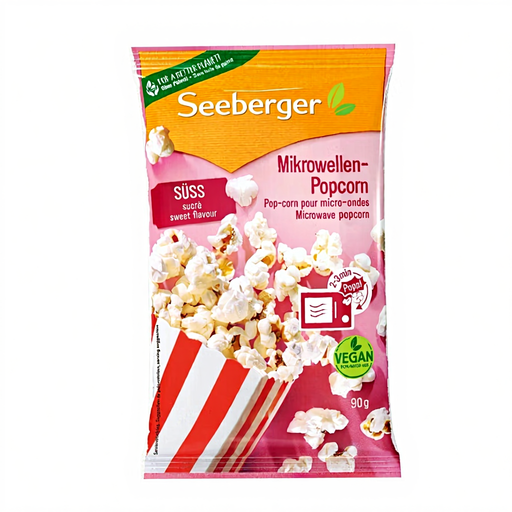 No image available
A sweet popcorn snack for when you have access to a microwave. The pack contains 90 g; follow the instructions on the bag and open it carefully to avoid the hot steam.
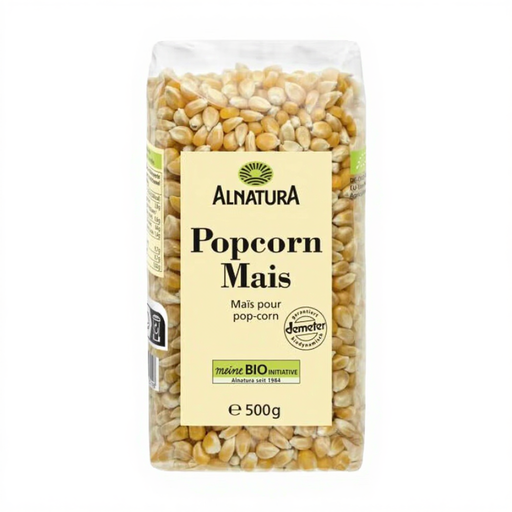 No image available
For anyone who wants to measure out and prepare their own popcorn kernels. The pack contains 500 g of kernels; when assessing the finished portion, remember to include any additions you actually use.
No, the three sweet products compared here don’t meet the conditions for this claim. Under EU Regulation (EC) No 1924/2006, the threshold for ‘low energy’ on solid foods is no more than 40 kcal (170 kJ) per 100 g.
No, the amount you eat matters too. Based on EDEKA’s listed 385 kcal per 100 g, the 200 g bag of EDEKA GUT&GÜNSTIG sweet popcorn contains 770 kcal by calculation if you eat the whole bag.
Follow the instructions on the specific bag and take the power of your microwave into account. Open the heated bag carefully, following the safety instructions, as the bag and steam may be hot.
If it appears on the pack, Nutri-Score can provide an additional point of reference when comparing products within a category. It doesn’t replace checking energy, sugar, fat, ingredients and your planned portion; ALDI SÜD also describes its usefulness as limited to comparisons within a product category.
Not necessarily: EDEKA notes that the products mentioned may not be available in every store. When shopping, also check the information on the actual pack, as it may differ from what is shown online.