If you’re keeping an eye on calories and portions
You’d like something crunchy to eat mid-morning and want to decide how much in advance. Compare the kcal per 100 g and think about how much popcorn you’ll put in a bowl from each pack.


For a calorie-conscious mid-morning snack, compare the energy per 100 g of sweet popcorn and consider how much you actually want to eat. The sweet products listed by EDEKA and REWE contain between 385 and 417 kcal per 100 g. If you pop the corn yourself, you can choose what to add, but you’ll need to allow time for preparation and portioning.
You’d like something crunchy to eat mid-morning and want to decide how much in advance. Compare the kcal per 100 g and think about how much popcorn you’ll put in a bowl from each pack.
You enjoy sweet popcorn but want to compare the sugar content of different varieties. As well as checking the nutrition information, read the ingredients list: according to Lebensmittelklarheit, ingredients are listed in descending order by weight.
You want to choose what goes into your popcorn. This takes time and the right equipment; Lidl, for example, recommends using a microwave-safe container with a lid.
For a mid-morning snack, it makes a difference whether you want to portion out a ready-to-eat snack, make hot popcorn or choose the ingredients yourself. Then compare the nutrition information using the same serving basis.
Best if: You want a snack with no preparation and would like to portion it out in advance.
Consider: According to EDEKA, GUT&GÜNSTIG bagged popcorn contains 30 g of sugar per 100 g.
Best if: You’d like hot popcorn and can follow the preparation instructions on the pack.
Consider: Sugar and fat are already part of the recipe in the sweet varieties listed by EDEKA and REWE.
Best if: You want to choose the quantity and seasoning yourself.
Consider: Preparation takes time, and additions such as oil or sugar change the nutrition values of the finished snack.
| What to consider | What to check | Who it matters to |
|---|---|---|
| Energy and portion size | Compare kcal per 100 g and consider the planned portion in relation to the pack size. | If I eat popcorn mid-morning, I want to portion it out in advance and be able to estimate the energy in that portion. For around 50% of consumers, energy density and portion size are the main considerations. |
| Sugar in sweet popcorn | Check ‘of which sugars’ per 100 g and compare the ingredients lists of similar varieties. | I’m happy to consider sweet popcorn, but sugar content should be the deciding factor. Around 30% of consumers put this figure first. |
| Choosing your own ingredients | When buying popcorn kernels, consider what you plan to add and which preparation method you’ll need. | I want to season it myself and am happy to allow time for preparation. Having control over the ingredients is the top priority for around 20% of consumers. |
A lower figure within a selection of products doesn’t automatically make a popcorn low in energy. EDEKA lists 385 and 395 kcal per 100 g for the two sweet varieties considered here, while REWE lists 417 kcal per 100 g for its variety.
Use kcal per 100 g to compare products, and also consider how much you plan to eat.
The sweet varieties considered here also differ in their sugar and fat content. EDEKA lists 30 g of sugar per 100 g for its bagged popcorn and 16 g for its microwave popcorn; REWE lists 22 g for its microwave variety.
Before choosing a variety, compare energy, ‘of which sugars’ and fat using the same serving basis.
The finished result when you use popcorn kernels depends on how much oil, sugar or other ingredients you add.
Decide on your portion size and additions before you start, and use a container suitable for your chosen method.
EDEKA notes that online information may differ from the details on the packaging. If you have an allergy, it’s especially important to check the labelling on the product you’ve actually bought.
Before eating, check the latest ingredients list, allergen information, nutrition details and, where applicable, preparation instructions.
EDEKA lists both sweet, ready-to-eat bagged popcorn and sweet microwave popcorn. This lets you compare two preparation methods using the nutrition information provided.
Sweet microwave popcorn is another option if you’d like to prepare hot popcorn.
Lidl describes preparing popcorn kernels at home as an alternative to ready-seasoned popcorn.
These popcorn kernels suit a preparation method where you choose the snack quantity and additions yourself.
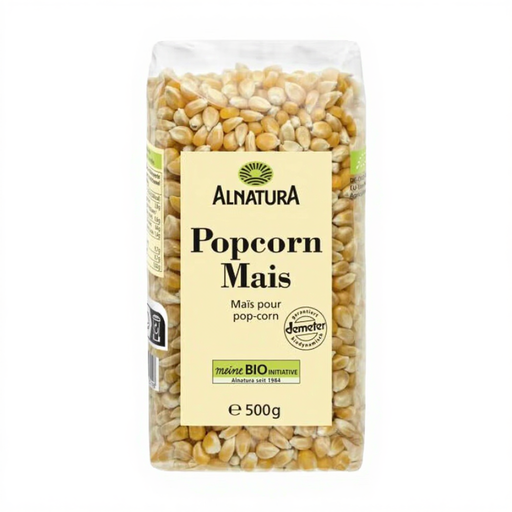 Image unavailable
Popcorn kernels to prepare at home when you want to choose the portion size and seasoning yourself.
Pack size: 500 g. The nutrition values of the finished popcorn will also depend on what you add.
No. A lower figure among the varieties considered here doesn’t mean it can be described that way. EDEKA lists 385 and 395 kcal per 100 g for its two sweet products, while REWE lists 417 kcal per 100 g for its product. The portion you eat also matters when choosing a snack.
Compare energy, sugar and fat per 100 g, then check the pack size and the portion you plan to eat. According to the Federal Centre for Nutrition, any Nutri-Score shown describes the nutritional composition across five grades; it doesn’t replace the specific nutrition information.
Follow the wattage and cooking time instructions on the pack, and take care when opening a hot bag because of the steam. For preparing popcorn kernels in the microwave, Lidl recommends using a microwave-safe container with a lid.
Read the ingredients list and allergen information on the pack you’ve actually bought. Lebensmittelklarheit highlights the requirement to label ingredients that can cause allergic reactions; online shop details or images can’t replace the information on the current packaging.