If you want to control how much fat you add to popcorn during your home-working lunch break, popcorn kernels you prepare yourself are a good choice. Ready-to-eat and microwave popcorn save on preparation time; with these options, the nutrition information for the specific variety will tell you how much fat, sugar and salt it contains. Compare values per 100 g only after checking whether they refer to dry kernels or prepared popcorn.
Which type of popcorn suits you
If you want to control the ingredients
If the amount of fat matters to you and you can allow some time for preparation, popcorn kernels are worth considering. You can choose how much oil to use, as well as checking the information on the packet of kernels.
If you have little time between meetings
Ready-to-eat popcorn and microwave popcorn are practical options for a short break when working from home. What matters is whether the specific variety fits what you want to eat in terms of fat, sugar and salt.
If you want to compare sweet popcorn more closely
If you prefer sweet popcorn, consider the sugar content as well as the fat content, and think about how much you’ll actually eat. One lower figure on its own doesn’t tell you everything about a product.
What to look for when buying
First decide whether you want to prepare the popcorn yourself or eat it straight away. Then compare the nutrition information for the specific products, and remember to include any ingredients you add if you’re preparing it yourself.
Popcorn kernels
A good choice if: You want to control the amount of oil and seasoning yourself.
The trade-off: Preparation takes time, and the oil you use changes the nutritional values of the finished portion.
Ready-to-eat popcorn
A good choice if: You want a snack without needing equipment or waiting.
The trade-off: With sweet varieties in particular, compare the sugar content as well as the fat content.
Microwave popcorn
A good choice if: You have a microwave and want to make popcorn just before eating.
The trade-off: Ingredients and nutritional values vary by variety; the bag and steam can get hot.
| Criteria |
What to check when buying |
Who it matters to |
| Added fat |
Check the fat per 100 g, the ingredients list and, for popcorn kernels, how much oil you plan to use. Check whether the figures refer to dry or prepared kernels. |
I want to decide for myself how much fat to add during preparation, and I’m happy to allow a little time for it. For around 42 % of consumers, having this control is the main priority. |
| Preparation time |
Compare ready-to-eat products with those that need preparing; for microwave popcorn, check the stated wattage and instructions for opening the bag. |
I only have a short break between meetings, so I want popcorn without a lengthy preparation process. Around 33 % of consumers prioritise saving time. |
| Sugar and salt |
As well as fat, check sugar, salt and energy per 100 g, along with the portion you plan to eat. If the packaging says “reduced fat”, check what it is being compared with. |
I don’t want to choose sweet popcorn just because it has a lower fat content, and I pay attention to the other nutritional values too. This is the most important buying consideration for around 25 % of consumers. |
Common comparison pitfalls
-
Taking “reduced fat” as an overall verdict
A comparison of fat content alone doesn’t tell you how much sugar, salt or energy a popcorn product contains.
Check what the packaging is comparing, then read the nutrition information per 100 g. The Verbraucherzentrale recommends assessing nutrition claims alongside, rather than instead of, the nutrition table.
-
Comparing dry kernels directly with ready-made popcorn
Oil may be added when you make popcorn yourself, and it won’t be included in the nutritional values for dry kernels. Microwave popcorn may already contain fat in its ingredients.
Check which product state the figures refer to, and take account of the amount of oil you actually use for your own portion.
-
Checking only the fat content of sweet popcorn
The sweet GUT&GÜNSTIG popcorn described by EDEKA contains 4,5 g of fat and 30 g of sugar per 100 g. These figures answer different questions.
Compare sugar and energy per 100 g too, and decide how much you want to eat during your break.
-
Ignoring the microwave popcorn instructions
The required heating time depends on the product and the microwave. The hot bag and steam can cause injuries when you open it.
Follow the time and power instructions on the packet, and open the bag carefully with the opening facing away from you.
Brands and own-label options to consider
EDEKA / GUT&GÜNSTIG
EDEKA’s product information lets you compare its own-label sweet ready-to-eat popcorn with its salty microwave popcorn.
- According to EDEKA, its sweet bagged popcorn contains 4,5 g of fat and 30 g of sugar per 100 g.
- For its salty microwave popcorn, EDEKA lists 21 g of fat and 2,5 g of salt per 100 g. These figures apply to this product, not to every salty variety.
REWE / REWE Beste Wahl
At REWE, you can look at popcorn kernels and microwave varieties using the information for each specific product.
- REWE states that its sweet REWE Beste Wahl microwave popcorn contains 13 g of fat and 22 g of sugar per 100 g.
- For this microwave variety, REWE warns that hot steam is released after preparation.
Lidl
Lidl’s preparation instructions can help you decide whether to use popcorn kernels yourself instead of choosing a ready-seasoned product.
- The instructions explain how to prepare popcorn in a microwave, letting you choose the ingredients yourself.
- For a nutritional comparison, remember to include anything you add during preparation.
Popcorn kernels at Joybuy
These popcorn kernels are a good choice if you want to prepare popcorn yourself and control how much oil and seasoning you add. When comparing them with ready-made popcorn, remember to include the ingredients in your prepared portion.
 No image available
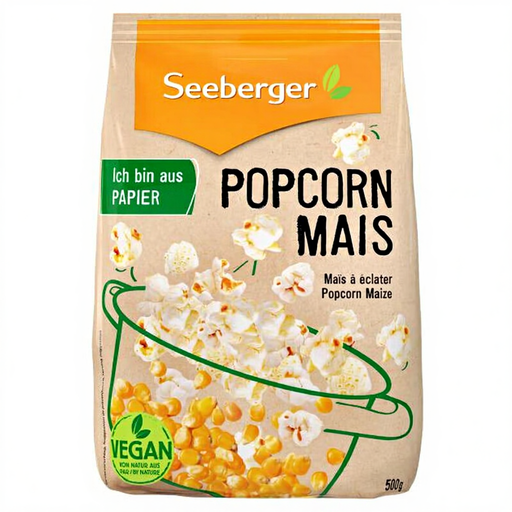
Seeberger popcorn kernels, 500 g
If you want to control how much fat you add, you can use these popcorn kernels to make your own.
The pack contains 500 g. If you prepare the popcorn with oil, the fat content of the portion you eat will also depend on how much you add.
If you have a nut or peanut allergy, check the allergen information on the packaging before buying.
View at Joybuy
Frequently asked questions
What does “reduced fat” mean for popcorn?
It refers to the fat content, not the amount of sugar or salt, or the whole portion. The European Commission describes nutrition claims as regulated statements. If a reduction is advertised, check what it is being compared with and read the full nutrition information.
Is sweet popcorn with less fat automatically a better choice?
No, the fat content alone isn’t enough to make that decision. EDEKA states that its sweet GUT&GÜNSTIG popcorn contains 4,5 g of fat and 30 g of sugar per 100 g; consider both figures and how much you plan to eat.
What should I include when calculating the nutrition of homemade popcorn?
Remember to include the oil and any other ingredients you add during preparation. For example, EDEKA’s air fryer recipe uses 2 TL of oil for four portions, so the nutritional values for dry kernels alone won’t describe every finished portion.
What should I look out for with microwave popcorn?
Follow the power and timing instructions on the packet, and open the hot bag carefully. REWE specifically warns that hot steam is released after preparing its sweet REWE Beste Wahl microwave popcorn.


