Make and season it yourself
You want to decide for yourself how much oil, salt or sugar to add to your popcorn, and have time to make it in a pan or a suitable appliance.


If you want to control how much fat goes into your popcorn over the summer holidays, loose popcorn kernels are a better choice than a pre-seasoned microwave bag. However, the kernels already contain some fat before preparation, and any oil you use adds to it. Microwave popcorn takes less effort; check the nutritional information for fat, sugar and salt to see whether its recipe suits you.
You want to decide for yourself how much oil, salt or sugar to add to your popcorn, and have time to make it in a pan or a suitable appliance.
You want to make hot popcorn with very little preparation for a film or rainy day, and have a microwave available.
You want to check the ingredients, potential allergens and nutritional information, rather than guessing what is in the recipe from the flavour or preparation method.
First, decide whether you want to control what you add yourself or use a ready-to-cook microwave bag. Then compare the nutritional information for similar products. With loose kernels, the preparation method also affects the finished popcorn.
| Factor | What to check | Who it matters to |
|---|---|---|
| Fat and preparation | Compare fat per 100 g within the same product type; with loose kernels, remember to factor in the oil used for preparation. | If I want to control how much fat I add, I’m happy to put in the extra effort to prepare it. Around 36% of consumers prioritise having this control. |
| Preparation time | For microwave bags, check the wattage and cooking instructions; for loose kernels, make sure you have a suitable appliance. | On a busy day during the holidays, I want a snack that’s ready without a lot of preparation. For around 29% of consumers, ease of preparation comes first. |
| Sweet or savoury | For similar varieties, compare sugar or salt per 100 g rather than relying on the flavour description alone. | I want a particular flavour, but I also want to know what’s already in the seasoning. Taste is the main reason for buying for around 21% of consumers. |
| Ingredients and labelling | Check the ingredients, allergen information and nutritional details on the specific pack. | If I need to watch out for particular ingredients, I check the pack carefully before choosing. For around 14% of consumers, this is a priority. |
Loose popcorn kernels let you choose how much oil to use, but they aren’t automatically “low fat”. The Verbraucherzentrale says that solid foods must contain no more than 3 g of fat per 100 g to carry this claim; Seeberger popcorn kernels listed by REWE contain 3.8 g per 100 g before preparation.
Use the figure on the pack as a starting point, and remember to account for any oil you actually add when preparing the popcorn.
Sweet and savoury bags also differ in their recipes. According to REWE, its REWE Beste Wahl sweet microwave popcorn contains 13 g of fat and 22 g of sugar per 100 g; for Seeberger’s savoury product, REWE lists 16 g of fat and 1.8 g of salt per 100 g.
Before choosing a variety, compare similar microwave products by their fat, sugar and salt content per 100 g.
The specific pack is the key source of information about ingredients, allergens and nutritional values. The Verbraucherzentrale explains which details on packaged foods can help guide your choice.
Before buying, read the ingredients list, allergen information, nutritional details and preparation instructions on the pack.
Hot steam can escape when you open the bag. Microwave bags also vary in their recommended wattage and cooking time.
Follow the instructions on your chosen pack and open the bag carefully, facing away from your body.
REWE stocks both loose Seeberger popcorn kernels and savoury microwave popcorn. The product type makes a big difference if you want to control the fat content.
Sweet microwave popcorn is an example of a bagged option for when you fancy something sweet and want to keep preparation to a minimum.
EDEKA’s own-brand savoury microwave popcorn is another example of a pre-seasoned bagged option.
These popcorn kernels are a good fit if you want to choose how to prepare and season them. Whether the finished portion meets your expectations also depends on how much oil and seasoning you use.
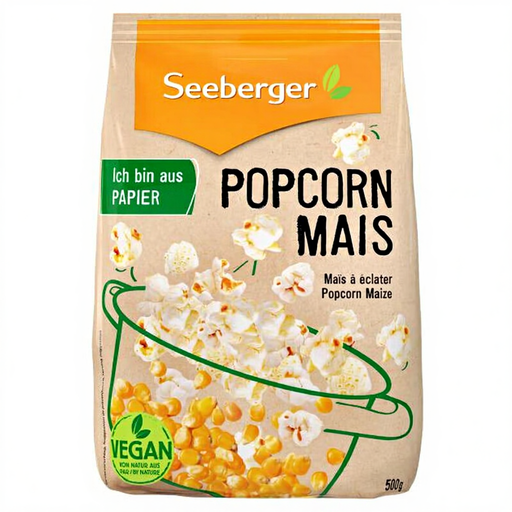 No image available
For anyone who wants to make their own popcorn and choose how to season it.
REWE lists 3.8 g of fat per 100 g of unprepared Seeberger popcorn kernels. If you prepare them with oil, the fat content of the finished portion will be higher.
Check the pack size before buying: the product information lists both 500 g and 10 × 500 g. If necessary, also read the allergen information on the pack.
No. The Verbraucherzentrale says that solid foods must contain no more than 3 g of fat per 100 g to carry the “low fat” claim. Seeberger popcorn kernels listed by REWE contain 3.8 g of fat per 100 g before preparation; any oil used to cook them adds to this.
That depends on whether your appliance is suitable. EDEKA’s recipe uses 2 tsp of oil for 120 g of popcorn kernels and recommends cooking small amounts in a single layer. Also follow your appliance’s instructions, and remember that the oil and any seasoning you add later will affect the finished portion.
Follow the wattage and cooking time on the pack, and open the hot bag carefully. REWE also notes that its savoury Seeberger microwave popcorn is not suitable for children under three or for people with swallowing difficulties.
For similar popcorn products, compare the nutritional information for fat, sugar and salt per 100 g, as well as the ingredients and allergen information. The Nutri-Score, explained by the Bundeszentrum für Ernährung, can offer an additional point of reference when comparing similar foods, but it doesn’t replace checking the individual values.