People keeping an eye on sugar
You want to avoid added sweeteners or compare the sugar content of different porridge products. To do so, you’ll need to check both the ingredients list and the ‘of which sugars’ figure per 100 g.


If you’re looking for porridge with less sugar to suit a low-fat diet, check the sugar and fat content of the dry mix separately rather than relying on a ‘no added sugar’ claim. According to the Verbraucherzentrale (German Consumer Advice Centre), this label does not tell you the total sugar content. Under EU rules, solid foods can only be labelled ‘low fat’ if they contain no more than 3 g of fat per 100 g. Using water instead of milk can reduce the fat contributed by the liquid, but Seitenbacher says it makes the porridge less creamy.
You want to avoid added sweeteners or compare the sugar content of different porridge products. To do so, you’ll need to check both the ingredients list and the ‘of which sugars’ figure per 100 g.
You check the fat per 100 g in the dry mix and consider how much milk, nuts or seeds add to your finished portion. A low sugar figure alone won’t answer your question.
You want to make porridge easily and choose for yourself which fruit, spices or other ingredients to add. A simple oat base leaves that choice up to you.
First, compare the nutritional information for the dry products per 100 g. Then decide which liquid and other ingredients are right for your finished portion.
| Criterion | What to check when buying | Who it matters to |
|---|---|---|
| Sugar | Compare the ‘of which sugars’ figures per 100 g for similar dry products, and read the ingredients list. According to the Verbraucherzentrale, ‘no added sugar’ does not automatically mean ‘low sugar’. | If you’re considering a sweet-tasting mix, you’ll want to know how much sugar it contains overall, even if none has been added. Around 40% of consumers put this sugar figure first when making their choice. |
| Fat | Check the fat per 100 g in the dry mix and take the ingredients in your portion into account. Under EU rules, solid foods can only be labelled ‘low fat’ if they contain no more than 3 g of fat per 100 g. | If a fat limit is important for your breakfast, checking the sugar figure isn’t enough. Around 40% of consumers prioritise the fat content of both the mix and their portion. |
| Preparation | Read the serving and preparation instructions, and think about which ingredients you’d like to add yourself. Using water instead of milk does not change the nutritional values of the dry mix. | If you’re short on time in the morning but want to choose your own fruit and other additions, a simple base is especially important. For around 20% of consumers, being able to customise their portion comes first. |
Fruit ingredients can contain sugar even if no sugar has been added to a product. The label alone therefore doesn’t tell you a specific ‘of which sugars’ figure.
Compare the sugar figures per 100 g for similar products and read the ingredients list. The Verbraucherzentrale lists dried fruit and fruit juice, among other ingredients, as potential contributors to sugar content.
These figures describe different qualities. For example, REWE lists Kölln Hafer-Porridge Feine Basis as containing 1.9 g of sugar and 11 g of fat per 100 g.
If a ‘low fat’ claim is important to your choice, check the fat figure for the specific product: the EU limit for solid foods is no more than 3 g per 100 g.
Milk and other ingredients are part of the finished portion, but not included in the nutritional information for the dry mix. Your choice can therefore change the fat content of the meal.
Factor in how you usually prepare your porridge. Using water instead of milk can reduce the fat contributed by the liquid; Seitenbacher says this makes the porridge less creamy and less intense in flavour.
Kölln offers oat porridge in several varieties. The Feine Basis listed by REWE contains oats, spelt, almonds and linseeds.
Seitenbacher offers a range of porridge products and suggests organic oats as a way to choose the ingredients in your portion yourself.
Alnatura offers, among other products, a children’s porridge made with oats and banana, which the manufacturer says is made without added sugar.
This selection includes oats and a porridge base for portions that you can customise with your own ingredients. Check the product’s nutritional information and consider how you prepare it to see whether it suits your fat limit.
 No image available
A base for your porridge if you’d like to choose the other ingredients yourself. Check the fat per 100 g if it’s a deciding factor in your choice.
 No image available
For oat-based porridge when you’d like to choose the other ingredients yourself. Compare the sugar and fat figures in the nutritional information for this specific pack.
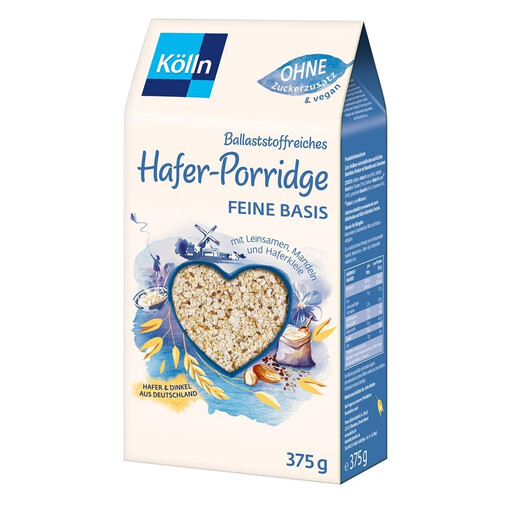 No image available
For anyone looking for a porridge base rather than individual oats. Assess the sugar and fat figures for this variety separately, and take the ingredients in your finished portion into account.
No. According to the Verbraucherzentrale, ‘no added sugar’ refers to added sugars and ingredients with a sweetening effect; naturally occurring sugar may still be present. To be labelled ‘low sugar’, solid foods must contain no more than 5 g of sugar per 100 g. You’ll find the figure in the nutrition table under ‘of which sugars’.
Under EU rules, solid foods can only be labelled ‘low fat’ if they contain no more than 3 g of fat per 100 g. Check the figure for the specific dry mix; a low sugar figure doesn’t tell you whether it meets this fat limit.
Water doesn’t change the nutritional values of the dry mix, but it can reduce the fat contributed by the liquid compared with milk. Seitenbacher points out that porridge made with water is less creamy and less intense in flavour.