Shoppers focused on fibre
If fibre content matters to you, compare the nutrition information per 100 g for the specific oats you’re considering. The product name alone doesn’t tell you which figure applies to that particular variety.


For stocking up on porridge oats, consider wholegrain oats and compare their fibre content using the nutrition information per 100 g. Choose fine oats for a softer texture, jumbo oats for more bite or instant oats for a quick, smooth porridge. Larger packs only make sense if you can use them before their quality declines and store them somewhere cool, dry and dark in an airtight container.
If fibre content matters to you, compare the nutrition information per 100 g for the specific oats you’re considering. The product name alone doesn’t tell you which figure applies to that particular variety.
If you’re buying several packs or a larger format, choose a quantity that suits how much you use. The Verbraucherzentrale recommends storing oats in airtight containers; they can turn rancid if kept for too long.
The type of oats you choose determines whether your porridge is soft, hearty or quick to prepare. If you have coeliac disease or allergies, you’ll also need to check the labelling and ingredients on each pack.
First, decide which type of oats you actually want to use for your porridge. Then compare the nutrition information for the specific variety and choose a pack size that suits your usage and storage space.
| What to consider | What to check when buying | Who it matters most to |
|---|---|---|
| Fibre and wholegrain | Compare the fibre per 100 g in the nutrition information and the ingredients for the specific variety. | If I choose oats mainly by their stated fibre content, a general claim that they’re wholegrain isn’t enough for me. Around 33% of shoppers put this criterion first. |
| Pack size and storage | Check the pack size and best-before date against how much you use; make sure you have somewhere dry to store them and an airtight container. | If I buy several packs, I want to avoid leaving oats open for a long time or letting pests spread through my food cupboard. That’s why storage is the main consideration for around 27% of shoppers. |
| Texture and preparation | Choose between fine, jumbo and instant oats by checking the product description and preparation instructions. | If I want my porridge to have some bite or to be quick and smooth, the type of oats makes all the difference. This is the most important reason to buy for around 20% of shoppers. |
| Gluten and allergen labelling | If you have coeliac disease, look for an explicit “gluten-free” label; if you have allergies, check the ingredients and may-contain information on every pack. | If I need to avoid certain ingredients, I can’t tell whether a product is suitable just because it’s labelled “organic” or “wholegrain”. Around 20% of shoppers put labelling first when making their choice. |
According to the Verbraucherzentrale, oats can turn rancid because of their fat content. Pantry pests can also spread to other dry foods.
Only buy as much as you’re likely to use. Store opened oats in an airtight container somewhere dry and away from light.
The Verbraucherzentrale distinguishes between oats according to how they’re processed: jumbo oats are rolled from whole oat grains, while fine oats are made from oats that have been cut first. Very fine varieties dissolve more easily.
Before buying several packs, try out the texture you prefer for your porridge, or keep different types of oats for different recipes.
If you have coeliac disease, neither an organic nor a wholegrain label is a substitute for an explicit “gluten-free” label. If you have allergies, ingredients and may-contain information can also be important.
Check the labelling on each pack individually. The Verbraucherzentrale recommends that people with coeliac disease only buy oats explicitly labelled “gluten-free”.
Kölln offers fine, jumbo and instant oats. REWE also lists a 1.250-g pack of Blütenzarte Köllnflocken, which could be a good option if you’re stocking up.
Seitenbacher describes wholegrain oats as part of its range. If you’re stocking up for porridge, check whether you’re choosing plain oats or a mix.
Brüggen includes oats in its mill products and describes their processing, from cleaning and sorting through to steaming.
Alnatura offers several types of oats, including extra-fine, fine, jumbo and quick-dissolving oats.
REWE Bio offers fine and jumbo oats. The type you choose matters more for your preferred porridge texture than the supermarket’s own-brand name alone.
EDEKA’s own brands include different types of oats, including an organic variety and GUT&GÜNSTIG jumbo oats.
Here you’ll find fine and jumbo oats in different pack sizes, as well as a porridge mix. If you only want to stock up on plain oats, remember that the mix is different from plain oats and check the pack details for each product.
 No product image available
If you regularly use fine oats for porridge, this gives you four individual 500-g packs instead of one single pack.
Store your supply somewhere dry and seal opened packs tightly. If you have coeliac disease, only choose a pack explicitly labelled gluten-free.
 No product image available
This single pack is a good choice if you’d like to try fine oats in your porridge first or prefer to keep a smaller amount in stock.
Pack size: 500 g. Check the fibre content per 100 g on the specific pack, and store opened oats somewhere dry in an airtight container.
 No product image available
If you’re looking for a coarser type of oats for your porridge, this is an alternative to fine oats.
Pack size: 500 g. Check the fibre content and, if you have allergies, the ingredients and may-contain information on the pack.
 No product image available
This fine variety could be a good choice if you’re looking for a smaller pack of organic oats for porridge.
Pack size: 400 g. Compare the nutrition information for the specific variety and check the labelling if you have coeliac disease or allergies.
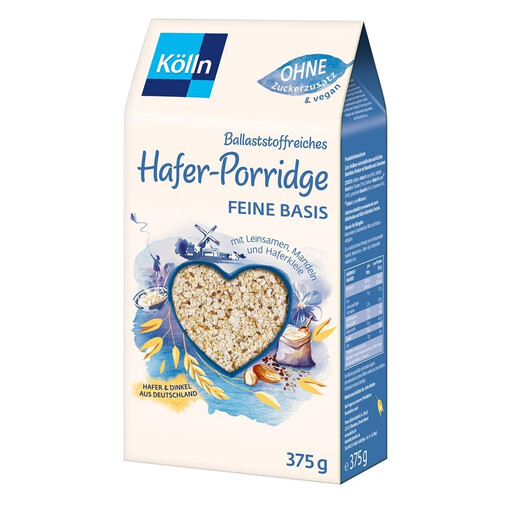 No product image available
Choose this porridge product only if you’re after a mix rather than plain oats.
Pack size: 375 g. Before buying, check the ingredients list, particularly for wheat and almonds, along with the other allergen information.
Compare the fibre per 100 g shown on each pack. Kölln states that its fine organic oats contain 9,2 g per 100 g and its instant oats 12 g per 100 g; REWE lists 9,4 g per 100 g for its fine organic oats, while Alnatura gives 9,7 g per 100 g for its extra-fine oats. These figures apply to the varieties listed, not to every product from those brands.
Store oats somewhere dry and dark in airtight containers. The Verbraucherzentrale recommends sealed containers to prevent pantry pests from spreading and points out that oats can turn rancid. Make sure the quantity you buy suits how much you use.
If you have coeliac disease, don’t assume ordinary oats are suitable just because they’re made from oats. The Verbraucherzentrale recommends only buying oats explicitly labelled “gluten-free”; check the label on every pack.
For quick, smooth porridge, try instant or quick-dissolving oats. Kölln describes its instant oats as dissolving in both hot and cold liquids, while Alnatura says its quick-dissolving variety dissolves instantly. If you prefer more bite, look for jumbo oats instead.