If you only have access to hot water at work
If you want to eat without a hob or kitchen scales, a single-serve sachet can make preparation quicker. Still, check whether you’ll need a mug or bowl and a spoon, and how long the mix needs to soak.


If you have access to hot water at work but little space to prepare your lunch, a pre-portioned mix saves you measuring it out. You may still need a bowl, a spoon and time for it to soak. With a large pack, you can choose the amount yourself, but you’ll need to portion it out and bring it with you. Whichever option you choose, check the preparation instructions, nutritional information and ingredients for the specific mix.
If you want to eat without a hob or kitchen scales, a single-serve sachet can make preparation quicker. Still, check whether you’ll need a mug or bowl and a spoon, and how long the mix needs to soak.
If the nutritional make-up of your lunch matters to you, compare the protein, fibre and sugar content of the specific portion. Also check whether the figures are for the dry mix or the prepared porridge.
If you want to avoid dairy ingredients, nuts or particular sweetening ingredients, check the ingredients list and allergen information for the variety you’re considering. If you have coeliac disease, make sure the specific product is explicitly labelled gluten-free.
Choose this if: You want to prepare your mix at work without weighing it out.
The trade-off: The portion size and recipe are fixed; even a single sachet may require a bowl and some waiting time.
Choose this if: You take porridge with you regularly and want to decide the portion size yourself.
The trade-off: You’ll need to portion out the mix for your office lunch and bring a suitable container.
| What to consider | What to check | Who it matters to |
|---|---|---|
| Preparation | Check the instructions for the amount and temperature of liquid, soaking time and the container you’ll need. | If there are no scales and little worktop space available during your break, you’ll want to prepare a portion without measuring it out. For around 42% of consumers, easy preparation is likely to be the main reason for buying. |
| Nutritional information | Compare protein, fibre and sugar per 100 g and per planned portion; check what the figures refer to. | If porridge is going to be my lunch rather than just a small snack, I want to assess its nutritional make-up based on the portion I’ll eat. Around 33% of consumers would put nutritional information first. |
| Ingredients and allergens | Read the ingredients list and allergen information; if you have coeliac disease, look for an explicit gluten-free label. | If I need to avoid certain ingredients or compare sugar content, the information for each variety is what matters. For around 25% of consumers, checking the ingredients would be the priority. |
A sachet saves you measuring out the mix, but doesn’t necessarily mean there’s no preparation involved. According to the instructions published by REWE, Ruf Porridge Classic 65 g requires a mug or bowl and 150 ml of boiling water.
Before buying, check that the instructions work with what’s available at your workplace.
According to the manufacturer, Seitenbacher High Protein Porridge Vanilla contains 35 g of protein and 11 g of sugar per 100 g, as well as milk protein concentrate. The protein figure alone doesn’t tell you whether it contains dairy or how much sugar it has.
For the variety you’re considering, check the nutritional information, ingredients and allergen details together.
The consumer advice centre Verbraucherzentrale points out that claims such as ‘sweetened only with fruit’ don’t give you reliable information about the total sugar content.
Compare the ‘of which sugars’ figures in the nutritional information per 100 g and for your planned portion.
Oat products aren’t automatically gluten-free. The Federal Centre for Nutrition (Bundeszentrum für Ernährung) stresses that people with coeliac disease need to follow a strictly gluten-free diet.
Look for an explicit gluten-free label on the specific product, and speak to a healthcare professional about any personal concerns.
Kölln offers high-protein porridge in single-serve sachets, among other products.
High Protein Porridge Vanilla is an example for shoppers who want to compare a stated protein figure.
The Alnatura oat and berry porridge reviewed is intended for children from 10 months old.
REWE stocks plain and fruit porridges, as well as single-serve products from various brands.
Haferhimmel Porridge Beeren is a 350-g fruit mix, rather than a ready-measured single portion.
H. & J. Brüggen KG lists porridge as part of its cereal range.
This selection focuses on individually portioned porridge for an office lunch. Before buying, check that the preparation method and ingredients meet your needs.
 No image available
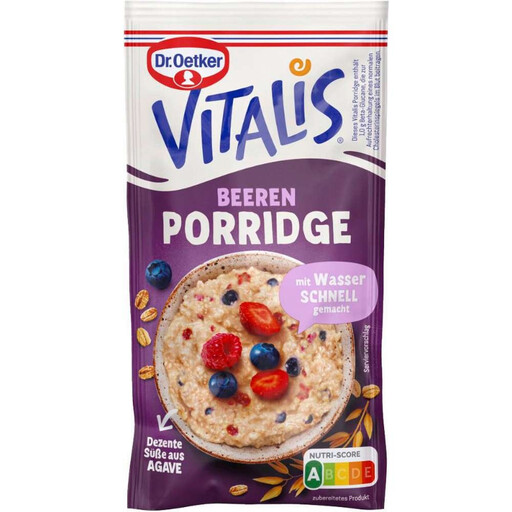
The 53-g portion could be a good option if you don’t want to measure out your office lunch yourself.
Check the preparation instructions against the water available to you, and if you need to avoid dairy or gluten, check the ingredients and allergen information.
You can’t tell whether a portion is right for your lunch just from the word ‘porridge’. Compare the portion size and nutritional information for the specific mix with what you have planned for your meal.
Not with every product: the Ruf single-serve sachet described by REWE is made with boiling water, while Kölln’s high-protein sample pack reviewed can be made with hot or cold water. Always follow the instructions for the variety you’ve chosen; nutritional information may also vary depending on how the product is prepared.
You can’t assume it has a low sugar content from this claim. Verbraucherzentrale advises against relying on such statements instead of the nutritional information; compare the ‘of which sugars’ figures per 100 g and for your planned portion.
No. Oat porridge isn’t automatically gluten-free. Look for an explicit gluten-free label on the specific product, and speak to a healthcare professional about any personal concerns.