Fair organisers prioritising allergen information
If you’re serving porridge to different families, you’ll need to identify the ingredients and allergens in every variety you use, and have the information available when serving it.


For a school fair, pre-portioned sachets or pots can be a practical choice, provided you check the portion size, preparation instructions and allergen information for the specific product. However, a single pack isn’t necessarily a pot or ready to eat. A larger dry mix can be portioned out for several guests, but you’ll need a portioning plan and accessible allergen information for every variety you serve.
If you’re serving porridge to different families, you’ll need to identify the ingredients and allergens in every variety you use, and have the information available when serving it.
If you want to minimise weighing, check the quantity per unit and whether you’ll need cups, water or other utensils to prepare it.
If you’re using a larger dry mix, you can set the portion size yourself and offer toppings separately. You’ll need to organise how you serve each variety and provide its allergen information.
Check the ingredients and allergen information for every variety you plan to serve. Then decide whether you want the portions pre-packed or would rather measure them out at your stall.
| What matters | What to check when buying | Who it matters most to |
|---|---|---|
| Ingredients and allergens | Ingredients list and highlighted allergens for each variety; check for an explicit gluten-free label and any precautionary ‘may contain’ warnings if needed. | If I’m serving porridge unwrapped to different families, I want to be able to share clear information about every variety. For around 46% of consumers, this clarity would be their top priority when buying. |
| Quick individual portions | Quantity per unit and type of packaging; whether water or milk is needed, and how long it takes to prepare. | When serving guests quickly, I don’t want to weigh out every portion or mistakenly assume a small pack is ready to eat. Around 36% of consumers would put easy individual portioning first. |
| Flexible portioning | Pack weight and stated serving size; ingredients in the base mix and any separately offered toppings. | If I’m preparing several portions myself, I want to set their size and keep toppings separate. For around 18% of consumers, this flexibility would come first. |
Even a pre-portioned dry mix may need hot water or milk and time to stand, as well as a cup and spoon.
Read the preparation instructions before you buy, and make sure you have the right liquids, containers and serving utensils.
The description alone doesn’t tell you everything about a product’s allergens. Oats are listed alongside gluten-containing cereals in Annex II of the EU Food Information Regulation. Depending on the recipe, other allergens may also be present.
Have the latest ingredients and allergen information for every variety you actually serve to hand. Check for any ‘may contain’ warnings too, and keep varieties separate so you can match them to the right information.
The pack weight alone won’t tell you exactly how many ready-to-serve portions you’ll get: portion size and the amount of liquid added depend on how you plan to prepare the porridge.
Decide on your portion size before you buy, and try preparing it with the liquid you intend to use at the stall.
Kölln offers oat porridge mixes. According to Kölln, its fruit oat porridge is a 375-g dry mix, not a designated single-serve pot.
Seitenbacher’s range includes High Protein Porridge 32.0 Vanilla.
Alnatura offers an oat and berry porridge in a 250-g pack as part of its baby and children’s range.
The REWE range includes both porridge in larger packs and 65-g products from other brands.
EDEKA Herzstücke Haferhimmel Porridge Beeren is sold as a 350-g dry mix to be prepared with milk or water.
The products below include a porridge pot, pre-portioned sachets and a larger dry mix. Compare the packaging with how you plan to serve the porridge; these products aren’t all single-serve pots.
 No image available
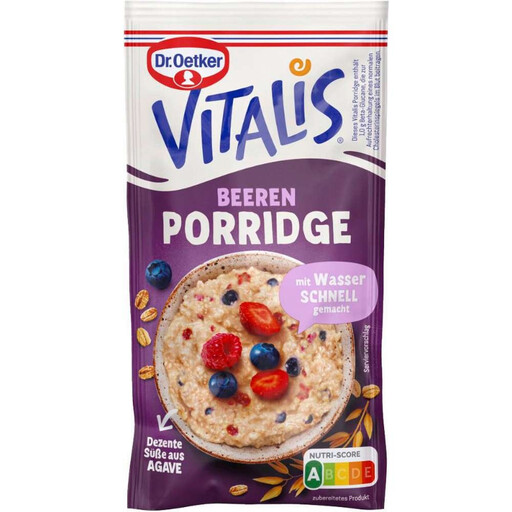
This pot is a good choice if you want to serve a 53 g portion without weighing it out yourself.
Allow time for preparation with boiling water. Before serving, check the information about oats, milk and any other allergens on the pack you buy.
 No image available
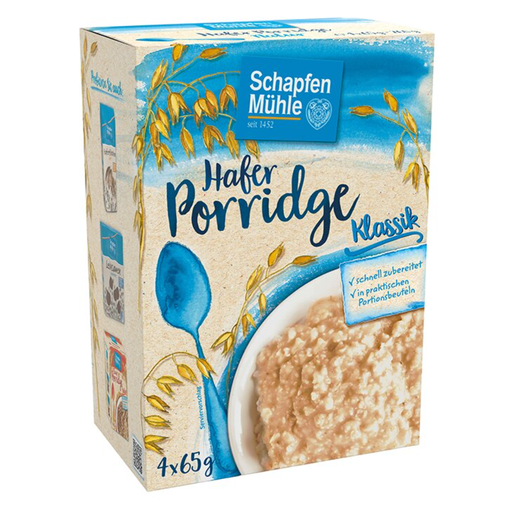
This pack contains four 65 g portions, making it a good option if you’d rather not weigh out each serving yourself.
You’ll need hot water and a cup or bowl to prepare it. Check the allergen information on the pack you buy, particularly for gluten, milk, soya, peanuts and tree nuts.
 No image available
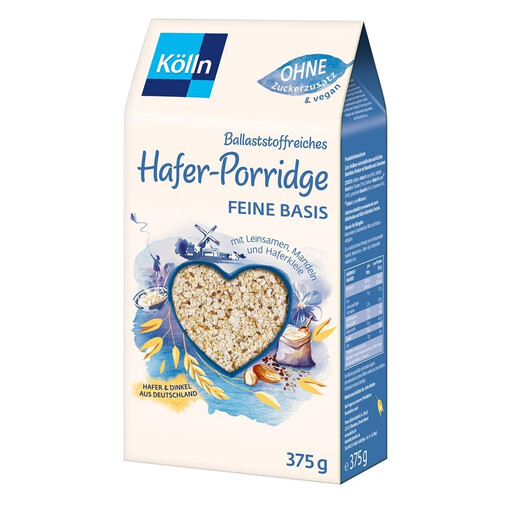
The 375-g pack suits a station where you want to set the portion size yourself; it isn’t a designated single portion.
Before planning how to serve it, check the packaging and the latest information about gluten, almonds, milk and peanuts on the pack you buy.
Yes. You must make information about any allergens present available even when serving food loose. The Federal Ministry of Agriculture, Food and Home Affairs explains the labelling requirements, so have the information for every variety of porridge you actually use ready when serving it.
No. The word ‘oats’ doesn’t prove that a product is gluten-free. Kölln warns that commercially available oats may contain traces. If you need to serve gluten-free porridge, check that the specific product is explicitly labelled as gluten-free and review its other allergen information.
Yes, as long as you organise the portion sizes and serving process yourself. Decide on the amount per bowl in advance, and take into account the preparation instructions and allergen information for each mix you use.
Not without checking the specific recipe. Seitenbacher lists milk protein concentrate in its High Protein Porridge 32.0 Vanilla, so this variety isn’t suitable for serving without milk. Check the full ingredients and allergen information for every variety.