For a school lunchbox, the key question is whether the particular type of porridge can be prepared cold at home or needs hot water. The Kölln, Seitenbacher, Alnatura and EDEKA varieties described here come in multi-portion packs, so you’ll need to portion them out for break time. The single portions shown below are designed to be prepared with boiling liquid. Always check the ingredients and allergen information on the specific pack, too.
Who is this selection for?
Families preparing a school lunch
If you’re not planning to use hot water in the morning, it’s important to check whether the porridge can be made cold and how long it needs to soak. Kölln describes its porridge as suitable for overnight oats, while Alnatura says its oat and berry porridge can be prepared cold with milk.
Households checking ingredients and allergens carefully
When choosing a variety, check its ingredients and allergen information. According to Germany’s Federal Ministry of Agriculture, Food and Home Affairs, oats are classed as a gluten-containing cereal that must be declared in Germany. Some blends also contain ingredients such as milk.
Families keeping an eye on added sugar
The claim ‘no added sugar’ applies to the specific variety, not every porridge from that brand. Compare the ingredients list and nutritional information when choosing between fruit and protein varieties.
What should you look for when buying?
First, decide whether you’ll prepare the portion before school or leave it to soak until break time. Then check the packaging format and the ingredients of the specific variety to see how practical it is for you.
| Criteria | What to check | Especially important for |
|---|
| Preparation |
Check the instructions for cold preparation, the liquid required and the soaking time for the specific variety. |
If you don’t want to use hot water in the morning, the portion needs to be ready before school. This straightforward preparation is a priority for around 25% of consumers. |
| Ingredients and allergens |
Read the ingredients, highlighted allergens and any separate ‘may contain’ information on the pack. |
If your child needs to avoid certain ingredients, checking the specific recipe matters more than the flavour. This is the main priority for around 31% of consumers. |
| Added sugar and recipe |
Assess ‘no added sugar’ claims for the specific variety only, and compare the ingredients list and nutritional information. |
If you want to avoid added sugar, you need information about the variety you’ve chosen rather than relying on the front of the pack alone. This is the main concern for around 19% of consumers. |
| Portion format |
Check the net weight and packaging type: single-serve pot, portion sachet or multi-portion pack. |
If you only want to pack one portion in the school bag, it makes a difference whether you’ll need a separate container. Around 25% of consumers put this format first. |
Common misconceptions
-
Assuming a pack of porridge is a single portion
The Kölln, Seitenbacher, Alnatura and EDEKA varieties described come in pack sizes from 220 g to 375 g. They are not confirmed single portions.
Check the packaging type as well as the net weight. If you buy a multi-portion pack, measure out the amount you want at home and put it in a suitable, tightly sealed container.
-
Assuming all oats are gluten-free
Germany’s Federal Ministry of Agriculture, Food and Home Affairs lists oats as a gluten-containing cereal for allergen labelling in Germany. So the words ‘oat porridge’ alone don’t tell you whether it’s suitable for an individual.
Check the labelling on the specific product. If you have coeliac disease or a diagnosed allergy, follow the advice given by your healthcare professional.
-
Assuming protein porridge is automatically a better fit
As well as oats, the Seitenbacher High Protein Porridge 32.0 Vanilla described here contains milk protein concentrate, cane sugar, flavouring and salt. The product name doesn’t answer questions about allergens or whether the recipe suits your needs.
Compare the ingredients of the specific variety with your requirements, rather than choosing based on the protein claim alone.
-
Confusing ‘no added sugar’ with ‘sugar-free’
The ‘no added sugar’ claim on Kölln Hafer-Porridge Früchte doesn’t mean the finished blend contains no sugar.
As well as checking the claim on the pack, read the ingredients list and the sugar content per 100 g in the nutritional information.
Brands to consider
Kölln
Kölln offers oat porridge in a range of flavours and also describes its porridges as suitable for making overnight oats.
- Kölln labels its Hafer-Porridge Früchte as having no added sugar.
- The fruit variety described comes in a 375-g pack. Check the ingredients and any ‘may contain’ information for the variety you choose.
Seitenbacher
Seitenbacher’s range includes High Protein Porridge 32.0 Vanilla, made with wholegrain oat flakes.
- The ingredients list specifically names milk protein concentrate, making it easier to compare the recipe.
- The 220-g pack described is not a confirmed single portion, and the vanilla variety also contains cane sugar.
Alnatura
According to the manufacturer, Alnatura Hafer-Beeren-Porridge can be made hot or cold. For preparation with whole milk, Alnatura recommends soaking it for five minutes.
- The cold preparation method may be useful if you’re making a portion at home.
- The 250-g pack is a multi-portion format. Alnatura lists possible traces of, among other things, soya, milk and nuts.
EDEKA Herzstücke
Haferhimmel Porridge Beeren is sold as a blend of wholegrain oat flakes and berries.
- EDEKA24 describes this variety as having no added sugar and says it can be made with milk or water.
- The 350-g pack described is not a confirmed single portion. Check the information on the specific pack.
Single-portion porridge at Joybuy
These portions may suit you if you can prepare them with boiling liquid before break time. A single-portion sachet or pot saves you measuring from a multi-portion pack, but you should still check the ingredients and preparation instructions.
 No image available
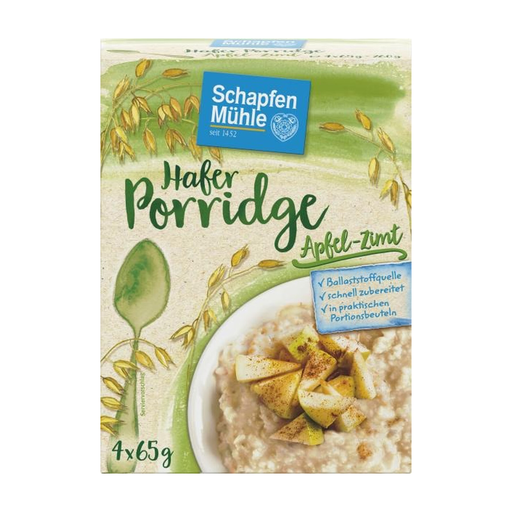
Schapfenmühle Apple & Cinnamon Porridge Oats, 4 × 65 g
Four individually portioned packs are a good choice if you’d rather not measure out the amount yourself. The preparation instructions call for boiling water. Check the ingredients and allergen information on the pack before buying.
View at Joybuy
 No image available
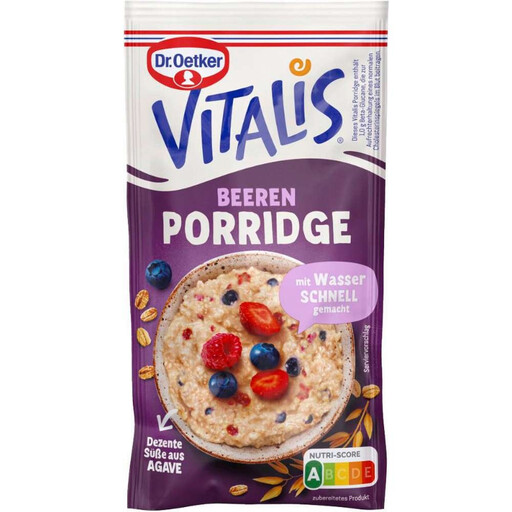
Dr. Oetker Vitalis Berries Porridge Oats, 53 g
The single 53-g pot is a handy option if you’d like a pre-portioned container. The preparation instructions call for boiling water. Before buying, check the labelling for oats, milk and any other potential allergens.
View at Joybuy
 No image available
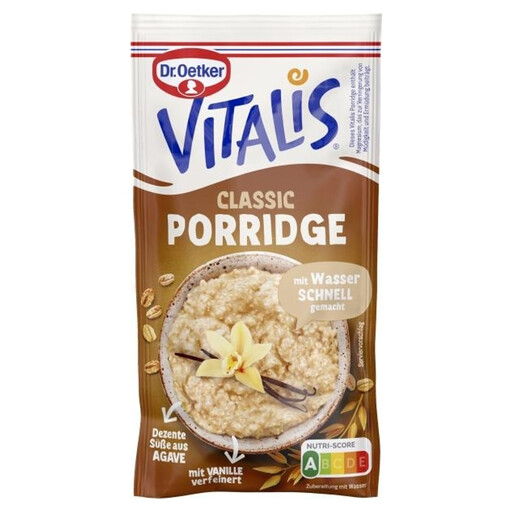
Dr. Oetker Vitalis Classic Oatmeal Porridge, 58 g
The pre-portioned 58-g sachet is a good fit if you have a container and boiling liquid available for preparation. Pay particular attention to the full ingredients and allergen information on the pack.
View at Joybuy
Frequently asked questions
Can you prepare porridge for school without hot water?
Yes, if the manufacturer says the specific variety can be prepared cold. Kölln describes its porridges as suitable for overnight oats, while Alnatura recommends cold milk and a five-minute soaking time for its oat and berry porridge. Follow the instructions for the variety you’ve chosen.
Is oat porridge automatically suitable for people with coeliac disease?
No. The fact that a product contains oats doesn’t, by itself, mean it’s suitable for people with coeliac disease. In Germany, the Federal Ministry of Agriculture, Food and Home Affairs lists oats as a gluten-containing cereal for allergen labelling. Check the labelling on the specific product and follow any individual professional advice.
Does ‘no added sugar’ mean porridge contains no sugar?
No. ‘No added sugar’ doesn’t mean ‘sugar-free’. The claim on Kölln Hafer-Porridge Früchte applies to that variety; check its nutritional information for the sugar content per 100 g.
What information is useful when comparing packaged porridges?
Compare the ingredients list, highlighted allergens, any ‘may contain’ information and nutritional details for the specific products. For Germany, the Federal Ministry of Agriculture, Food and Home Affairs explains the labelling of the 14 recognised allergen groups. The German Food Federation describes how ingredients are listed in order of weight.


