People who need help with preparation
If you’d like an individual breakfast or snack alongside your delivered lunch, you could use a portion sachet, provided you have water, a cup or bowl and help with the preparation if needed.


A pre-portioned porridge sachet can work as an additional breakfast or snack if you have water, a bowl or cup and, where needed, help with preparation. A dry sachet isn’t ready to eat and won’t replace a Meals on Wheels menu tailored to individual needs. If you have specific dietary or texture requirements, check the exact variety before buying.
If you’d like an individual breakfast or snack alongside your delivered lunch, you could use a portion sachet, provided you have water, a cup or bowl and help with the preparation if needed.
If someone can stock up on and prepare porridge, you can choose between pre-portioned sachets and a pack that you measure out yourself. The German Red Cross describes Meals on Wheels as a service that delivers midday meals; porridge would be an additional meal.
If you have allergies, coeliac disease or a prescribed diet, the information for the specific variety must match your individual needs. Texture matters too if you have difficulty chewing or swallowing: the German Nutrition Society advises that food and drinks should be adapted accordingly.
If you’re considering porridge as an addition to Meals on Wheels, first check whether you need a ready-to-eat portion or can prepare a dry mix. Then consider the portion format and any specific requirements for ingredients and texture.
| What to consider | What to check | Who it matters to |
|---|---|---|
| Preparation required | Check what liquid, container and preparation steps are needed. RUF says its Bircher-style sachet requires 150 ml of boiling water and three minutes to stand. | If I only want one portion, I still need to be able to mix it safely. Around 42% of consumers prioritise keeping preparation to a minimum when choosing this kind of addition. |
| Portion and storage | Check whether you’re buying individual sachets or a multi-portion pack. For the latter, check how to measure out a serving and store the pack after opening. | If I want several additional meals, I’d like to choose the amount myself or stock up on pre-portioned servings. Around 33% of consumers put storage and portion planning first. |
| Ingredients and texture | Read the ingredients and allergen information for the variety. If you have coeliac disease, look for a ‘gluten-free’ label; if you have difficulty chewing or swallowing, ask a professional what texture you need. | If I need a specific diet or texture, the word ‘porridge’ alone isn’t enough to help me decide. Around 25% of consumers prioritise checking that the product meets these needs. |
RUF says its Bircher-style sachet needs to be mixed with boiling water. Kölln also says its portion sachets need to be made up with liquid and stirred. So a pre-portioned dry mix doesn’t remove the need for preparation.
Before buying, check that you’ll reliably have a suitable container, a spoon and help if needed. If you need a ready-to-eat portion, make sure the product is explicitly labelled as such.
RUF lists hazelnuts and fruit pieces among the ingredients in its Bircher-style variety. The German Nutrition Society says people with difficulty chewing or swallowing need food with a suitably adapted texture; the general term ‘porridge’ doesn’t tell you what that texture will be.
Check the ingredients and the prepared texture against your individual requirements. If you have difficulty swallowing, don’t judge whether a product is suitable from the packaging alone.
The German consumer advice centre warns that oats can come into contact with cereals containing gluten during processing. So a general reference to oats or organic ingredients doesn’t replace a ‘gluten-free’ label if you have coeliac disease.
If you have coeliac disease, check that the specific pack is labelled ‘gluten-free’.
The German Red Cross describes Meals on Wheels as a midday meal service that may also cater for special diets in some areas. Ordinary porridge won’t automatically meet those requirements.
Think of porridge as a separate meal. If you need a diet tailored to your needs, check with your local meal service and confirm your dietary requirements before making any changes.
The product ranges mentioned here differ mainly in portion format and preparation. You can only assess whether a product is suitable for a specific diet by checking the exact variety and pack.
Kölln sells porridge in multi-portion packs, as well as High Protein Porridge in packs containing individually portioned 60-g sachets.
RUF offers porridge in 65-g portion sachets to prepare in a cup or bowl.
REWE Bio Berry Porridge comes in a 500-g pack, with several portions to measure out yourself.
EDEKA Herzstücke Haferhimmel Berry Porridge is described as a 350-g multi-portion pack.
Alnatura sells an oat and berry porridge in a 250-g pack as part of its baby and children’s food range.
Seitenbacher sells High Protein Porridge 32.0 Vanilla in a 220-g multi-portion pack.
These porridge products could work as an additional individual serving or as a pack of pre-portioned servings. Both need to be prepared; the cup portion isn’t ready to eat.
 No image available
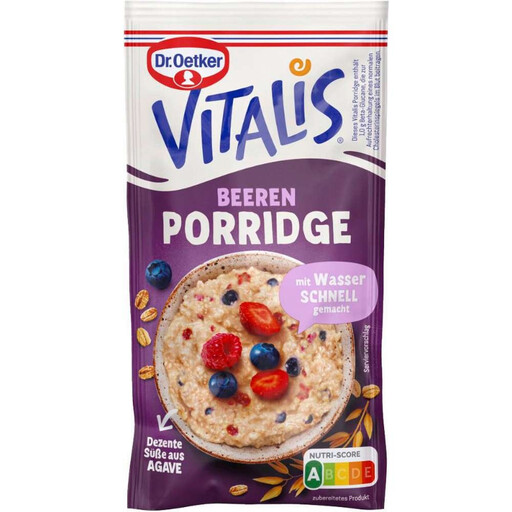
A pre-portioned cup serving for an additional meal, if you have boiling water and help with stirring.
The product name gives the weight as 53 g. If you have specific requirements for ingredients or texture, check the exact pack and whether it’s suitable for you before buying.
 No image available
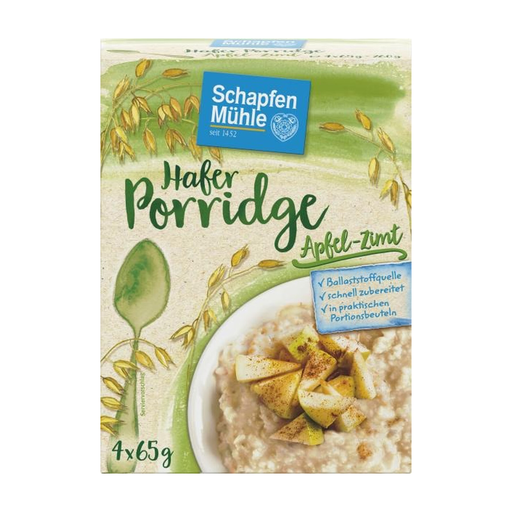
For households that want to stock up on several pre-portioned servings of porridge and prepare one at a time in a cup or bowl.
The product name specifies four servings of 65 g each. You’ll need to use hot water and stir the mixture; if you have specific dietary or texture requirements, check the exact pack against them.
Not automatically. Porridge may be suitable as an additional breakfast or snack, but it isn’t a general substitute for a lunch menu tailored to your needs. The German Red Cross describes Meals on Wheels as a service delivering hot lunches or frozen meals. If you have specific dietary needs, discuss any change to your meal provision with the relevant service.
No, the dry mixes described here need to be made up. For its Bircher-style variety, RUF specifies 150 ml of boiling water and three minutes to stand. For Kölln’s High Protein portion sachets, the manufacturer says to add hot or cold water and then stir.
If you have coeliac disease, check that the specific oat product is labelled ‘gluten-free’. The German consumer advice centre warns that oats can come into contact with cereals containing gluten during processing, so the word ‘oats’ alone isn’t enough.
Read the ingredients list and the information for the specific variety. The German Federal Office of Consumer Protection and Food Safety explains that the 14 main substances or products that can cause allergies or intolerances must be listed in the ingredients. ‘May contain’ warnings can also be relevant to your choice.
No, the description ‘soft’ doesn’t confirm that the texture is suitable for your individual swallowing needs. The German Nutrition Society advises that food and drinks should be adapted for people with difficulty chewing or swallowing. So check the texture you need with your meal service or an appropriate healthcare professional.