
Lieferung heute & morgen

Qualitätsgarantie

Willkommens-Angebote freischalten: KOSTENLOSE Lieferung | Bis zu 80 % RABATT | Kostenlose 30-Tage-JoyPlus-Testphase
App herunterladen
A portable 11kW EV charger promises flexibility for electric vehicle drivers, enabling fast charging at home, on holiday, or at a friend's house without being tied to a permanently installed station. However, the market is filled with devices whose marketing promises often outweigh their technical reality. Before you make a decision, it's crucial to understand the most common pitfalls that can lead to bad buys and safety hazards.
As your Joybuy Product Recommendation Officer, I'm here to help you identify the essential features and make an informed choice.
To make a future-proof and safe choice, you should check three core technical parameters. These define the performance, safety, and user convenience of your device.
An 11kW portable charging station is the common standard for private charging in Europe. It uses a three-phase, 16-amp connection (16A 3-phase mobile charger) and typically plugs into a red CEE-16 socket. This power level is sufficient to fully charge most EV batteries overnight. Ensure the device is equipped with a Type 2 plug, the European standard for AC charging, to guarantee compatibility with nearly all vehicles sold in the region.
In addition to the RCD mentioned earlier, other protection mechanisms are crucial. These include protection against overvoltage, undervoltage, overheating, and lightning. A high-quality 11kW portable EV charger will feature active temperature monitoring in both the control box and the plug. If overheating is imminent, the device should automatically reduce the charging power rather than abruptly stopping the session.
An 11kW Type 2 charging cable with an app only reaches its full potential with stable and functional software. Check if the companion app offers the following features:
Based on these criteria, we have identified several models that are particularly well-suited for specific requirements and user groups.
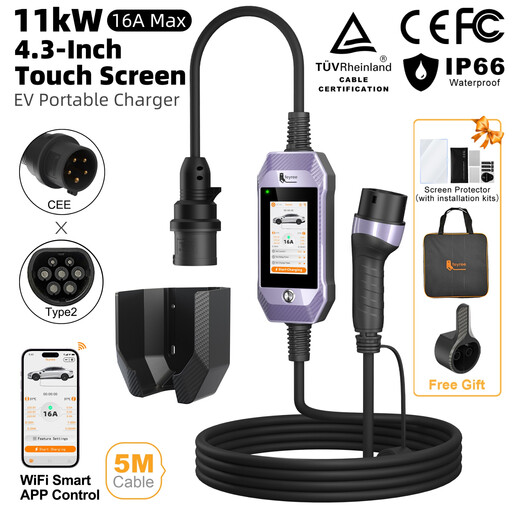
Why This Fits Their Persona: Ideal for users who want full control and transparency. The large touchscreen display offers direct access to charging data, while the app connectivity provides detailed logs and remote Over-the-Air (OTA) updates to keep the device current.
Delivers true smart features via the Tuya app, including detailed charging history and remote current adjustment—far more than a simple timer.
Combines on-device touchscreen operation with comprehensive app control. Features integrated Type B RCD (AC 30mA + DC 6mA) protection.
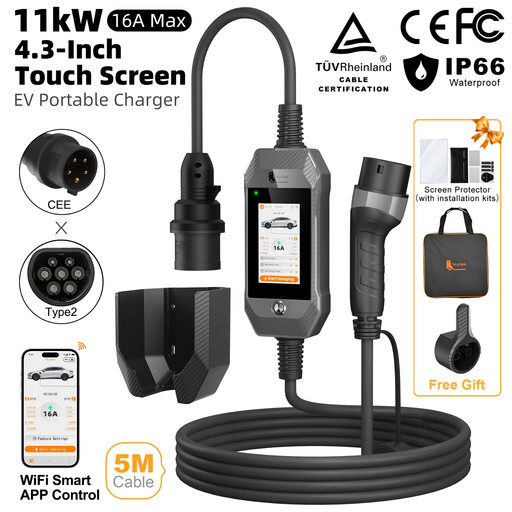
Why This Fits Their Persona: For renters who cannot or prefer not to install a permanent wallbox. This portable charger only requires an existing CEE-16 socket. Its compact design and included carrying case make it easy to transport and use in various locations.
Provides comprehensive, certified protection, including a Type B RCD and dual temperature monitoring. This ensures safety even when using the device with unfamiliar or older electrical outlets.
Maximum portability with zero installation hassle. Its wide voltage compatibility (single-phase 85V-264V, three-phase 380V ± 20%) ensures reliability across different power grids.
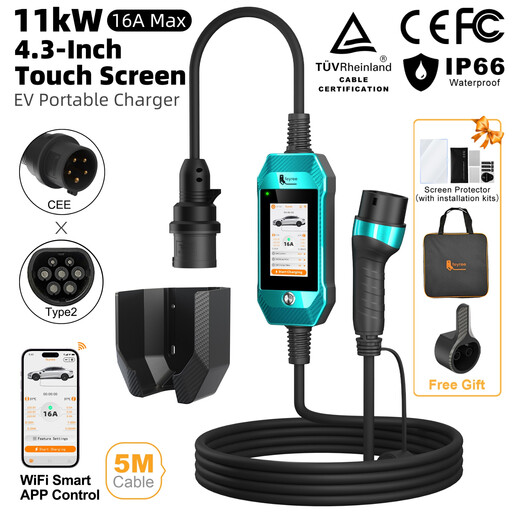
Why This Fits Their Persona: Perfect for EV drivers who want to actively reduce their charging expenses. The app's charge scheduling feature allows them to automatically shift charging sessions to cheap, off-peak nighttime hours when electricity rates are lowest.
The app provides a precise and reliable scheduling function. Users can set charging times like an alarm and trust that their car will be fully charged by morning, without any manual intervention.
Direct cost savings through smart load management. The detailed consumption history helps users track charging expenses and further optimise their charging habits.
We have compiled a complete, real-time updated list of products that fully meet these strict selection criteria and German safety regulations.
A portable EV charger connected to an existing, correctly installed CEE-16 three-phase socket generally does not need to be registered with the grid operator. The reporting obligation for charging equipment up to 11 kW applies to permanent installations. However, if you have a new CEE-16 socket installed specifically for the charger, this work must be done by a qualified electrician and reported to the grid operator.
The three most critical safety features are:
Yes, if you choose a model with smart app control. The charge scheduling feature allows you to shift charging sessions to nighttime hours. Many electricity providers offer special tariffs with significantly lower prices at night. By automating this process, you can ensure you always charge at the cheapest rate without sacrificing convenience.