
Lieferung heute & morgen

Qualitätsgarantie

Willkommens-Angebote freischalten: KOSTENLOSE Lieferung | Bis zu 80 % RABATT | Kostenlose 30-Tage-JoyPlus-Testphase
App herunterladen
As an electric car or plug-in hybrid owner, a reliable charging solution is crucial. While permanently installed wallboxes are one option, a portable 3.7 kW EV charger offers unmatched flexibility. However, the market is filled with products where differences in quality and safety are hard to spot at first glance. This guide will help you avoid common pitfalls and make an informed decision.
Many buyers focus solely on price or marketing promises, overlooking the critical technical details that determine safety and durability.
To avoid the mistakes mentioned above, focus on three verifiable technical features. These define the quality and real-world usability of your portable charging station.
The maximum charging power of 3.7 kW (single-phase) is achieved via two different plug types:
Safety is non-negotiable. Look for the following specifications:
A high-quality portable EV charging station adapts to the situation, not the other way around.
Based on the criteria above, we've identified products that represent a suitable solution for specific user profiles.
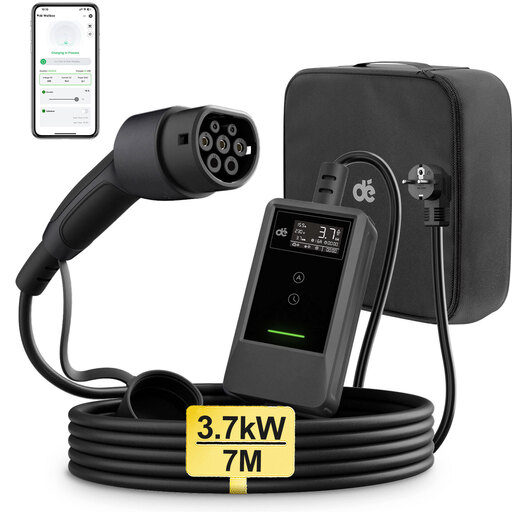
Why This Fits Their Persona: Ideal for plug-in hybrid drivers looking for a straightforward and cost-effective solution for overnight charging from a standard Schuko socket. The 7-metre cable length is sufficient for most garages and parking spaces.
Thanks to the adjustable current (6-16A) via the app, the charging power can be safely adapted to the specific domestic wiring, preventing the overload of Schuko sockets.
App control for remote monitoring and current adjustment; LCD screen for immediate status updates.
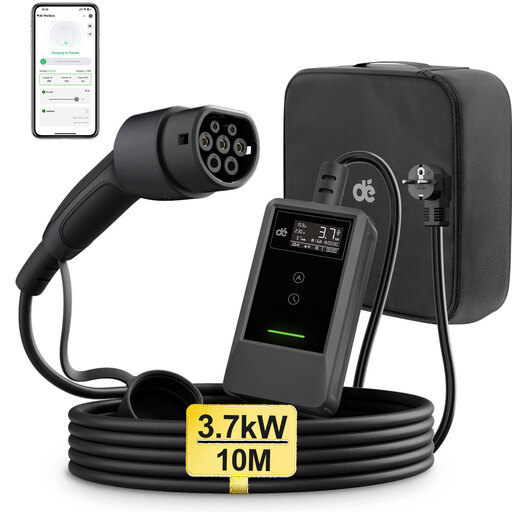
Why This Fits Their Persona: Perfect for homeowners whose power outlet is located far from their parking space. The 10-metre cable effortlessly bridges the distance, making daily charging convenient and straightforward.
The generous 10-metre cable length prevents the hazardous use of improper extension cords, thus avoiding a common installation mistake.
Maximum reach thanks to the 10m Type 2 charging cable; Adjustable charging current for safe operation on any Schuko socket.
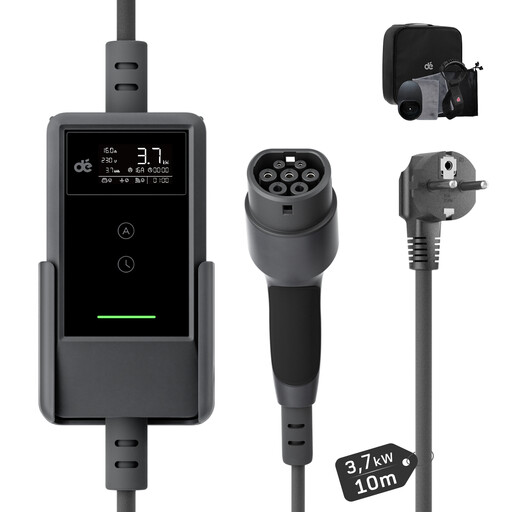
Why This Fits Their Persona: The first choice for anyone who needs maximum charging performance and flexibility on the road. The included adapter allows for charging from robust CEE sockets found at campsites or industrial sites.
This device takes advantage of the CEE plug for stable 3.7 kW charging, bypassing the overheating risk associated with Schuko sockets under continuous load. Integrated temperature monitoring offers additional safety.
Includes a portable CEE 16A charging cable adapter for stable 3.7 kW charging; Adjustable current (6A-16A) for universal compatibility.
We have compiled a complete, real-time list of products that fully satisfy these strict selection criteria and UK safety regulations.
Modern portable chargers from reputable manufacturers integrate the same core safety features as fixed wallboxes. These include a residual current device (often RCD Type A + 6mA DC protection), over/undervoltage protection, overcurrent protection, and temperature monitoring. When used correctly with a properly installed socket, charging is safe.
No. A charging power of 3.7 kW requires a continuous 16A load. A standard domestic Schuko socket is not ideal for this and should only be used for continuous charging at a reduced current (e.g., 10A). To safely use the full 3.7 kW, you need a blue CEE 16A socket, which is designed for this load. Check what type of outlets you have available before you buy.
The charging time depends on your vehicle's battery capacity. As a rule of thumb, you can divide the battery capacity (in kWh) by the charging power (in kW). For example, a 40 kWh battery would theoretically take about 10.8 hours to charge fully (from 0 to 100%) (40 kWh / 3.7 kW). In practice, it takes a bit longer, often 11-12 hours, due to charging losses and the charging speed tapering off as the battery gets full.