
Lieferung heute & morgen

Qualitätsgarantie

Willkommens-Angebote freischalten: KOSTENLOSE Lieferung | Bis zu 80 % RABATT | Kostenlose 30-Tage-JoyPlus-Testphase
App herunterladen
Dropping tyre pressure rarely announces itself. Whether you're on your way to work, heading off on a camping holiday, or about to start a bike tour, a flat or underinflated tyre is more than just an annoyance. A portable air compressor promises a quick fix. However, the market is flooded with devices whose performance claims often don't hold up in practice. Before you make a purchase, it's crucial to understand the typical pitfalls that can lead to a costly mistake.
Many users invest in a portable air pump, only to find out at the critical moment that the device overheats, the battery dies after inflating half a tyre, or the displayed pressure reading is wildly inaccurate. This guide will show you which technical features truly matter and how to find a reliable device that meets your needs.
Marketing claims can be misleading. Pay close attention to these three points to avoid falling into a cost trap:
To find the right portable compressor for you, you should focus on the following objectively measurable criteria.
The choice of power source depends directly on your intended use case.
As mentioned, the maximum pressure (PSI/Bar) alone is not a very meaningful metric. The inflation speed, measured in litres per minute (L/min), is the decisive value for performance.
Modern devices offer more than just air. Useful features include:
Here are some recommendations tailored to specific user profiles that avoid the pitfalls mentioned above.
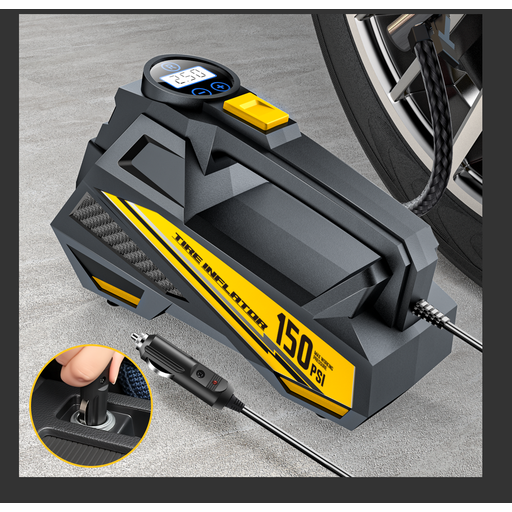
Why it's a great fit: Ideal for drivers looking for a reliable, no-fuss solution for the glove compartment. Powering it via the 12V socket eliminates any worries about a dead battery. Perfect for regular pressure checks and emergencies.
This model completely bypasses the weak battery pitfall by drawing power directly from the vehicle. The digital display with auto-shutoff also prevents the problem of inaccurate gauges.
Consistent power without battery charging; digital pressure preset for precise results; integrated LED light for night-time use.

Why it's a great fit: For users who value high performance, cordless freedom, and modern technology. The large 7500 mAh battery capacity and high 35 L/min inflation speed make this device a powerhouse for a wide range of vehicles.
The combination of a very large battery and a high inflation speed directly addresses the problems of insufficient power and short runtimes. The large LED display and preset modes ensure simple and accurate operation.
Very high battery capacity (7500 mAh); fast inflation speed (35 L/min); large, easy-to-read display and power bank function.

Why it's a great fit: The dual-power system offers ultimate flexibility. Use the 6000 mAh battery for quick jobs on your bike or tent, and when needed, connect the device to your car's 12V socket to fill even large tyres without battery anxiety.
This model provides a direct solution to the fear of a dead battery at the wrong moment. The ability to switch to 12V power guarantees it's ready for action, even if the battery isn't charged.
Flexible dual-power system (Battery + 12V); solid 6000 mAh battery capacity; doubles as an emergency power bank for other devices.
We have compiled a complete, up-to-date list of products that fully meet these strict selection criteria and UK/EU safety regulations.
Yes, most powerful models can. However, this process takes significantly longer than simply topping up the air. For a 12V compressor, the vehicle's engine should be running during operation to avoid draining the car battery. For cordless models, fully inflating an empty tyre can consume a large portion of the battery's capacity.
The runtime heavily depends on the battery capacity (measured in mAh) and the power being drawn. A good battery with 5000–6000 mAh should be able to top up four car tyres by a few PSI or fully inflate 8–10 bicycle tyres. The actual performance can vary depending on the ambient temperature and tyre size.
To avoid putting excessive strain on the car battery, it is recommended to keep the vehicle's engine running while the compressor is in use. Also, be sure not to exceed the manufacturer's specified maximum continuous runtime (often 10–15 minutes) to prevent the device from overheating. Allow the compressor to cool down for a few minutes afterwards.