
Lieferung heute & morgen

Qualitätsgarantie

Willkommens-Angebote freischalten: KOSTENLOSE Lieferung | Bis zu 80 % RABATT | Kostenlose 30-Tage-JoyPlus-Testphase
App herunterladen
By Joybuy Product Recommendation Officer, August 29, 2026
When summer temperatures soar, the desire for a cool breeze at home quickly becomes a priority. A portable air conditioner promises quick relief, but the market is crowded and confusing. Many buyers invest in a unit, only to discover later that it's too loud, too weak, or a hidden cost trap.
Before you make a decision, it's crucial to understand the most common pitfalls that lead to disappointment.
To avoid these pitfalls, you should focus on three objective metrics. These will help you factually assess a unit's performance and make an informed choice for your home.
Cooling capacity is the most important metric for effectively cooling a room. It is specified in BTU (British Thermal Unit) per hour or in Watts. A unit with insufficient power will never bring the room to the desired temperature, while an oversized model will consume an unnecessary amount of energy.
As a rule of thumb for sizing, you can use the following values:
These values apply to rooms with a standard ceiling height (approx. 2.5 m) and average sun exposure. For top-floor apartments or rooms with large, south-facing windows, you should opt for a higher performance class.
An air conditioner with energy efficiency class A or better is a must for anyone wanting to keep an eye on their electricity bill. The EU energy label provides information about consumption. A key value here is the EER (Energy Efficiency Ratio). It describes the ratio of the cooling output generated to the electrical power consumed. A higher EER value means better efficiency. Units in classes A+ or A++ are often slightly more expensive to purchase but pay for themselves through lower operating costs.
Nobody wants to sleep next to a jet engine. The noise level is therefore a critical factor, especially for bedrooms or home offices. Pay attention to the sound pressure level, indicated in dB(A).
Many units offer a special sleep mode that reduces the fan speed and thus the noise level. An air conditioner with app control can also be practical for turning the unit down without having to get up.
Based on these objective criteria, we have identified several models that offer a suitable solution for different needs and room sizes.
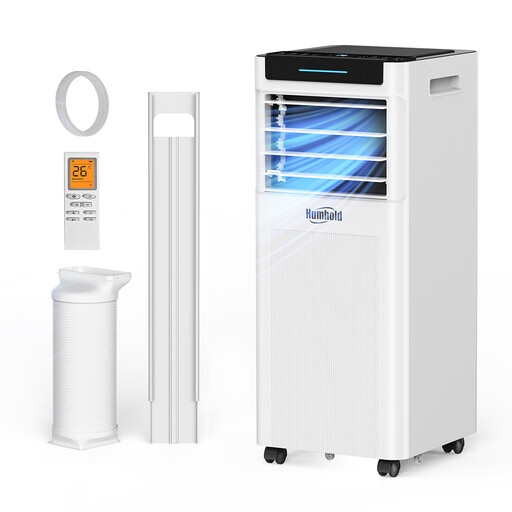
Why This Fits Their Persona: This model is a pragmatic choice for cooling smaller spaces like bedrooms or home offices up to 28 m?. It focuses on the core functions of cooling, dehumidifying, and ventilating without costly extras.
It addresses the noise trap with a dedicated sleep mode that, according to the manufacturer, allows for operation below 49 dB. The included window kit helps to minimize efficiency loss.
Its low weight of 19.7 kg and compact dimensions make the unit highly mobile. The self-evaporation function reduces the need to manually empty the water tank.
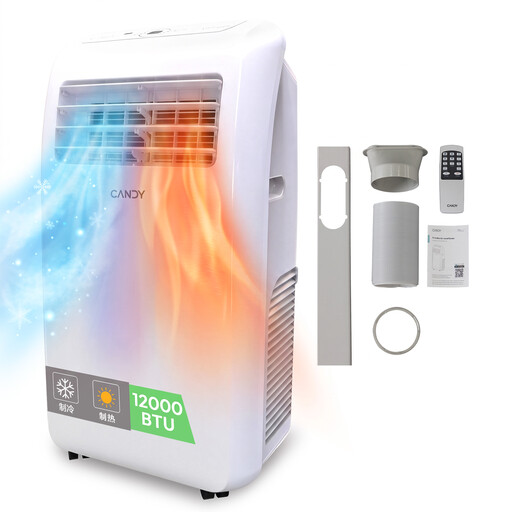
Why This Fits Their Persona: For users seeking a powerful, year-round solution. With 12,000 BTU of cooling power and an integrated **heating function**, this unit is suitable for both hot summers and cool transitional seasons in rooms up to 35 m?.
This unit tackles the energy cost trap with an A+ energy efficiency class in both cooling and heating modes. This ensures manageable operating costs for year-round use.
The 4-in-1 functionality (cooling, heating, dehumidifying, ventilating) eliminates the need for multiple separate devices. The high air circulation of 400 m?/h ensures fast and even temperature distribution in the room.
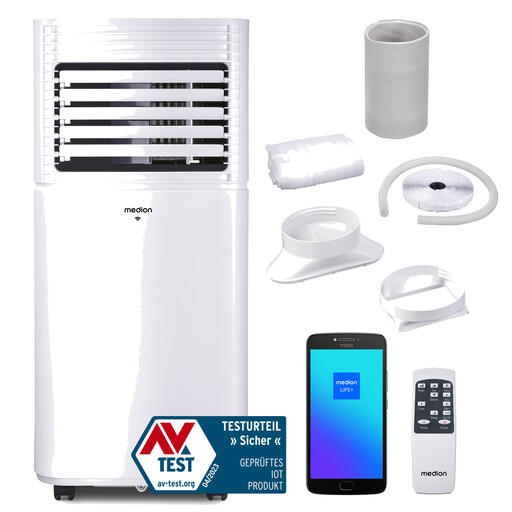
Why This Fits Their Persona: Ideal for tech-savvy users who value convenience and integration. With 9,000 BTU, it's designed for rooms up to 32 m? and integrates seamlessly into a digital lifestyle.
This device avoids the trap of cumbersome operation. Instead of relying solely on a remote control, it offers full control via app and voice command, maximizing convenience and allowing for flexible control from anywhere.
The comprehensive control options via Wi-Fi are the clear advantage. The unit can be turned on before you get home or switched to sleep mode at night with a voice command, without having to search for the remote.
We've compiled a complete, up-to-date list of products that fully meet these strict selection criteria and German safety regulations.
Power consumption depends heavily on the cooling capacity (BTU/Watt) and the energy efficiency class. A 9,000 BTU unit with energy efficiency class A typically consumes about 1 kilowatt-hour (kWh) per hour of operation. At an electricity price of 35 cents/kWh, that would be 35 cents per hour. A class A+ unit can reduce this figure by 10–20%. Pay attention to the EER value: the higher, the more efficient.
Proper installation is crucial for efficiency. The hose must vent the warm air outside. A merely tilted window is the worst solution, as warm air flows right back in. It is essential to use a suitable window seal kit. This seals the window gap around the hose and prevents the backflow of warm air. Such seals, like the Portable Air Conditioner Window Seal Strip, are easy to install and significantly increase the device's effectiveness.
Devices advertised without an exhaust hose are not true air conditioners. They are what's known as evaporative coolers. They cool the air through the evaporation of water (evaporative cooling). This effect is significantly weaker than that of a compressor-based air conditioner and also increases the humidity in the room, which can be perceived as unpleasant in muggy weather. For a noticeable reduction in room temperature, a portable air conditioner with an exhaust hose is the technically superior solution.