
Lieferung heute & morgen

Qualitätsgarantie

Willkommens-Angebote freischalten: KOSTENLOSE Lieferung | Bis zu 80 % RABATT | Kostenlose 30-Tage-JoyPlus-Testphase
App herunterladen
Rising summer temperatures are making effective room cooling a necessity for many homes and workplaces. A portable air conditioner offers a flexible solution for cooling specific rooms without the need for complex structural modifications. However, selecting the right unit depends on a range of technical parameters that must be tailored to the specific use case. This guide breaks down the crucial criteria and presents a selection of units for different requirements.
Choosing a portable air conditioning unit should be based on an objective analysis of its performance, efficiency, and operational characteristics. The following factors are essential for making an informed choice.
Cooling capacity is the most important parameter and is specified in BTU (British Thermal Unit) per hour or in kilowatts (kW). It describes the amount of heat a unit can remove from a room per hour. Insufficient capacity leads to ineffective cooling, while an oversized unit consumes unnecessary energy.
As a guideline for rooms with a standard ceiling height of about 2.50 meters, the following rule of thumb can be applied:
The multiplier varies depending on sun exposure, insulation, and the number of people in the room. 1,000 watts is equivalent to approximately 3,412 BTU/h.
The Energy Efficiency Class, indicated on the EU energy label from A to G, provides information about power consumption relative to cooling capacity. An energy-saving air conditioner with a high efficiency class (e.g., A or higher) significantly reduces running costs.
Modern units often use inverter technology. Unlike conventional on/off systems, an inverter compressor continuously adjusts its speed to match the cooling demand. This avoids energy-intensive start-stop cycles and ensures a more consistent room temperature.
The noise level, measured in decibels (dB(A)), is a critical factor, especially for use in bedrooms or offices. Values below 50 dB(A) are generally considered quiet. Pay attention to the sound pressure level specification, as this describes the noise perceived by the ear. Many models offer a special sleep or silent mode with reduced fan speed and therefore lower noise emissions.
Based on technical specifications and practical utility, we have compiled a selection of units for various applications.
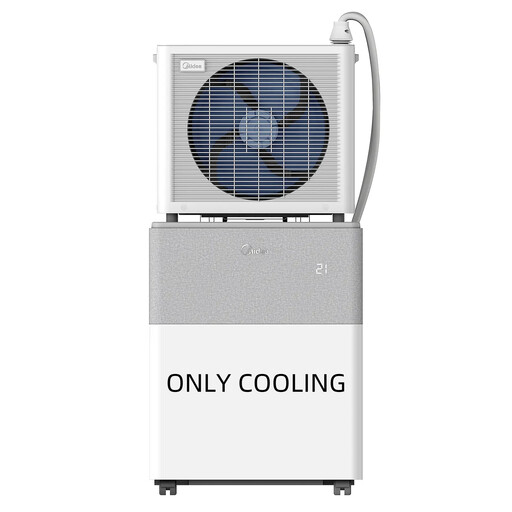
Why we recommend this product: The Midea PortaSplit Cool is a portable split air conditioner that combines the advantages of a fixed split system with the flexibility of a portable unit. By locating the compressor in the outdoor unit, it achieves a very low indoor sound pressure level of down to 38 dB(A) in Silent Mode. This makes it an ideal solution for noise-sensitive environments.
Pros:
Best for: Users seeking a very quiet and efficient cooling solution for their home who have the space to place a compact outdoor unit on a balcony or outside a window.
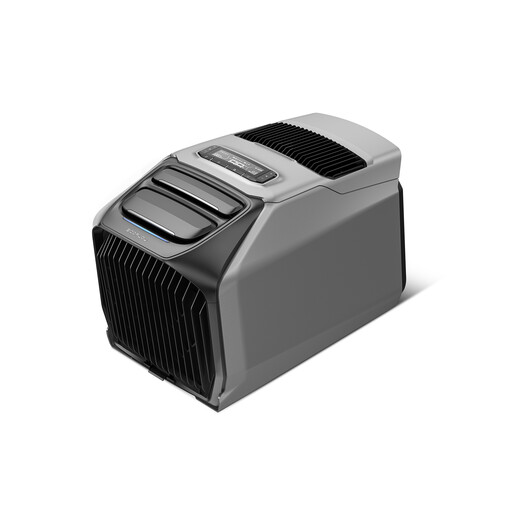
Why we recommend this product: The ECOFLOW WAVE 3 redefines the portable air conditioner category by combining high cooling and heating performance with optional battery operation. With a cooling capacity of 1800W (6100 BTU) and a battery life of up to 8 hours (with the separately available add-on battery), it is designed for off-grid use.
Pros:
Best for: Outdoor enthusiasts, campers, RV owners, and anyone who needs a powerful, off-grid climate control solution on the go.
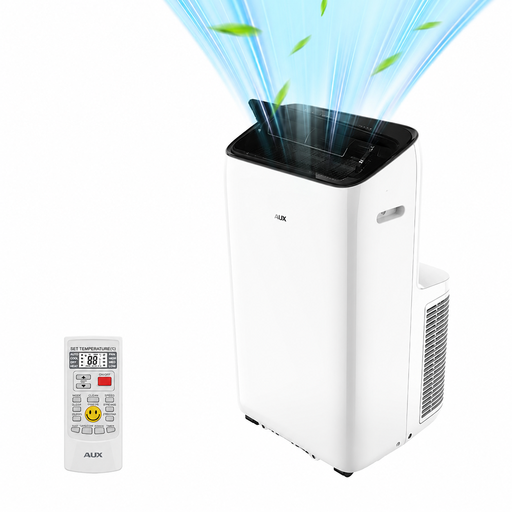
Why we recommend this product: This monobloc unit from AUX stands out for its high cooling capacity of 12,000 BTU and its use of inverter technology. According to the manufacturer, this allows for energy savings of up to 30% compared to fixed-speed models. The high air circulation of 450 m?/h ensures rapid and even room cooling.
Pros:
Best for: Users looking for a powerful monobloc solution for medium to large living spaces or offices who value energy efficiency and stable temperature control.
If the models presented here don't precisely meet your requirements, or if you are looking for different performance classes and features, you can find a wider selection in our main category. There, you can filter for units that meet your specific needs.
Discover more models in the portable air conditioners category.
1. How many BTUs does my portable air conditioner need? You can get a rough estimate by multiplying the square meterage of the room by a factor of 60 (for well-insulated, shaded rooms) to 100 (for sunny rooms or top-floor apartments). The result is the required cooling capacity in watts. To convert this to BTU/h, divide the watt value by 0.293. For example, a 25 m? room requires approximately 1,500–2,500 watts, which corresponds to 5,100–8,500 BTU/h.
2. What is the difference between a portable air conditioner and an air cooler? A portable air conditioner works like a refrigerator: a refrigerant goes through a cycle, extracts heat from the room's air, and expels it outside through an exhaust hose. This results in an effective and measurable reduction in room temperature. An air cooler (or evaporative cooler), on the other hand, draws air over a water-saturated pad. The evaporation of the water slightly cools the airflow but also increases the room's humidity. Its cooling power is significantly lower than that of a true air conditioner.