
Lieferung heute & morgen

Qualitätsgarantie

Willkommens-Angebote freischalten: KOSTENLOSE Lieferung | Bis zu 80 % RABATT | Kostenlose 30-Tage-JoyPlus-Testphase
App herunterladen
A portable air conditioner can be a flexible solution for rented flats, bedrooms, home offices or individual living spaces. It usually doesn’t need permanent wall mounting and can be wheeled into another room when needed. However, unclear room-size guidance, underestimated exhaust requirements and misleadingly low noise figures often lead to poor buying decisions.
A rating such as 9,000 or 12,000 BTU may sound clear-cut, but on its own it tells you little about how well a unit will work in practice. Ceiling height, sunlight, insulation and the number of people in the room all affect cooling requirements. So an air conditioner for rooms up to 35 m² won’t necessarily work equally well in every room of that size.
Units with around 7,000 to 9,000 BTU may be sufficient for smaller, normally insulated rooms. Larger rooms, or those that get very hot or face south, may need more power. The manufacturer’s recommended room size is a useful guide, but it doesn’t replace an assessment of your room.
A portable air conditioner with an exhaust hose needs to vent warm air outside. You’ll need a window kit or similar seal for this. If you simply hang the hose out of an open window, warm air from outside will flow back into the room. This reduces cooling performance and can increase electricity consumption.
Before buying, check the following:
A portable air conditioner is often easier to use in a rented flat than a permanently installed split system. However, your window still needs to be suitable for venting the exhaust air.
A quiet portable air conditioner is especially important in the bedroom. However, manufacturers may use different testing conditions, operating modes or measuring distances. Noise levels quoted for sleep mode aren’t necessarily comparable with the maximum noise level.
Check the figure in dB(A) and whether it applies to normal operation, the lowest setting or sleep mode. The compressor, airflow and vibrations can also produce different types of noise. Placing the unit on a firm, level surface helps reduce operating noise.
Cooling capacity is often given in BTU/h and also in kilowatts. To compare different units, it’s useful to look at cooling capacity alongside power consumption and the energy efficiency rating. A portable air conditioner with an A energy efficiency rating may use a different amount of energy from a unit rated A+ or A++ with similar cooling capacity.
Actual electricity consumption depends on the outside temperature, target temperature, running time and room insulation. An air conditioner with a timer can help you match operating times to your daily routine. Wi-Fi control or a remote control won’t automatically reduce energy consumption, but they do make the unit easier to use.
A 3-in-1 air conditioner usually combines cooling, fan and dehumidifier functions. Depending on the model, water may collect in the tank in dehumidifier mode, even if the unit has self-evaporation. So if humidity is high or you plan to use the unit for long periods, check the manual.
An air conditioner with a heating function can be useful in milder weather between seasons. Check whether the heating capacity is listed separately and what room size it applies to. The recommended room size for cooling may differ from the one for heating.
Several of the models listed use R290. Product information describes this refrigerant as a natural refrigerant with low global warming potential. However, R290 is flammable. The refrigerant circuit must not be damaged, and the manufacturer’s safety and installation instructions must be followed.
Washable filters should be cleaned regularly and allowed to dry completely before being refitted. A clogged filter can restrict airflow. The exhaust hose, air intake and condensate drain must also be kept clear.
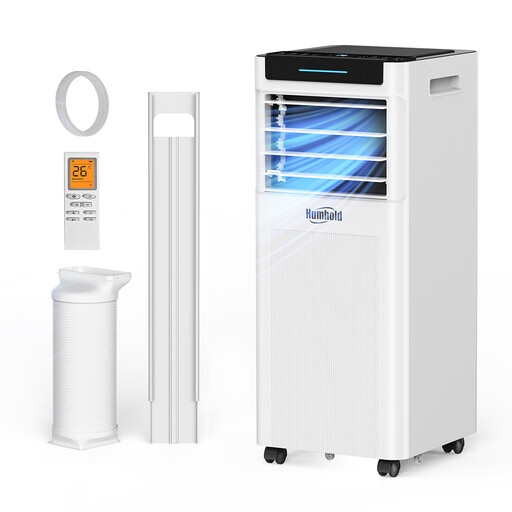
Why this product suits this profile: This model is designed for smaller living spaces and home offices, offering cooling, dehumidification and fan functions in a compact housing.
The product details list 7,000 BTU, 2.0 kW cooling capacity, a window kit and a 24-hour timer. This gives you key information for planning the room layout and installation.
R290 refrigerant, washable filter, remote control, 19.7 kg weight and a stated sleep mode noise level of under 49 dB.
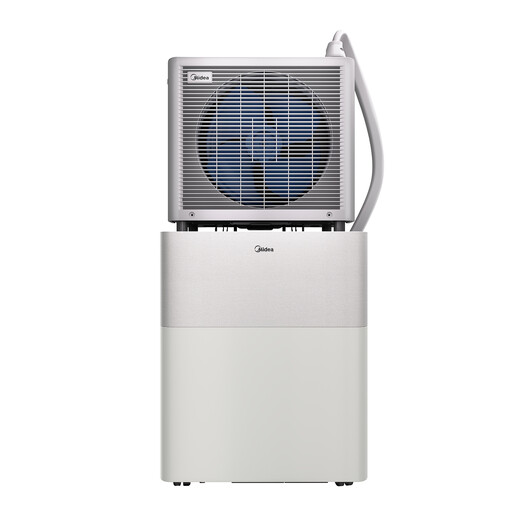
Why this product suits this profile: Its stated A++ energy efficiency rating and 12,000 BTU cooling capacity make it a good fit for buyers who prioritise performance figures and efficiency over a particularly light unit.
The product description lists cooling capacity, energy efficiency rating, R32 refrigerant and a weight of 45.5 kg. This makes it easier to check the space available and consider how you’ll move the unit before buying.
A++ rating, 12,000 BTU, compact mini-split design and castors, according to the product details.
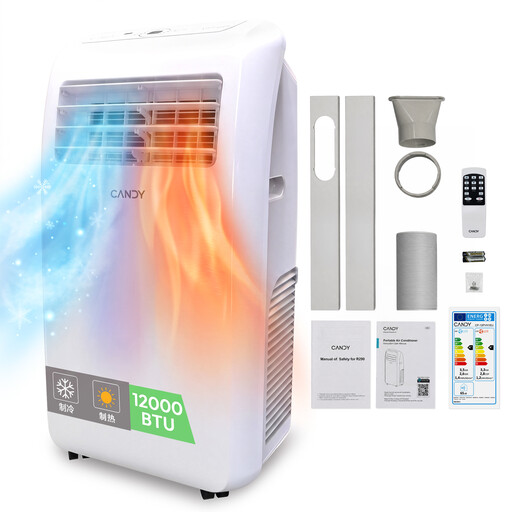
Why this product suits this profile: This unit combines cooling, dehumidification, fan and heating functions, making it a good choice if you need several features in one portable unit.
The product details list separate cooling and heating capacities, as well as a window kit. This makes it easier to check whether the unit can handle your chosen room size in both modes.
12,000 BTU, A+ energy efficiency rating, 400 m³/h airflow, R290, 24-hour timer and remote control.
We’ve put together a complete, regularly updated list of products that meet these strict selection criteria and the safety requirements in force across the EU.
Fit the window kit to the window according to its design. Then connect the exhaust hose to the unit and the adapter. Seal the opening as tightly as possible. Don’t block or sharply bend the hose, as this can make it harder to vent the warm air.
Consumption depends on power input, running time and operating conditions. Multiply the power input in watts or kilowatts by the planned running time. Using a timer, choosing a suitable target temperature and keeping windows closed while the unit is running can help avoid unnecessary operating time.
There’s no set lifespan that applies to every unit. It depends on the number of hours it’s used, maintenance, filter cleaning, careful handling during transport and the condition of the hose, seals and condensate drain. The user manual explains which maintenance tasks you can carry out and when you should contact customer service.