
Lieferung heute & morgen

Qualitätsgarantie

Willkommens-Angebote freischalten: KOSTENLOSE Lieferung | Bis zu 80 % RABATT | Kostenlose 30-Tage-JoyPlus-Testphase
App herunterladen
A portable air conditioner is an appealing option for tenants and homeowners who do not want a fixed split system installed. Being able to position the portable air conditioning unit wherever you need it, move it on castors and store it away after the warm season is practical. However, unclear performance specifications, missing accessories and underestimated operating noise often lead to disappointing purchases.
Specifications such as 7000 BTU portable air conditioner or 12000 BTU portable air conditioner describe the cooling capacity, but do not automatically indicate the right room size. Sun exposure, insulation, ceiling height, window area and the number of people in the room also affect the required capacity.
The room size stated by the retailer should therefore be treated as a guide. A heavily sun-heated loft room may need more power than a shaded bedroom, even if it has a smaller floor area.
A portable air conditioner with exhaust hose must direct warm exhaust air outside. If the window remains open around the hose, warm outdoor air will flow back in. Cooling performance drops and electricity consumption may increase.
Before buying, check the following:
A window kit is not a substitute for a professionally installed fixed system, but it can make temporary sealing easier in everyday use.
Noise levels are often given as a single figure. This may refer to a particular operating setting. Technical specifications sometimes include several values, such as figures for low and high output. For bedrooms and home offices, the sleep mode, lowest fan setting and measurement standard are therefore more important than a single advertising claim.
For smaller bedrooms or studies, a unit offering around 7000 BTU may be sufficient, provided the room is not heavily heated by the sun. Models with 9000 to 10000 BTU provide more flexibility for medium-sized rooms. Portable air conditioners with 12000 BTU are designed for larger or more demanding rooms, but usually require more floor space and weigh more.
Power consumption should be considered separately. A unit may offer high cooling capacity while still requiring a significant electrical input. A simplified calculation for running costs is:
Electricity consumption in kWh × individual unit price = operating costs.
The key specifications are therefore the power consumption, energy efficiency class and EER or comparable efficiency ratings.
A 3-in-1 air conditioning unit typically combines:
A dehumidifying air conditioner can be useful in muggy weather. However, depending on the humidity level, water may collect in dehumidifying mode and need to be drained manually. Automatic evaporation reduces the effort in certain conditions, but does not prevent the water tank from needing to be emptied in every operating state.
Some units also offer a heating function. This can extend their use beyond the warm season. Heating capacity and energy consumption should be checked separately from the cooling figures.
A remote-controlled air conditioner makes it easier to operate the unit from bed or the sofa. A Wi-Fi air conditioner additionally allows you to control it via an app. Check which app is required and whether a compatible Wi-Fi network is needed.
A timer air conditioning unit can limit the operating time. This helps to avoid unnecessary continuous operation, but does not replace setting the target temperature carefully.
The following are also important:
A refrigerant circuit must not be opened or damaged. Disconnect the unit from the mains before cleaning and maintenance.
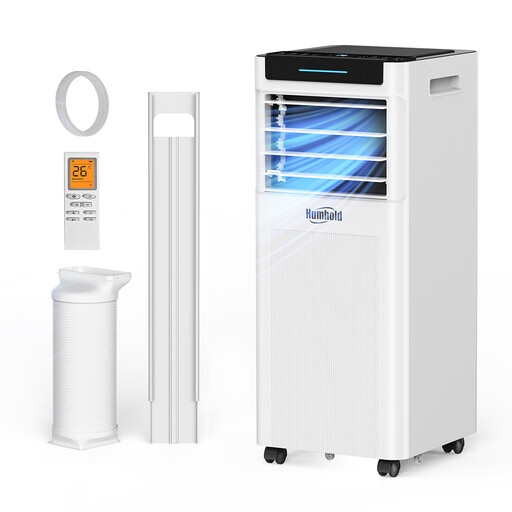
Why this product suits the profile: At 19.7 kg, this unit is comparatively lightweight and designed for smaller rooms of up to 28 m², according to the retailer. It combines cooling, dehumidifying and fan functions.
According to the product specifications, a window kit, exhaust accessories, timer and washable filter are included. The noise figure below 49 dB refers to the stated operating value.
7000 BTU, three operating modes, 24-hour timer and castors for moving it between rooms.
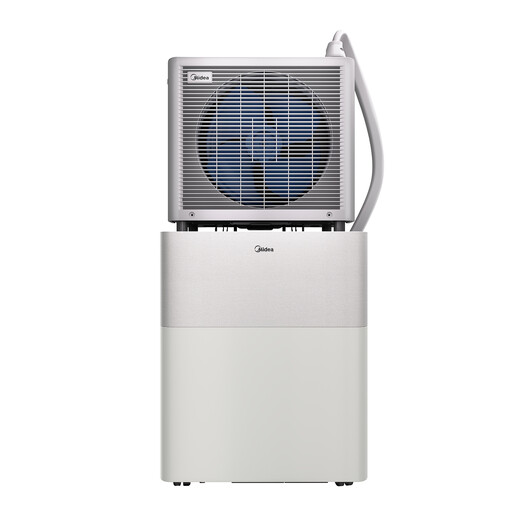
Why this product suits the profile: The portable mini-split design is aimed at users who prioritise higher cooling capacity and a low stated noise level of 39 dB(A).
Before buying, check the stated A++ energy efficiency class and separate indoor and outdoor units against your intended installation location.
12000 BTU, cooling and heating functions, and stated suitability for rooms of up to 105 m³.
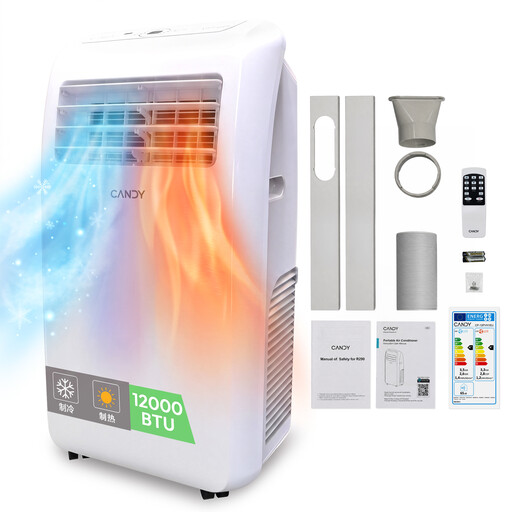
Why this product suits the profile: This 4-in-1 unit offers cooling, dehumidifying, fan and heating functions. It is therefore suitable for households looking to use one appliance across several operating modes.
According to the product description, the window kit is included and designed for both vertical and horizontal sliding windows. The water-level guidance should nevertheless be followed.
12000 BTU, A+ energy efficiency class, 400 m³/h airflow and 24-hour timer.
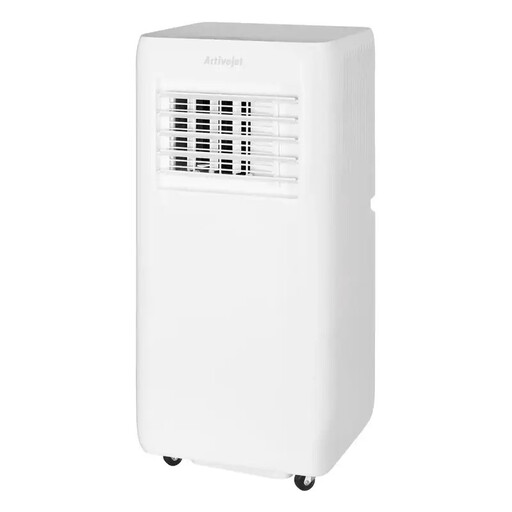
Why this product suits the profile: According to the retailer, this compact unit is designed for rooms of up to 25 m² and features app control, a remote control and two fan settings.
The technical specifications state 7000 BTU, A energy efficiency class, exhaust hose installation and a maximum noise level of 53 dB(A).
3-in-1 operation, Tuya Smart app, washable filter and programmable 24-hour timer.
We have put together a complete, regularly updated list of products that fully meet these strict selection criteria and the safety regulations applicable in the EU.
The portable air conditioner should stand on a level, stable surface. Maintain the clearance from walls specified by the manufacturer. The exhaust hose should run to the window as directly as possible, without tight bends. Keep doors and windows in the room being cooled closed wherever possible during operation.
At high humidity or in dehumidifying mode, the water tank may fill up. A suitable drainage system or regular emptying prevents interruptions to operation. Clean the filter according to the manufacturer’s instructions; if the unit is used frequently, checking it approximately every two weeks is advisable.
Position the unit near a window. Connect the exhaust hose to the outlet on the unit and to the window kit. Warm air must be expelled outside. Before using the unit for the first time, read the operating instructions and observe the required clearances and refrigerant guidance.
Costs depend on power consumption, usage time and your electricity tariff. As a guide, multiply the electrical power consumption in kilowatts by the operating hours and the unit price. A timer, a suitable target temperature and a well-sealed window can help reduce unnecessary consumption.
Its service life depends on how intensively it is used, filter maintenance, storage and correct positioning. Regular cleaning, an exhaust hose without kinks and protection from moisture all support proper operation. If you notice unusual noises, smells or smoke, switch the unit off and disconnect it from the mains.