
Lieferung heute & morgen

Qualitätsgarantie

Willkommens-Angebote freischalten: KOSTENLOSE Lieferung | Bis zu 80 % RABATT | Kostenlose 30-Tage-JoyPlus-Testphase
App herunterladen
A portable air conditioner can cool rooms selectively without requiring permanent wall installation. This makes it a flexible solution for tenants, small flats, bedrooms or home offices. However, portable air-conditioning units vary considerably in cooling capacity, noise levels, energy consumption and installation effort.
Anyone who focuses only on the BTU rating, special offers or terms such as ‘whisper-quiet’ may overlook important details. Three typical buying pitfalls are particularly relevant:
Cooling capacity is often stated in BTU/h or kilowatts. For small rooms of up to around 20 m², more compact units are often sufficient, depending on insulation, sunlight and the number of occupants. For an air conditioner for rooms of up to 30 m², the stated capacity should match the actual room size.
The product specifications provide a useful guide:
These figures are not a guarantee for every home. Loft rooms, large windows and poorly insulated external walls increase cooling requirements. A warm bedroom with the windows closed may need less power than a sunny living room.
An air conditioner with an exhaust hose needs a way to direct the heated air outside. The window kit should be suitable for the window and seal the gap as tightly as possible. Before buying, check the following:
A short, as straight as possible exhaust route supports the intended operation. In rented accommodation, a portable unit is usually easier to use than a permanently installed system. Nevertheless, the operating instructions should be followed, particularly with regard to the power supply: the product specifications for the Humhold units indicate that an earthed 220–240-volt socket should be used and extension leads should be avoided.
A quiet portable air conditioner is particularly appealing for bedrooms and home offices. However, you should not look only at the lowest dB figure. Compressor noise, sleep mode and the timer also affect how practical the unit is in everyday use.
Useful features include:
An energy-efficient air conditioner should not be selected solely on the basis of its energy-efficiency rating. Power consumption, the desired room temperature, operating time and effective window sealing are also important. A fan or air cooler generally uses less electricity than a compressor-based air conditioner, but it does not reduce the room temperature in the same way.
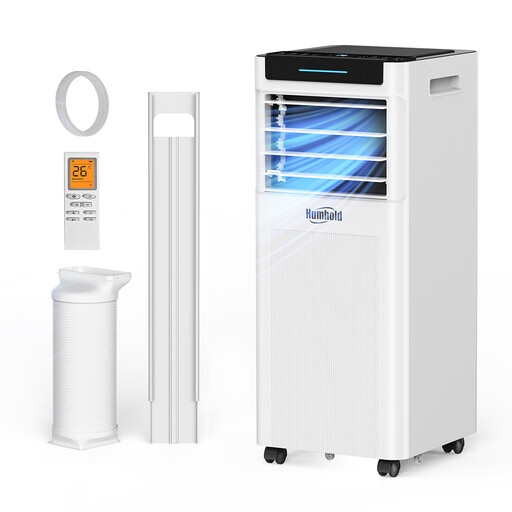
Why this product matches the profile: The unit offers 2.0 kW of cooling capacity and, according to the product specifications, is intended for rooms of up to 28 m². Three operating modes cover cooling, dehumidification and fan operation.
The recommended room size, exhaust hose and window kit are clearly specified in the product details.
2.0 kW, 24-hour timer, remote control and a stated sleep mode with noise levels below 49 dB.
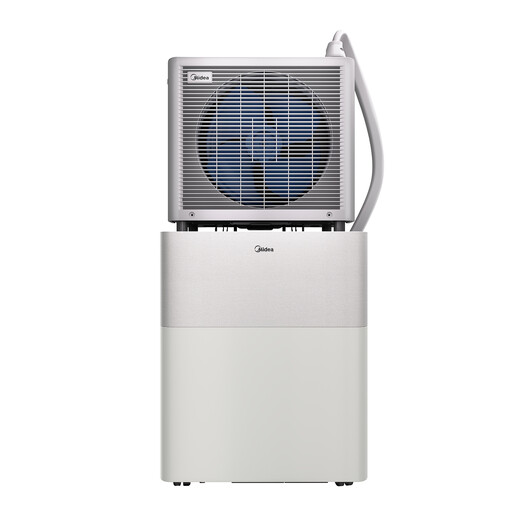
Why this product matches the profile: The mini-split design, 12,000 BTU and A++ energy-efficiency rating are aimed at users who consider technical specifications and an additional heating function.
According to the product description, the noise level is 39 dB(A); the design differs from conventional monobloc units.
Cooling and heating, A++, R32 refrigerant and 220–240-volt power supply.
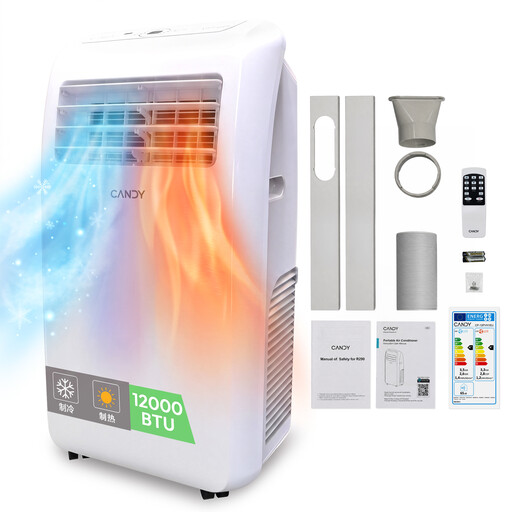
Why this product matches the profile: Four modes – cooling, dehumidification, fan operation and heating – make this unit appealing to households that want to use it across several seasons.
The performance data, recommended room size of up to 35 m² and information on condensate management are clearly stated.
3.5 kW cooling capacity, A+ according to the product specifications, 24-hour timer and window kit.
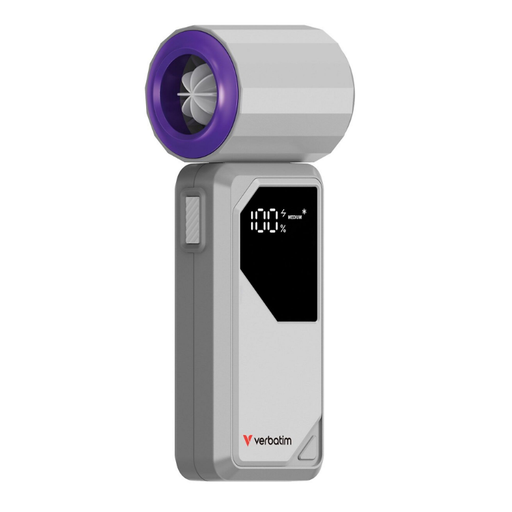
Why this product matches the profile: For commuters, camping, travelling or use at a desk, a small rechargeable fan is more practical than a compressor-based unit.
It is not presented as a room air conditioner, but as a personal USB fan with a clearly limited area of use.
4,000 mAh battery, USB-C charging port, four speed settings and LED display.
We have put together a complete, regularly updated list of products that fully meet these strict selection criteria and the safety regulations applicable in the EU.
Not every warm room needs a portable air conditioner. A pedestal fan circulates air throughout the room, while a desk fan is used at a workstation or bedside table. A USB fan is suitable for use with a laptop, power bank or small desk. A rechargeable fan offers additional flexibility for balconies, travelling and camping.
An air cooler works through water evaporation. Models such as the Beurer LV 50 are compact and, according to the product specifications, can also be used without water as a conventional fan. Evaporation can be noticeable in dry indoor air; in humid rooms, its effect is more limited. The water tank must also be cleaned regularly.
The unit should stand on a stable, level surface. The exhaust hose should be routed through the window kit to the outside, keeping it as short as possible and avoiding sharp bends. The air inlet and outlet must not be obstructed. Before operation, follow the manufacturer’s instructions regarding clearance, power connection and condensate.
Its service life depends on usage, filter care, transport and storage. Washable filters should be cleaned regularly according to the instructions and only refitted once completely dry. Before moving the unit, switch it off and disconnect it from the mains. After extended storage, the operating instructions should be followed when putting it back into use.
Running costs depend on power consumption, operating time and your personal electricity tariff. For a rough calculation, multiply the power consumption in kilowatts by the number of operating hours and the price per kilowatt-hour. A timer, suitable room size, closed windows and a well-sealed exhaust route can help reduce unnecessary running time.