
Lieferung heute & morgen

Qualitätsgarantie

Willkommens-Angebote freischalten: KOSTENLOSE Lieferung | Bis zu 80 % RABATT | Kostenlose 30-Tage-JoyPlus-Testphase
App herunterladen
A portable air conditioner can be set up without permanent installation and taken with you when you move. This makes it appealing to tenants, people working from home, homeowners, campers and van owners. However, some product claims often lead to unsuitable purchases: a high BTU rating alone does not guarantee effective cooling, a supplied window kit will not automatically fit every window, and a stated noise level says little about actual use in a bedroom without knowing the operating mode.
The following criteria will help you compare a portable air conditioner objectively and choose a portable cooling solution that suits your room.
Manufacturers often specify a maximum floor area. However, this depends on several factors:
According to product specifications, a 7,000 BTU unit may be suitable for smaller rooms, while models with 9,000 to 12,000 BTU are intended for larger living spaces. These figures are a guide only and do not replace an assessment of the specific room conditions.
A portable air conditioner with an exhaust hose must vent warm air outside. If the hose is simply passed through a tilted window, warm outside air will often flow back in. A suitable window seal for a portable air conditioner can reduce this heat and air exchange.
Before buying, check the type of window, the opening direction and the available width. Some appliances are designed for sliding-window kits, while other solutions also work with casement or tilt-and-turn windows. Separate sealing strips, for example, are available in lengths of 3 or 4 metres:
The compressor, fan and airflow all produce noise when a portable air conditioner is running. For an air conditioner for the bedroom, the stated sound pressure level, a sleep mode and several fan speeds are therefore important. Wherever possible, compare values measured using the same method. A unit rated at 49 dB(A) in the specified mode will not automatically be equally quiet at every setting.
BTU/h and kilowatts describe cooling capacity. A higher value may be useful in large or heavily overheated rooms, but it often also means greater weight, larger dimensions and higher power consumption. So do not check only the BTU rating; also look at the manufacturer’s recommended room volume.
For an air conditioner for a flat or home office, castors, carrying handles and hose length are also important. The unit should be positioned close to a window without sharply bending the exhaust hose.
The energy efficiency rating provides an initial indication of performance. Power consumption is also important when calculating running costs. A simple guide is:
Electricity costs = power consumption in kW × operating hours × electricity price per kWh
A unit with a cooling capacity of 750 watts may have a different electrical power consumption according to its product data. Therefore, read the technical specifications in full and distinguish between cooling capacity and power consumption. An energy-efficient air conditioner only genuinely saves energy when windows, doors and the exhaust outlet are as airtight as possible, and the unit is not left running unnecessarily long.
A 3-in-1 air conditioner generally combines cooling, dehumidifying and fan functions. An air conditioner with dehumidifier can be useful when humidity is high, although some models require the water tank to be emptied from time to time. Appliances with a heating function extend the period of use, but their heating capacity and efficiency should be assessed separately.
Wi-Fi, app control and a 24-hour timer are useful for people who want to set the appliance before returning home or going to bed. However, these functions do not replace suitable positioning or regular filter maintenance.
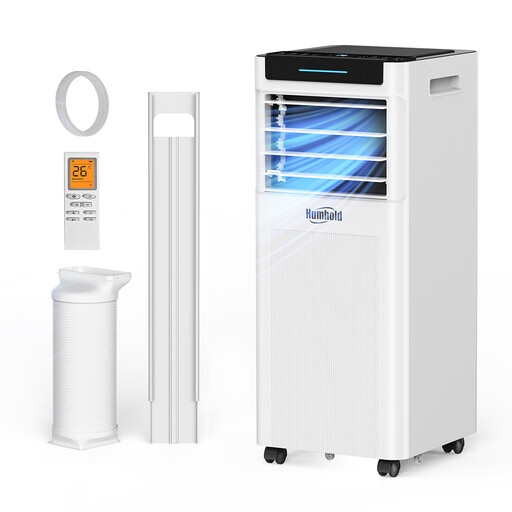
Why this product suits the profile: With a stated cooling capacity of 2.0 kW, three operating modes and a weight of 19.7 kg, this model is suitable for smaller flats, bedrooms and home offices where the appliance may occasionally need to be moved between rooms.
The listed contents include a window kit, exhaust hose and drainage pipe. The stated noise level in sleep mode is below 49 dB.
Cooling, dehumidifying and fan functions; 24-hour timer, castors and washable filter.
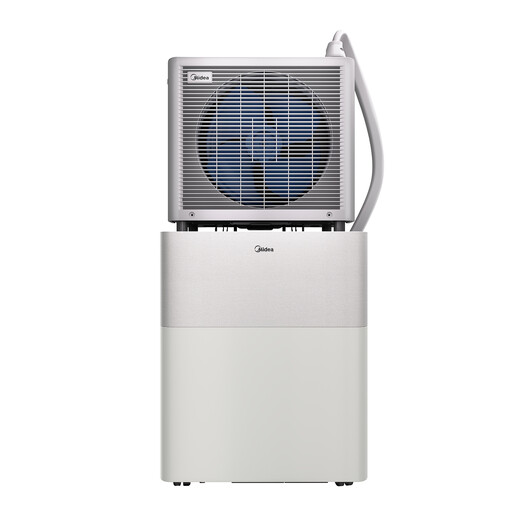
Why this product suits the profile: The combination of 12,000 BTU, an A++ energy efficiency rating and a stated noise level of 39 dB(A) is aimed at users who prioritise technical specifications and a fixed, long-term installation location.
The technical data specifies the efficiency rating, noise level, R32 refrigerant and substantial weight of 45.5 kg. This makes it easier to weigh up mobility and performance realistically.
Cooling, dehumidifying and fan functions; suitable for rooms with a stated volume of up to 105 m³.
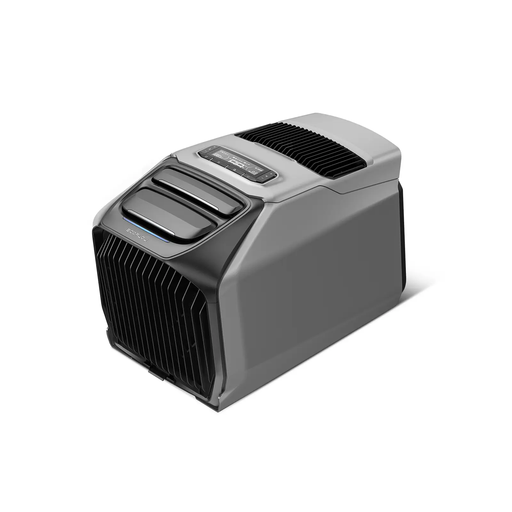
Why this product suits the profile: For campers, motorhomes, SUVs and vans, the compact design with optional battery use is particularly relevant. According to the product data, the cooling capacity is 1,800 W and the heating capacity is 2,000 W.
The specifications explicitly state that exhaust air must be vented outside. According to the manufacturer, the unit is not intended for use while travelling.
App control, 44 dB in sleep mode, heating function and operation with an additional battery.
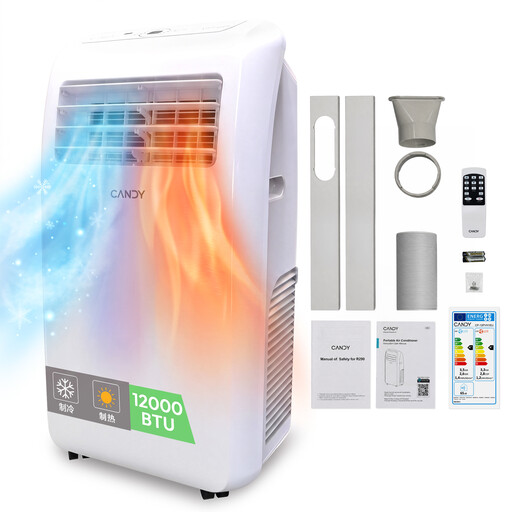
Why this product suits the profile: Anyone looking for an air conditioner with a heating function and window kit for different seasons will find four specified modes here: cooling, dehumidifying, fan and heating.
According to the product description, the window kit is included and designed for vertical and horizontal sliding windows. Window compatibility should still be checked before purchase.
12,000 BTU, A+ energy efficiency rating, 24-hour timer and stated heating capacity of 3.3 kW.
We have put together a complete, regularly updated list of products that fully meet these strict selection criteria and the safety regulations applicable in the EU.
Place the portable air conditioner on a level, stable surface and maintain the distances from walls and furniture specified in the instructions. The exhaust hose must not be blocked or sharply bent. Appliances using R290 contain a flammable refrigerant; the refrigerant circuit must not be damaged. Use an earthed socket and follow the manufacturer’s instructions regarding the use of extension leads.
Disconnect the appliance from the mains before cleaning or maintenance. Washable filters should be cleaned regularly as instructed and only refitted once completely dry. Stop using the appliance if you notice an unusual smell, smoke or unusual noises.
Position the unit close to the window, attach the appropriate window kit and connect the exhaust hose. An additional window seal can reduce open gaps. The hose should be routed outside as directly as possible, without tight bends, and kept as short as possible.
Costs depend on power consumption, operating time, electricity tariff, room temperature and insulation. Use the formula power consumption in kW × operating hours × price per kWh. A timer, thermostat operation and an airtight window seal can help limit unnecessary running time.
It is not possible to give a reliable general lifespan. Regular filter maintenance, proper storage outside the season and operation in accordance with the instructions can help maintain usability. Build quality, servicing options and compliance with safety requirements are also important factors.