
Lieferung heute & morgen

Qualitätsgarantie

Willkommens-Angebote freischalten: KOSTENLOSE Lieferung | Bis zu 80 % RABATT | Kostenlose 30-Tage-JoyPlus-Testphase
App herunterladen
When summer temperatures in Germany rise, the search for effective cooling for your home—especially in attic apartments or home offices—becomes a priority. A portable air conditioner promises quick and flexible relief. However, the market is confusing, and not every unit delivers on its promises. As your Joybuy Product Recommendation Officer, I'll help you avoid the common pitfalls and make an informed decision.
Many buyers are disappointed with their unit after a short time. This is often due to exaggerated marketing promises or overlooked technical details. These three points most frequently lead to a purchase you'll regret:
To avoid these mistakes, focus on the following non-negotiable technical specifications. These will help you objectively evaluate a unit's performance and suitability.
Cooling capacity is specified in BTU per hour (BTU/h) or in watts (1,000 BTU/h ≈ 293 watts). As a rule of thumb for normally insulated rooms with a ceiling height of about 2.50 m:
Sun exposure, the number of people in the room, and additional heat sources (like computers) can increase the requirement. An air conditioner for 30 sqm should therefore have at least 9,000 BTU to work effectively.
Operating costs are a significant factor. Look for an energy efficiency class A air conditioner or better. These units consume less electricity relative to their cooling output. Another important point is the refrigerant used. Modern devices often use propane R290. It is considered more environmentally friendly because it has a significantly lower global warming potential than older refrigerants.
Many modern units are multifunctional. A very useful function is that of an air conditioner with a dehumidifier. On humid days, reducing the humidity can make the indoor climate much more pleasant, even with moderate cooling. Other useful features include a timer, a sleep mode with reduced fan speed, and a remote control for added convenience.
Here are some recommendations tailored to different user profiles and room situations.
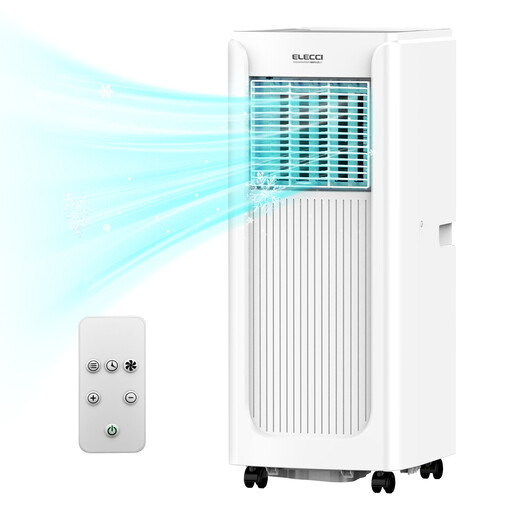
Why This Fits Their Persona: Ideal for renters or homeowners looking for a straightforward and cost-effective solution for a single room like a bedroom or a small home office (up to approx. 20 m?). The 4-in-1 functionality offers year-round utility.
With 6,000 BTU, the cooling capacity is clearly defined for smaller rooms, which avoids the mistake of an undersized unit. The included window kit provides a basic solution for the exhaust, reducing the initial installation effort.
Energy efficiency class A and the R290 refrigerant keep operating costs in check. The 4-in-1 functions (cooling, dehumidifying, fan, sleep mode) offer high value.
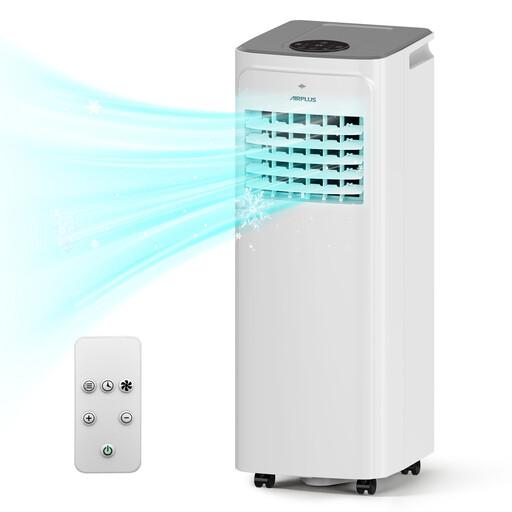
Why This Fits Their Persona: Perfect for users who want to effectively cool their living room or a large bedroom (up to 30 m?). This unit provides the necessary power to ensure a comfortable climate in larger living areas, even on hot days.
With 9,000 BTU, the performance is explicitly designed for rooms up to 30 m?, preventing inefficient cooling. The low-noise mode (down to 45 dB according to the manufacturer) addresses concerns about noise disturbance during quiet times.
The combination of a powerful compressor and 3-in-1 functionality (cooling, dehumidifying, fan) offers a high-performance and flexible solution. Energy efficiency class A and the R290 refrigerant ensure responsible operation.
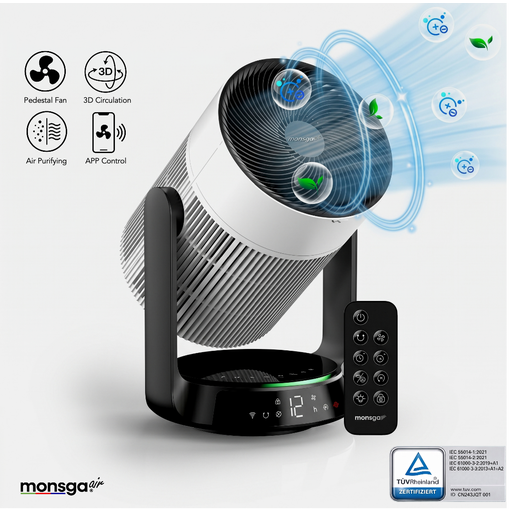
Why This Fits Their Persona: This is an alternative for users for whom air quality and quiet operation are more important than maximum cooling power. It is not an air conditioner, but an air purifier and circulator fan that serves as a companion to an AC unit or for year-round comfort.
This device bypasses the typical drawbacks: It requires no exhaust hose and is extremely quiet, with an operating noise of just 25 dB in sleep mode. It solves the problem of air circulation without the complexity of a true air conditioner.
The combination of air purification (CADR 280 m?/h) and 360° air circulation improves the indoor climate year-round. It is ideal for allergy sufferers and can boost the efficiency of an existing air conditioner by better distributing the cool air.
We have compiled a complete, up-to-date list of products that fully meet these strict selection criteria and German safety regulations.
1. How do I correctly install the exhaust hose of a portable air conditioner? The exhaust hose must vent the warm air directly outside. For the tilt-and-turn windows common in Germany, the simple panels provided are often unsuitable. A better solution is special fabric window seals that are attached to the frame with Velcro. They enclose the hose and prevent warm air from flowing back into the room, which significantly increases the unit's efficiency.
2. What are the electricity costs for a portable air conditioner? The costs depend on the unit's power consumption (in watts), its usage duration, and your electricity tariff. For example: A unit with 1,000 watts (approx. 3,400 BTU/h) consumes 1 kilowatt-hour (kWh) in one hour. With an electricity price of 40 cents/kWh, one hour of operation costs 40 cents. A unit with energy efficiency class A helps to keep these costs as low as possible.
3. Can a portable air conditioner replace a permanently installed split-system AC? An air conditioner without an outdoor unit is primarily designed for cooling individual rooms and offers flexibility, as it can be moved as needed. A permanently installed split-system air conditioner is generally much more efficient and quieter because the noisy compressor is located outside the building. For cooling an entire apartment, a split system is the more powerful, but also more expensive and installation-intensive solution. The portable air conditioner is the ideal choice for renters and for targeted, uncomplicated cooling.