
Lieferung heute & morgen

Qualitätsgarantie

Willkommens-Angebote freischalten: KOSTENLOSE Lieferung | Bis zu 80 % RABATT | Kostenlose 30-Tage-JoyPlus-Testphase
App herunterladen
When summer temperatures soar, your home can quickly become a heat trap. An effective and flexible cooling solution is essential, especially in rental properties or buildings without central air conditioning. A portable air conditioner offers a practical way to cool individual rooms without the need for complex installation.
This article serves as your guide. It explains the key technical features to consider when making your choice and presents a selection of units with different characteristics to help you decide.
Selecting the right unit depends on several factors. The following points will help you define your requirements and find a suitable model.
Cooling capacity is typically measured in British Thermal Units (BTU) per hour. The higher the BTU value, the larger the area the unit can effectively cool. Insufficient capacity leads to inefficient operation, while an oversized unit consumes unnecessary energy.
As a rule of thumb:
Also, consider factors like ceiling height, sun exposure, and the number of people in the room, as these influence cooling needs. For example, an air conditioner for a 30 m? room should have a capacity of at least 9,000 BTU.
A portable air conditioner often runs for several hours a day. The energy efficiency rating indicates how economically the unit operates. Models with an A++ or A+ portable air conditioner rating consume less power relative to their cooling output, which lowers running costs.
The operating noise level, measured in decibels (dB), is a crucial factor, especially for use in a bedroom or office. A quiet portable air conditioner operates in special modes at a volume below 50 dB, which is comparable to a quiet conversation. Pay attention to the manufacturer's specifications for the sound pressure level at different operating stages.
Modern units often offer more than just cooling. Many models combine air conditioning, cooling, and dehumidifying functions in one device. The dehumidifying function can significantly improve the indoor climate on humid days.
There are also two basic designs:
Features like a portable air conditioner with app control or a remote control greatly enhance convenience, allowing you to adjust settings easily from a distance.
Here is a selection of units that meet different needs—from ultra-quiet models to powerful all-rounders.
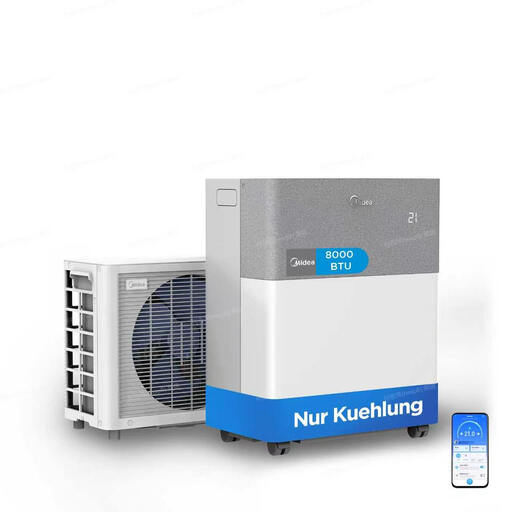
What sets this model apart: The Midea PortaSplit Cool is a portable split air conditioner. By separating the indoor and outdoor units, noise inside the room is minimised. In Silent Mode, the unit reaches a sound pressure level of just 38 dB(A), according to the manufacturer. With an energy efficiency class of A++, it is also designed for economical operation.
Pros:
Who is this unit for? Ideal for users seeking an exceptionally quiet portable air conditioner for noise-sensitive environments like bedrooms, children's rooms, or home offices, and who value high energy efficiency.
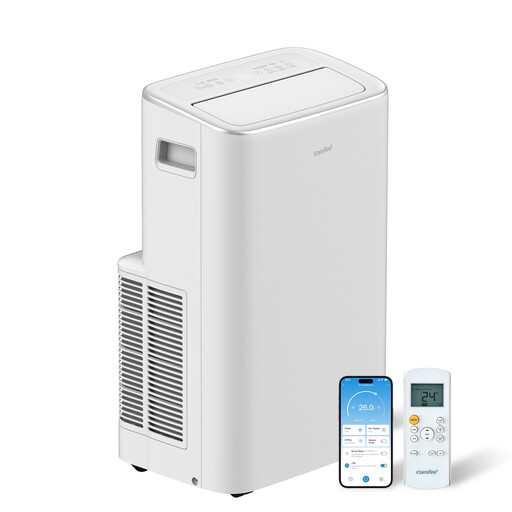
What sets this model apart: This monobloc unit from Comfee' is designed as a multifunctional solution. It combines cooling, dehumidification, and ventilation in a compact housing. With 9,000 BTU of cooling power, it is suitable for rooms up to approx. 18 m?. It can be controlled flexibly via the touch panel, remote control, or the companion app, which also offers special modes like an energy-saving or sleep mode.
Pros:
Who is this unit for? A great choice for users looking for a straightforward and flexible all-in-one solution for small to medium-sized rooms who appreciate the convenience of smart control.
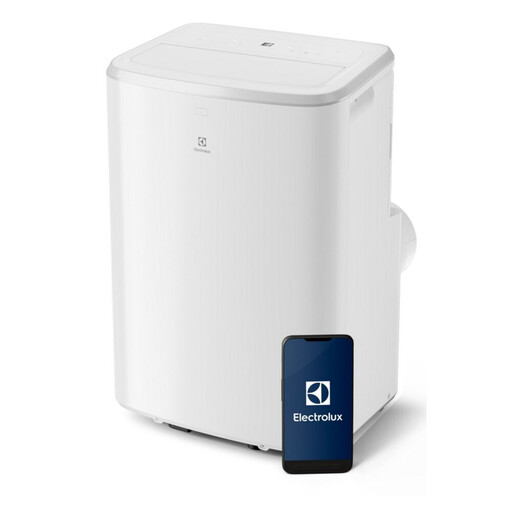
What sets this model apart: The Electrolux Comfort 600 offers a high cooling capacity of 12,000 BTU (3.4 kW), designed for rooms up to 49 m?. It features four operating modes (Auto, Cool, Dehumidify, Fan) and can be controlled via Wi-Fi using the Electrolux app. According to the manufacturer, it uses the more eco-friendly R290 refrigerant, which has a significantly lower global warming potential compared to R410a.
Pros:
Who is this unit for? Suitable for cooling larger living areas, open-plan spaces, or small offices where high performance is required and smart operation is desired.
The models presented here cover only a fraction of the available options. If you are looking for different performance levels, designs, or specific features, you can find more alternatives in our wide range.
Discover our entire selection of Home Air Conditioners and find the perfect unit for your needs.
A portable monobloc air conditioner draws in warm room air, cools it internally using a refrigerant cycle, and releases the cooled air back into the room. The heat generated in this process is vented outside through a flexible exhaust hose via a vented window or a special window sealing kit.
The main difference is the design. A portable air conditioner (monobloc) combines all components in one housing. A split air conditioner consists of two parts: an indoor unit that distributes the cool air and an outdoor unit that houses the compressor and heat exchanger. Portable split units are quieter in operation because the loudest component is placed outside the room.
Power consumption depends on the cooling capacity (BTU/kW), energy efficiency class, and duration of use. A unit with 2.5 kW of cooling power and an energy efficiency class of A consumes about 1 kilowatt-hour (kWh) per hour at full load. Models with a better efficiency class, such as A++, require significantly less energy for the same cooling performance. You can find the exact consumption values on the energy label of the respective product.