
Lieferung heute & morgen

Qualitätsgarantie

Willkommens-Angebote freischalten: KOSTENLOSE Lieferung | Bis zu 80 % RABATT | Kostenlose 30-Tage-JoyPlus-Testphase
App herunterladen
Ensuring a consistent and comfortable room temperature all year round can be a challenge. As summers get hotter, the transitional seasons and winters remain cool. A portable air conditioner with a heating function offers a flexible solution to respond to seasonal temperature shifts without the need for permanent installation.
This guide is designed to help you navigate your options. It highlights the objective criteria for choosing a suitable unit and presents several models with their specific features, providing a solid foundation for you to make an informed decision.
Selecting the right unit depends on several technical factors. The following points will help you interpret manufacturer specifications.
An air conditioner's capacity is often specified in BTU (British Thermal Unit) per hour. A higher BTU value means greater cooling power. For most residential spaces, a 12000 BTU air conditioner is a popular choice, suitable for rooms of approximately 35 to 45 square metres.
At the same time, energy efficiency is crucial for operating costs. Pay attention to the EU energy label. An energy-efficient A++ air conditioner consumes significantly less electricity in cooling mode than models with lower ratings like A or B. For units with a heating function, the efficiency for heating is often listed separately (e.g., A+).
A quiet portable air conditioner is particularly beneficial in bedrooms or offices. The sound pressure level is measured in decibels (dB(A)). Values below 55 dB(A) are often perceived as less disruptive during operation. Some models offer special silent or night modes that reduce the fan speed and, consequently, the noise level.
Modern features like an air conditioner with app control provide additional convenience. Using Wi-Fi and a smartphone, you can control the unit on the go, ensuring you return to a perfectly tempered home. Timer functions and a remote control are now standard features.
The most common design is the monobloc unit. Here, all components are housed in a single casing, and the warm air is expelled outside through an exhaust hose.
The portable split unit represents a technical advancement. Similar to permanently installed systems, it consists of an indoor and an outdoor unit connected by a flexible conduit. The noisy compressor is located in the outdoor unit, making the indoor unit significantly quieter. Furthermore, the energy efficiency of these devices is often higher.
Based on the criteria mentioned, we have compiled a selection of models that cater to different needs.
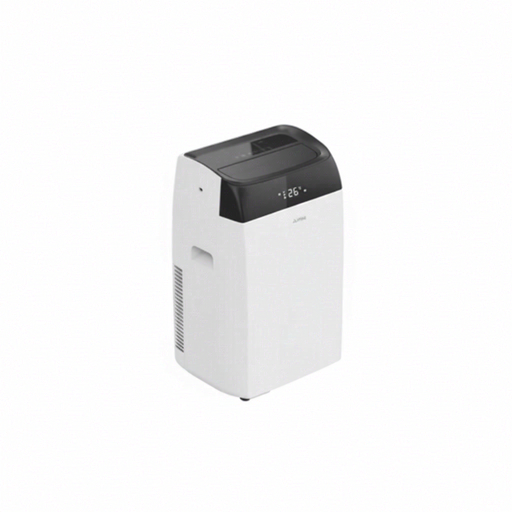
Why it stands out: The Daitsu APD 12FCX is a versatile 4-in-1 unit that combines cooling, heating, dehumidifying, and ventilation in a compact design. The heating function is powered by an efficient heat pump. Integrated Wi-Fi functionality allows for convenient control via the Smart Life app.
Advantages:
Who is it for? For users seeking a flexible and smart year-round solution for medium to large rooms who also value good value for money.
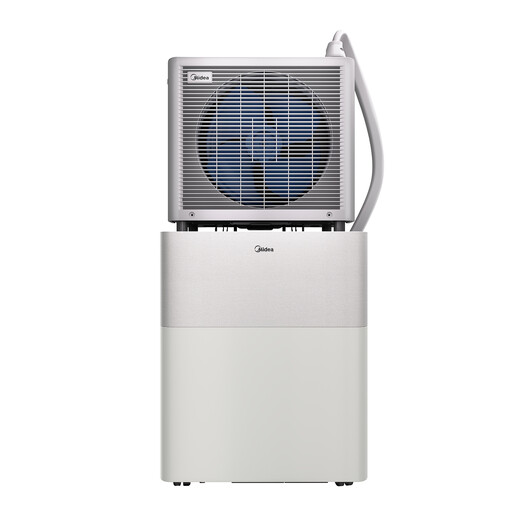
Why it stands out: The Midea PortaSplit-E 12K is a portable split unit that combines the advantages of a permanently installed split system with the flexibility of a mobile device. By placing the compressor in the outdoor unit, it achieves a very low indoor noise level. With an A++ energy efficiency rating, it is also extremely economical to run.
Advantages:
Who is it for? For noise-sensitive users and anyone who demands the highest standards of efficiency and quiet operation, for example, for use in bedrooms, living rooms, or offices.
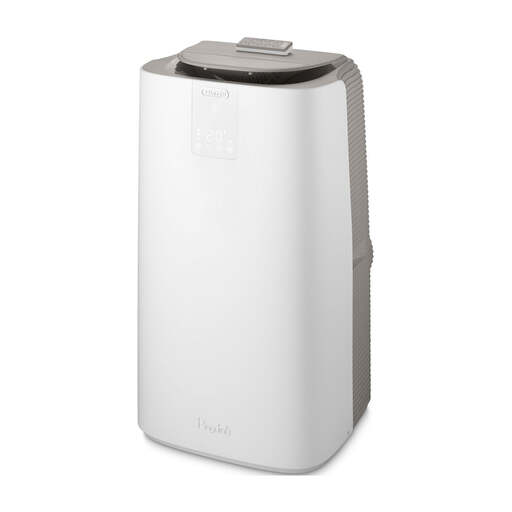
Why it stands out: This model from De’Longhi utilises comfort technologies to optimise the indoor climate. The "Eco Real Feel" technology automatically adjusts temperature and humidity to create an ideal comfort climate with optimised energy consumption. The "Silent Technology" ensures a reduced noise level.
Advantages:
Who is it for? For users looking for a portable air conditioner for the home from an established brand who value intelligent automatic functions that minimise user effort.
The market for portable air conditioners is diverse, offering a suitable solution for almost every need. The models presented here are designed for the combination of cooling and heating.
For users considering a portable air conditioner without an exhaust hose (often called an air cooler) or other specialised models, our broader category overview offers more options.
Discover more portable air conditioners here
Most high-quality portable air conditioners with a heating function use a heat pump. In this process, the refrigeration cycle is reversed: instead of extracting heat from the room and expelling it outside, heat is extracted from the outside air and released into the room. This principle is significantly more energy-efficient than heating with a purely electric heating element (PTC heater), which is found in simpler models.
The noise level is measured in decibels (dB(A)). For context: a whisper is around 30 dB, a quiet library is 40 dB, and a normal conversation is 50–60 dB. A quiet portable air conditioner should have a sound pressure level below 55 dB(A) during operation. Models like the Midea PortaSplit-E, with values around 39 dB(A), are particularly noteworthy.
Most portable air conditioners are monobloc units and absolutely require an exhaust hose to direct the heat removed from the room outside. Without this hose, the heat would remain in the room, negating the cooling effect. Portable split units also have a connection to the outside. An exception is air coolers (evaporative coolers), which operate without an exhaust hose but only cool the air by a few degrees through water evaporation, while also increasing humidity. They are not fully-fledged air conditioners.