
Lieferung heute & morgen

Qualitätsgarantie

Willkommens-Angebote freischalten: KOSTENLOSE Lieferung | Bis zu 80 % RABATT | Kostenlose 30-Tage-JoyPlus-Testphase
App herunterladen
A portable air pump can be useful in the car, on a cycle path or when camping. However, models vary considerably in terms of power supply, air flow, pressure range and accessories. A high PSI rating alone does not indicate whether a pump is suitable for your intended use.
The following points will help you avoid common buying mistakes and choose an electric air pump, battery-powered air pump or manual model to suit your needs.
Ratings such as 150 PSI or more may look impressive at first glance. However, when inflating car tyres, it is equally important to consider how much air the pump delivers per minute and how long it can operate under load. A 150 PSI compressor may reach a high theoretical maximum pressure, but could still take several minutes to inflate a completely flat tyre.
The vehicle’s recommended tyre pressure should also be the main consideration. The value shown on the tyre or in the vehicle documentation is more important than the pump’s maximum pressure.
A battery-powered tyre inflator can be used independently of a mains socket. However, its battery must be charged. Corded models with a 12-volt connection can be powered directly from the vehicle’s socket, but they require a sufficiently long cable and an accessible power connection.
When choosing a portable air pump, you should therefore check not only its weight and housing size, but also its charging time, battery life and connection type.
Tyres require comparatively high pressure with a low volume of air. Air beds, inflatable boats and large camping products generally need a high air volume at a lower pressure. A small battery-powered air pump designed for tyres is not necessarily suitable for these products.
A high-volume pump with suitable nozzles is often a better choice. A selection of high-volume pumps can be useful if you regularly need to inflate or deflate air beds.
The pressure range should match your intended use. Cars, motorbikes, bicycles and balls each have different typical target pressures. A digital display with multiple units, such as PSI, Bar, kPa and kg/cm², makes it easier to check the pressure.
Preset modes for cars, motorbikes, bicycles and balls are practical features. Automatic shut-off reduces the risk of unnecessarily exceeding the desired pressure. The display should also be easy to read while the pump is running.
Air flow is often specified in litres per minute. For car tyres, pressure build-up and operating time are particularly important. A battery-powered air pump should also state how many tyres can be inflated on a single charge and how long a full recharge takes.
For longer jobs, it is important to take breaks as specified in the instruction manual to prevent the motor and housing from overheating. A 12-volt tyre inflator is suitable for use on the go, but depends on the vehicle’s power supply.
Before buying, check that the following components and features are included:
A manual bicycle pump remains a straightforward alternative when no power source is available and you only occasionally need to top up smaller tyres.
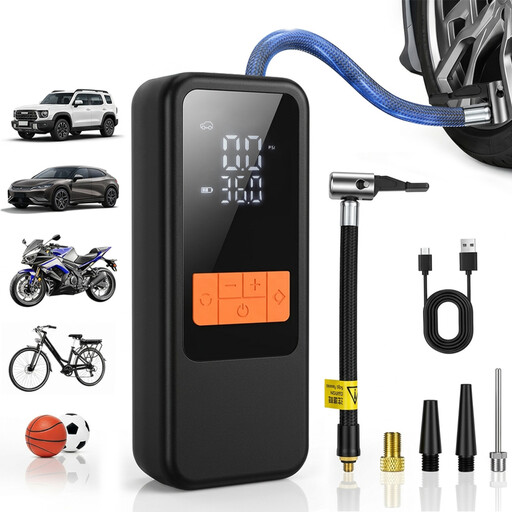
Why this product suits this profile: This compact battery-powered model is suitable for users looking for a portable solution for car, motorbike or bicycle tyres, with a choice of preset modes.
The specifications state a 4,000 mAh battery capacity, around 25 minutes of operating time and a maximum pressure of 150 PSI. This makes the battery dependency and operating limits easier to assess.
Five modes, a Type-C connection, an LED light with continuous and SOS modes, plus a stated air flow of 26 L/min.

Why this product suits this profile: This model combines digital pressure selection, battery power and multiple connections in a compact tyre inflator for cars, motorbikes, bicycles and balls.
The product information explicitly states limitations for off-road vehicles, motorhomes, lorries and trailers. This makes it easier to assess the intended applications realistically before buying.
150 PSI maximum pressure, 17 L/min air flow, 4,000 mAh battery, five modes, automatic shut-off and USB-C input and output.
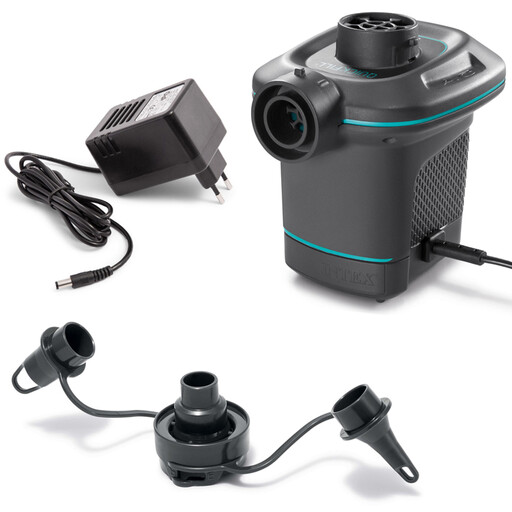
Why this product suits this profile: Campers and air-bed users get a battery-powered solution for inflating and deflating leisure products, even when no mains socket is available.
This pump is not described as a high-pressure tyre compressor, but as a device for moving high volumes of air. Six C batteries and three nozzles should be accounted for before use.
A stated air flow of at least 420 L/min, three nozzle adapters, and functions for both inflating and deflating.
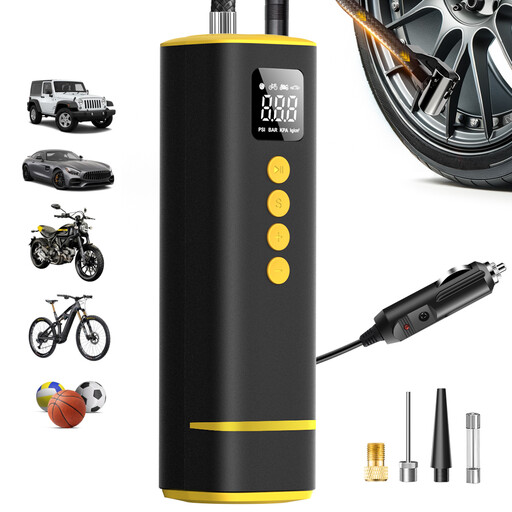
Why this product suits this profile: Drivers who do not want to plan around charging times can use this corded 12-volt model directly from their vehicle.
The power supply is clearly specified as a 12-volt connection. The extended cable addresses the common drawback of short leads, but you should still check the position of the connection in your vehicle.
12-volt operation, a stated maximum pressure of 150 PSI and suitability for car, motorbike and bicycle tyres.
We have put together a complete, regularly updated list of products that fully meet these strict selection criteria and the safety regulations applicable in the EU.
For car tyres, an electric tyre inflator with a pressure display, suitable valve connection and automatic shut-off is a practical choice. Battery-powered models offer flexibility, while a 12-volt compressor does not need to be charged beforehand. Maximum PSI should not be your only selection criterion.
Battery life depends on battery capacity, tyre size, starting pressure and the desired final pressure. The Porbi Q16, for example, is specified with a 4,000 mAh battery and around 25 minutes of operating time. Cold temperatures, battery age and frequent use can affect the actual operating time.
A battery-powered air pump uses energy when charging, while a 12-volt model draws power from the vehicle connection. High-volume pumps operating at 220 to 240 volts can deliver a considerably higher air flow, but are designed for use with a mains supply. For occasional use, choosing the right type of device is therefore more important than making a blanket comparison of power consumption.