Which hobs are right for you?

Cooking on the go during a renovation

If you need to cook before your built-in hob is ready, choose the number of cooking zones to suit your available space and the pans you’ll use at the same time. ROMMELSBACHER describes portable single hobs, while SEVERIN offers a double hob.

Making risotto with a pan you already own

If you want to keep using your current pan, check the material and diameter of its base before choosing an induction hob. ROMMELSBACHER says the CT 2020/IN requires a ferromagnetic base; the diameter of the pan’s rim may differ from that of its base.

Planning a permanent kitchen

If you want to fit a hob in your finished kitchen, plan the cut-out and electrical connection around the exact model. Bosch specifies a niche size of 560 × 490–500 mm for both the PKN645FP2E and PVS63KBB5E, and says they must be connected without a plug by a qualified electrician.

Which buying criteria matter most?

Portable single induction hob

A good fit if: one pan for risotto is usually enough during the renovation, and the pan base is compatible with the cooking zone.

The trade-off: You can heat only one pan at a time on a single hob.

Portable double induction hob

A good fit if: you regularly use a frying pan or a second saucepan alongside your risotto pan, and have enough space for the hob.

The trade-off: A larger hob takes up more space. The manufacturer lists the SEVERIN DK 1031 as 59 cm wide, with a total output of 3400 W.

Portable radiant ceramic hob

A good fit if: your current pan isn’t suitable for induction and you need a portable cooking surface during the renovation.

The trade-off: The cooking surface gets hot; the ROMMELSBACHER CT 2203/TC has a residual heat indicator to alert you.

Built-in hob

A good fit if: you’ve measured a permanent space for the hob and need several cooking zones.

The trade-off: A built-in hob isn’t a portable stopgap. Its installation dimensions and connection requirements vary by model, so you’ll need to plan ahead.

What you need What to check before buying Who is this important to?
Cooking during a renovation Check the available space, appliance dimensions, plug type and number of cooking zones you’ll need at the same time. If I need to cook before my built-in hob is ready, I want to choose the number of zones to suit the space and the pans I’ll use at the same time. A practical temporary solution is a priority for around 33% of consumers.
Adjusting the heat while making risotto Check the controls and power settings for the specific model; these alone don’t indicate a particular level of cooking performance. When adding stock gradually, I want to be able to reach and adjust the heat easily. This matters most to around 27% of consumers.
Keeping the pan I already own For induction, check the material and diameter of the pan base, not just the diameter of the rim. If I want to keep using my current risotto pan, its base needs to be compatible with the cooking technology and zone. Keeping an existing pan is the top priority for around 20% of consumers.
Fitting a hob in the finished kitchen Before buying, check the exact niche dimensions, cooking zones and connection type against your kitchen plans. If I’m planning a permanent hob, I want to make sure the cut-out and connection will suit my kitchen. A built-in hob is the top priority for around 20% of consumers.

Which common buying mistakes can you avoid?

  • Assuming CERAN means induction

    A ceramic glass surface doesn’t tell you how the heat is generated. Induction and radiant heating have different requirements; a radiant-heated surface may still be warm after you switch it off.

    Check the heating technology in the model description. With induction, the pan base needs to be compatible; with radiant heating, look out for a residual heat indicator.

  • Choosing a built-in hob by its visible width alone

    Niche dimensions and connection requirements vary by model. The 90-cm Siemens EX975LXC1E has different cut-out dimensions from the 60-cm Bosch models described here.

    Before ordering, check the cut-out and electrical requirements against the specifications for your chosen model. The manufacturer says the Bosch built-in hobs mentioned here must be connected by a qualified electrician.

  • Automatically choosing a single hob for a temporary kitchen

    A single hob can hold one pan at a time. The REWE mushroom risotto recipe calls for the mushrooms to be cooked in a separate frying pan; you may also want to heat the stock separately.

    Before buying, consider whether you’re happy to cook in stages or need a second cooking zone at the same time.

Which branded models can help you compare?

ROMMELSBACHER

The CT 2020/IN and CT 2203/TC are two portable single hobs with different heating technologies.

  • ROMMELSBACHER lists ten power settings for the CT 2020/IN; the pan needs a ferromagnetic base.
  • The CT 2203/TC has a 140-/210-mm HiLight zone and a heated surface with a residual heat indicator.

SEVERIN

The DK 1031 is an example of a portable double induction hob.

  • SEVERIN lists two cooking zones, a Schuko plug and a total output of 3400 W.
  • At 59 cm wide, the model needs enough worktop space; these specifications apply to the DK 1031.

CASO Design

The Touch 2000 is a portable single induction hob with one cooking zone.

  • CASO lists ten power settings and a suitable pan diameter of 12–24 cm.
  • Check that your pan and intended set-up are suitable for the specific model.

Bosch

The PKN645FP2E and PVS63KBB5E are built-in hobs with radiant and induction heating respectively.

  • Bosch lists four cooking zones and a niche size of 560 × 490–500 mm for both models.
  • According to Bosch, both models are supplied without a plug; the induction model also needs a compatible pan base.

Siemens

The EX975LXC1E is a 90-cm induction hob for a kitchen planned to accommodate its size.

  • Siemens lists five cooking zones and a niche size of 880 × 490–500 mm.
  • This isn’t a portable hob. The manufacturer says it must be connected without a plug by a qualified electrician.

Joybuy portable hob products

This selection of Joybuy products includes portable induction and infrared hobs for a temporary kitchen. Before choosing, check that the heating technology, pan and number of cooking zones suit the way you’ll use it.

Portable double induction hob with two cooking zones

Portable double induction hob with 5 temperature settings

For a temporary kitchen when you want to use a second pan alongside your risotto pan.

The product title lists two cooking zones, five temperature settings, and simmering and keep-warm functions.

View at Joybuy

Portable induction hob with 10 temperature settings

Portable induction hob, 3500 W, 10 temperature settings

Described as a portable single hob for a temporary kitchen. First, check that your pan base is suitable for induction.

The product title lists 3500 W and ten temperature settings. According to the product information, the hob switches off automatically if it doesn’t detect compatible cookware.

View at Joybuy

DTL06 portable infrared hob with a ceramic glass surface

DTL06 infrared hob, 3500 W

This radiant-heated hob is a portable alternative if you’re not looking for an induction hob.

The product title lists a ceramic glass surface, 3500 W and a timer. It describes the hob as suitable for heat-resistant cookware.

View at Joybuy
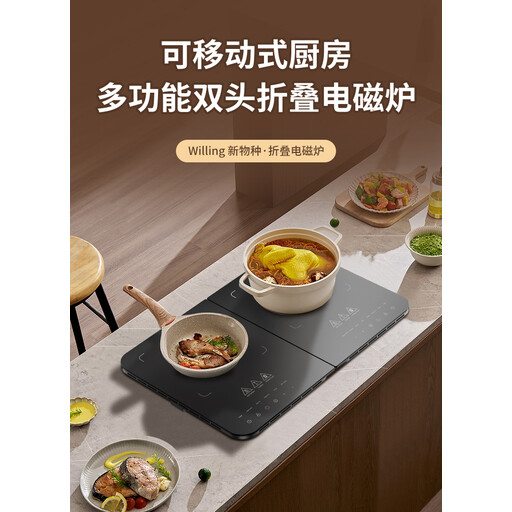
MCJOY DL03 folding double induction hob

MCJOY DL03 folding double induction hob

For a temporary kitchen where you need to use two pans at once and want to fold the hob away neatly afterwards.

The product information describes two independently controlled cooking zones and a slim folding design. Let the hob cool before cleaning or storing it, and keep the ventilation openings clear while it’s in use.

View at Joybuy
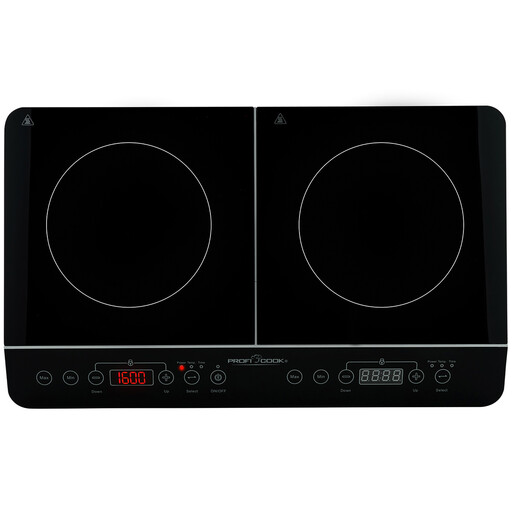
ProfiCook PC DKI 1067 double induction hob

ProfiCook PC DKI 1067 double induction hob

For heating your risotto pan and another pan at the same time; make sure both are suitable for induction.

The product title lists two cooking zones, ten temperature settings per zone, a timer and a temperature range up to 240 °C. According to the product information, a zone switches off if it doesn’t detect a compatible pan.

View at Joybuy

Frequently asked questions

Do I need two cooking zones to make mushroom risotto?

One suitable cooking zone is enough for the risotto pan itself. If you want to fry mushrooms in a separate pan at the same time, as in the REWE recipe, or heat the stock separately, a second cooking zone is useful—but it isn’t essential for every risotto.

How do I check whether my pan will work on an induction hob?

Check whether the base is magnetic or explicitly labelled as induction-compatible, then compare its diameter with the cooking zone. The diameter of the pan’s rim may differ from that of its base.

Can I simply plug in a built-in hob during a renovation?

According to the manufacturer, this isn’t possible with the Bosch PKN645FP2E and PVS63KBB5E: both are supplied without a plug and are intended to be connected by a qualified electrician. Portable appliances may have a plug, depending on the model; even so, check that the location and power connection are suitable for the way you plan to use the hob.

Who can make changes to the kitchen’s fixed electrical installation?

Under § 13 of the Low Voltage Connection Ordinance, work on the electrical installation downstream of the building’s main fuse may only be carried out by an installation company registered in a network operator’s installer directory, apart from the network operator itself. This is different from using a portable hob that is designed to be plugged in.

What should I know about using an induction hob with an active implant?

The Federal Office for Radiation Protection points out that electric and magnetic fields can affect electronic implants, and that individual advice should come from a doctor. This doesn’t mean induction is generally prohibited, nor does it amount to individual medical clearance.