What should you look for when buying?
First, decide whether you want to keep the soup hot between meals or chill it and reheat it later. Then consider how many cooking zones you’ll need at once, and whether the pan, available space and electrical connection are suitable.
| What you need |
What to check before buying |
Who is this especially important for? |
| Managing soup between meals |
Check for a keep-warm function and timer; if keeping the soup hot, check its temperature. If storing it for longer, plan to cool it promptly and reheat it later. |
If the next portion won’t be served until later, I want to plan a suitable way to keep it hot or store it. Around 33% of consumers put this consideration first when buying. |
| Using other pans at the same time |
Check how many cooking zones you need and whether they’re arranged to suit the bases of your pans. |
If I’m cooking side dishes or other meals alongside the soup, I need zones I can use at the same time. Around 27% of consumers prioritise this need to cook several things at once. |
| Adding a portable cooking zone |
Compare the appliance’s dimensions, suitable pan-base size and the specific model’s load capacity with the weight of your filled pan. |
If I want to add a single cooking zone and put it away afterwards, I look at how much space it takes up and whether it suits my pan. Around 20% of consumers prioritise a portable additional cooking zone. |
| Continuing to use your pan and existing installation space |
Check that your pan is induction-compatible, has a flat base and is the right size for the zone. For a built-in model, check the exact cut-out and connection specifications. |
If I want to use my existing pans or built-in space, the model I choose needs to be compatible. Around 20% of consumers focus on this compatibility. |
Joybuy products
The options below include built-in hobs with several zones and portable induction hobs for adding a cooking zone. What matters is whether each appliance suits your pan, kitchen space and cooking routine.
 No image available
Bosch PIE61RBB5E Series 4 built-in induction hob
An option if you’re looking for a built-in induction hob and your existing kitchen is compatible with this specific model.
Model: PIE61RBB5E; Series: Series 4; built-in induction hob. Use induction-compatible cookware. In Germany, work on a fixed electrical connection is subject to § 13 NAV.
Joybuy
 No image available
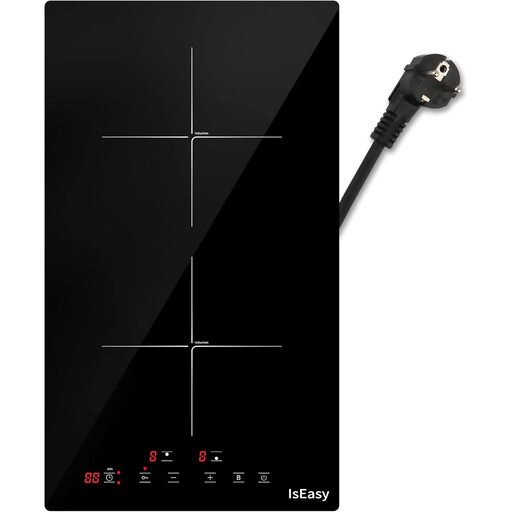
IsEasy Domino induction hob with two cooking zones
An option if you’re looking for a hob with two zones for cooking at the same time.
Two cooking zones; 3400 W; 29.5 cm; nine heat settings; timer; child lock; booster function. The product title describes this model as a built-in appliance with a plug-in connection. Before buying, check that the connection and installation suit your kitchen.
Joybuy
 No image available
IsEasy portable induction hob, 2100 W, 28 cm
An option if you want to add a portable cooking zone; check that it suits your pan and the space available.
The product title lists 2100 W, 28 cm, nine heat settings, a timer, touch controls and a glass surface. Use induction-compatible cookware.
Joybuy
 No image available
Induction hob with two cooking zones and five temperature settings
An option if you want to use two cooking zones and are looking for a temperature setting to keep food warm.
The product title lists two cooking zones and five temperature settings. A keep-warm setting doesn’t prove that all the soup has reached at least 60 °C; the BfR recommends this temperature throughout the dish.
Joybuy
 No image available
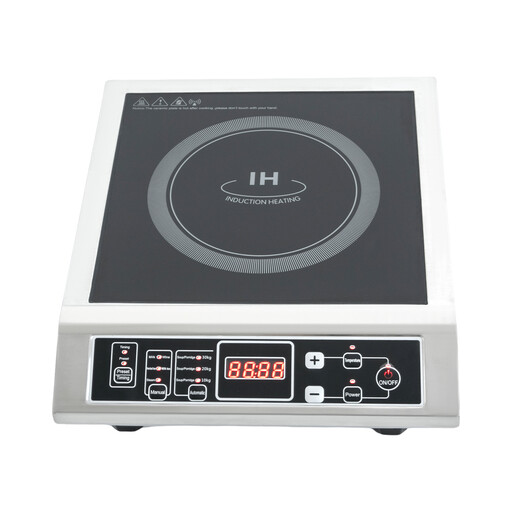
Portable induction hob, 3500 W
An option if you want to add a portable cooking zone for a compatible induction pan.
The product title lists 3500 W, IGBT heating, a timer and a reservation function. Use compatible magnetic cookware.
Joybuy
Frequently asked questions
Is the keep-warm function enough if the next portion won’t be eaten until later?
No. It doesn’t, on its own, confirm the temperature of the whole dish. The German Federal Institute for Risk Assessment recommends keeping food at a minimum of 60 °C throughout when holding it hot. If you’re storing the soup for longer rather than keeping it hot, its food hygiene guidance recommends cooling hot food promptly to below 7 °C. When reheating, it specifies at least 70 °C for two minutes throughout.
Can I keep using my existing soup pan?
Only if its material, flat base and size are suitable for the induction hob you choose. The German Federal Office for Radiation Protection points out that cookware made from unsuitable materials, with an uneven base or of the wrong size is not suitable. Portable models may also have their own pan size requirements.
Can I connect a built-in hob to the mains myself?
In Germany, work on electrical installations is subject to § 13 NAV. In general, it may only be carried out by the network operator or an installation company listed in an installer register; the regulation provides a limited exception for certain maintenance work. For the built-in models mentioned here, Bosch and Siemens advise that they must be connected without a plug by a qualified electrician. Plugging in a portable appliance designed to be connected this way is different.
What should I consider if I have a pacemaker?
The German Federal Office for Radiation Protection advises people with active implanted medical devices to check with their doctor whether the electric or magnetic fields from household appliances could affect their particular device. This is an individual precaution, not a blanket ban for all buyers.
Does an energy label show how much electricity a hob uses?
No. According to the consumer advice centre, the EU energy label for a cooker combination relates to the oven, not the hob. It doesn’t show the hob’s electricity consumption.


