
Lieferung heute & morgen

Qualitätsgarantie

Willkommens-Angebote freischalten: KOSTENLOSE Lieferung | Bis zu 80 % RABATT | Kostenlose 30-Tage-JoyPlus-Testphase
App herunterladen
A portable cooler for cars and camping needs to offer more than generous storage capacity. The right cooling technology, a suitable power supply and a format that fits conveniently in a vehicle, tent or motorhome are all crucial. Focusing solely on the stated capacity or particularly low temperature figures can mean overlooking important differences.
This buying guide from the Joybuy Product Recommendation Officer explains what campers, travellers, anglers, families and vanlife enthusiasts should consider in 2026.
An electric cooler with a thermoelectric system often operates based on a temperature difference from the surrounding environment. If the temperature inside a vehicle rises significantly in summer, the actual internal temperature may also be higher. Figures such as “as low as 4°C” should therefore always be considered in relation to the ambient temperature, ventilation and how full the cooler is.
A compressor cooler, by contrast, regulates the target temperature independently of ice and can also be used as a freezer, depending on the model. However, it is generally heavier, more expensive to purchase and more demanding in terms of power consumption.
A 40-litre cooler offers considerably more space than a 20-litre cooler, but it also requires more room. In electric models, internal compartments, the compressor and divider walls can reduce the volume that is actually available. Before buying, you should therefore check the internal dimensions, rather than looking only at the external dimensions and gross capacity.
A 12V cooler is designed to connect to the car’s cigarette lighter socket. However, the starter battery may not be sufficient for longer periods when the vehicle is stationary. Models with battery-protection settings can reduce the risk of completely draining the battery, but they do not replace a separate power station or auxiliary battery.
This is not a concern with a passive cooler. However, ice or ice packs need to be replenished regularly.
A cooler with a warming function is not automatically designed to cool and warm at the same time. The operating modes should be used separately.
A 20-litre cooler or smaller may be sufficient for one person or short car journeys. Families and groups are generally better served by capacities of 30 to 45 litres. However, large models are heavier when fully loaded.
As a guide:
You should also check whether the cooler fits on a seat, in the boot or beneath a camping kitchen. Wheels and telescopic handles make heavier compressor models easier to transport.
When comparing a 12V cooler, consider its power consumption, battery protection and cable length. An ECO mode can reduce consumption, while MAX mode cools more quickly but uses more energy. Some devices also support 24V DC, 100–240V AC, USB-C or solar input.
Actual consumption depends on the outside temperature, target temperature, insulation and how frequently the cooler is opened. Manufacturer specifications such as “45 W” or “190 Wh/24 h” should therefore be treated as technical reference values measured under specific conditions.
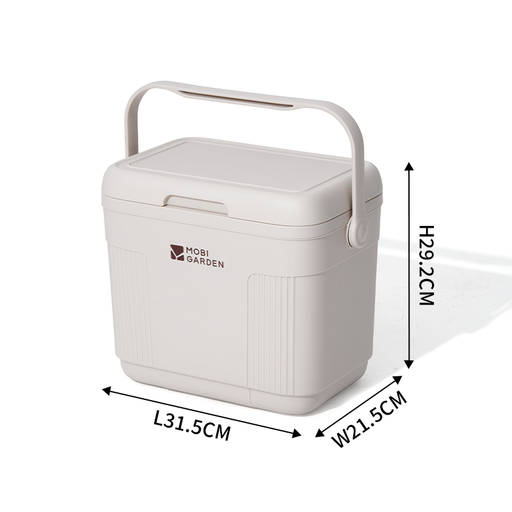
Why this profile is a good match: This passive cooler is suitable for picnics, day trips, fishing and short camping outings, without requiring a 12V connection or mains adapter.
Cooling performance depends transparently on ice packs, pre-chilling and exposure to sunlight. No active cooling performance is promised.
10-litre capacity, an empty weight of approximately 1.35 kg and PU insulation. According to the product specifications, cooling performance with ice packs lasts between 16 and 40 hours.

Why this profile is a good match: This model is designed for vanlife enthusiasts, families and travellers who need ample provisions and flexible power options.
The stated usable capacity is 45 litres. Two temperature zones allow separate use as a refrigerator and freezer compartment.
AC, vehicle, solar and USB-C charging options. According to the manufacturer, the device operates at less than 38.5 dB in ECO mode and supports app control.
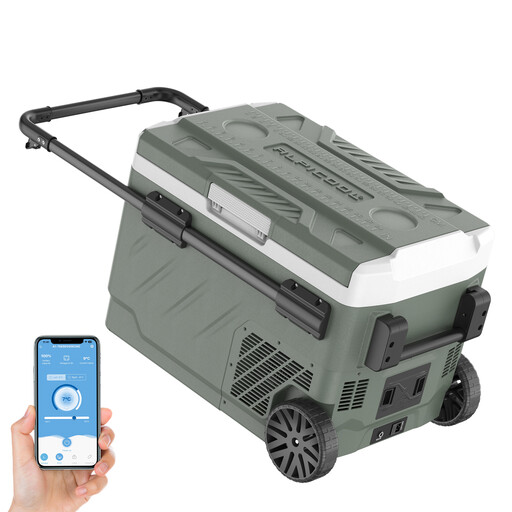
Why this profile is a good match: This compressor cooler is designed for motorhomes, longer car journeys, campsites and use with a power station or solar panel.
The device offers three battery-protection levels and operates with 12/24V DC as well as 100–240V AC. This allows you to choose the most suitable power source for each use case.
40-litre capacity, two temperature zones, interior LED lighting, wheels and a telescopic handle. According to the product specifications, the temperature range is between -20°C and 20°C.
Our selection includes additional beverage coolers for garden parties, day trips and mobile use. Before buying, always check the capacity, power supply and cooling technology.
That depends on the device, battery and battery-protection settings. A 12V connection is standard for several hours while driving. For overnight stays, you should plan for an auxiliary battery, power station or solar solution.
The duration depends on the insulation, cooling medium, contents, outside temperature and how frequently the cooler is opened. According to the product specifications, the Mobi Garden 10-litre cooler keeps contents cold for 16 to 40 hours with ice packs; the 22-litre model is rated for up to 36 to 48 hours. These figures are manufacturer specifications measured under certain conditions and are not a guarantee for every use case.
For day trips and keeping food warm, a 12V thermoelectric cooler may be sufficient. For multi-day camping, freezing and precise temperature control, a compressor cooler is generally the better choice. Power supply, weight, noise level and available storage space remain key considerations.