
Lieferung heute & morgen

Qualitätsgarantie

Willkommens-Angebote freischalten: KOSTENLOSE Lieferung | Bis zu 80 % RABATT | Kostenlose 30-Tage-JoyPlus-Testphase
App herunterladen
A portable carpet cleaner can target spilled drinks, pet stains and dirt on your sofa, carpet or car seat with precision. However, these devices differ significantly in suction power, tank size, reach and maintenance requirements. If you only focus on wattage or advertising claims, you might end up with a machine that needs constant refilling in daily use or leaves damp fabrics behind.
The motor power in watts describes the electrical consumption or rated power, not directly the suction power at the nozzle. For practical use, you also need to consider details such as vacuum pressure in kPa, spray volume, nozzle design and airflow. A carpet washer with 600 watts cannot simply be compared to a 500-watt model based on that figure alone.
Compact devices are easier to store. However, a small fresh water tank will need refilling more often when cleaning larger sofas, stairs or multiple car seats. It’s also important that the dirty water and fresh water tanks are separate. A dual-tank system prevents you from continuing to work with water that has already picked up dirt.
A steam cleaner for carpets works with heated water or steam. Delicate upholstery, certain synthetic fibres and non-colourfast fabrics can be damaged by this. Before use, you should check the care label on the fabric and carry out a colour and moisture test on an inconspicuous area. For many households, a classic spray-and-suction process offers more control.
A suitable stain cleaner sprays water or cleaning solution onto the surface, loosens dirt with a brush, and then sucks the liquid back up. This 3-in-1 principle of spraying, brushing and suction is ideal for targeted stains on carpets, sofas and car seats.
Manufacturer specifications for suction power are not always measured under identical conditions. Values between 12 and 17 kPa can serve as a guide, but should be considered alongside the nozzle and tank design. What really matters is that you move the nozzle slowly over the area and that as little residual moisture as possible is left behind.
For occasional stains, smaller containers are sufficient. For families, pet owners, or regular use as an upholstery washer, larger tanks are more practical. As a rough guide:
After each use, you should empty, rinse and fully dry the dirty water tank, hose and brush head. A self-cleaning function for the hose can reduce maintenance effort, but it doesn’t replace cleaning the tanks and nozzles.
Before you start:

Why this product fits the profile: This cordless handheld device is designed for individual stains on carpets, sofas, upholstery and car seats. The 600-watt rating and 17 kPa suction power provide clear technical comparison points.
The separate fresh and dirty water system prevents reusing the same water. The instructions also specify a maximum water temperature of 40 °C.
600-watt motor, 17 kPa suction power, dual tank and flexible hose for targeted wet cleaning.
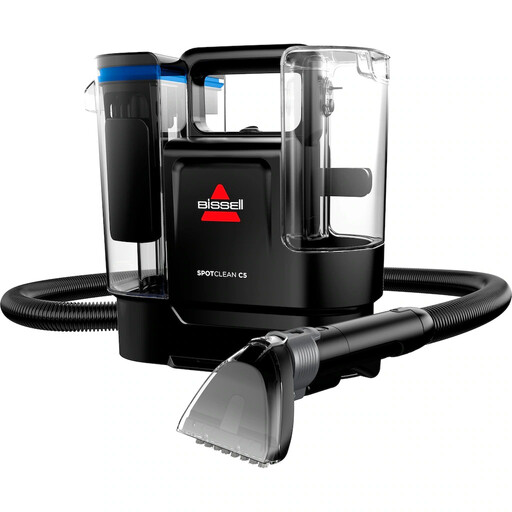
Why this product fits the profile: This compact model is intended for carpets, upholstery, stairs and vehicle interiors, combining a 1.7-metre hose with a 4.3-metre power cord.
The HydroRinse nozzle helps with hose maintenance. The separate tanks hold 0.9 litres of fresh water and 0.8 litres of dirty water.
Over 15 kPa stated suction power, spray-brush-suction system, self-cleaning tool and 4 kg device weight.

Why this product fits the profile: This cordless model is ideal for users who frequently clean car seats, tackle stairs, or want to work inside a vehicle without a power cable.
The stated run time of up to 55 minutes makes the battery limitation transparent. For longer sessions, you should check the charge level before starting.
24-volt battery, 15 kPa suction power, 1.6-litre fresh water tank, 0.8-litre dirty water tank and hose cleaning attachment.
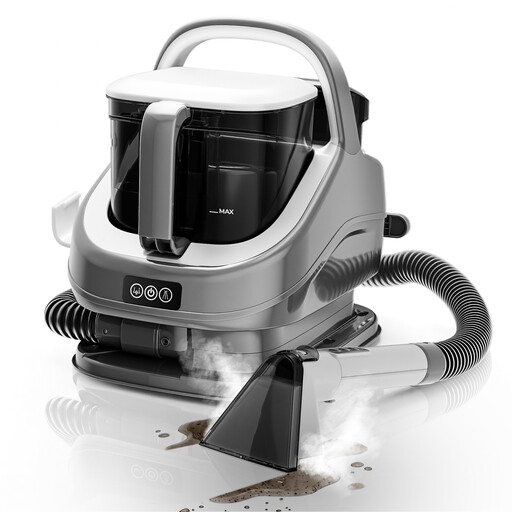
Why this product fits the profile: The choice between cold water, hot water and steam is designed for users with different water-safe fabrics and varying cleaning tasks.
The three modes require careful checking of material compatibility. The instructions explicitly state not to use the device on non-waterproof fabrics.
1300 watts, 13 kPa suction power, 1.4-litre fresh water tank and 1.2-litre dirty water tank.
We’ve put together a complete, regularly updated list of products that fully meet these strict selection criteria and the safety regulations in force in the EU.
The running costs mainly depend on electricity, water, cleaning solution and, where applicable, battery charging. With corded devices, there’s no battery replacement to worry about, while cordless models offer more flexibility. You should only use cleaning solution in the amount recommended by the manufacturer. Too much foam can impair the suction.
For an even result, first spray the stained area, work it in briefly, and then slowly suction it up. Several short passes with little liquid are often more effective on many fabrics than one heavily soaked pass.
That depends on the material, the amount of liquid, room temperature and air circulation. Thorough suctioning, airing the room and a dry environment can help reduce residual moisture. You should only use the area intensively again once it is completely dry.
Yes, provided the seat cover is suitable for wet cleaning. Beforehand, you should test on a hidden area to see if the colour or material changes. Electrical seat components, switches and seat belts must not become soaked.
It’s not possible to give a reliable fixed lifespan. It depends on frequency of use, filter maintenance, emptying and correct storage. If you rinse the tanks and nozzles after each use, check the hoses for blockages and store the device dry, you’ll reduce typical maintenance issues.