
Lieferung heute & morgen

Qualitätsgarantie

Willkommens-Angebote freischalten: KOSTENLOSE Lieferung | Bis zu 80 % RABATT | Kostenlose 30-Tage-JoyPlus-Testphase
App herunterladen
A portable cordless tyre inflator for cars can come in handy on your commute, on holiday or when you’re camping. At first glance, many models seem similar: 150 PSI, a digital display, an LED light and several adapters are common features in product advertising. But other questions matter more when choosing one: how quickly can it actually inflate a tyre? Can you rely on the pressure reading? Will the battery last for several tyres? And could the device overheat after a short period of use?
A 150 PSI air compressor can theoretically reach a high maximum pressure. However, the recommended pressure for standard car tyres is usually much lower. Airflow, inflation time at a realistic tyre pressure and the permitted operating time are therefore more important.
A mini compressor for bicycles and motorbikes may be sufficient for occasional top-ups, but it could take longer to inflate several car tyres. What’s more, manufacturers’ specifications don’t always refer to the same tyre size or starting pressure.
The mAh rating is only useful for comparison up to a point, as voltage, motor power and efficiency also play a part. A cordless tyre inflator should be fully charged before your first journey. If it’s going to be stored for a long time, regular recharging in line with the relevant instruction manual is recommended.
If you use it frequently, a model with an additional 12-volt cable may be a good choice. You can keep using it via the vehicle’s power socket when the battery is flat, provided the cable, fuse and connection are suitable.
A car compressor with an LED light can make it easier to see the valve in the dark. SOS or flashing modes provide additional ways to signal for help, but they’re no substitute for a high-visibility vest, warning triangle or a safe position away from moving traffic.
A jump starter with a compressor is no substitute for a suitable vehicle battery or professional breakdown assistance either. Before you buy, check the vehicle voltage and engine type, as well as the engine sizes specified by the manufacturer.
Maximum pressure is usually given in PSI, bar or kPa. 150 PSI is approximately 10.3 bar. This figure describes the device’s upper limit; it doesn’t automatically indicate the right tyre pressure for your vehicle.
Also check:
You’ll find the correct tyre pressure in your vehicle’s handbook, on the door pillar or inside the fuel filler flap. For the most reliable reading, check your tyres when they’re cold. An integrated digital tyre pressure gauge is handy, but shouldn’t be treated as equivalent to a calibrated workshop gauge.
A tyre inflator with automatic shut-off stops pumping once it reaches the target pressure you’ve set. This reduces the risk of accidentally continuing to inflate the tyre. You should still check the pressure after inflating, especially if there are any safety-critical discrepancies or the display is unclear.
It’s useful to have a choice of units, such as PSI, bar and kPa, as well as preset programmes for cars, motorbikes, bicycles and balls. Manual adjustment is handy if the pressure recommended by your vehicle manufacturer doesn’t match a preset.
A cordless compressor gives you flexibility, but needs to be charged regularly. So check for:
Below, you’ll find a selection of models for different needs.

Why this product suits this type of buyer: According to the product details, this compact cordless compressor weighs around 530 g. It’s suitable for occasional top-ups of car, motorbike and bicycle tyres, as well as balls.
According to the manufacturer, the digital display shows the current pressure and supports PSI, bar and kPa. The LED light has an illumination mode and an SOS mode.
7.2-volt battery with 2,500 mAh capacity, up to 150 PSI and compact dimensions of around 8.68 × 5.24 × 14 cm, according to the product description.

Why this product suits this type of buyer: Designed for commuters and travellers who prefer a lightweight device with digital pressure control, this model has a compact design and several inflation modes.
The product description lists five modes and pressure accuracy of ±0.05 bar. The automatic shut-off is designed to stop at the target pressure you’ve set.
2,500 mAh battery at 7.4 volts, weight of around 459 g and three air nozzles included, according to the manufacturer.
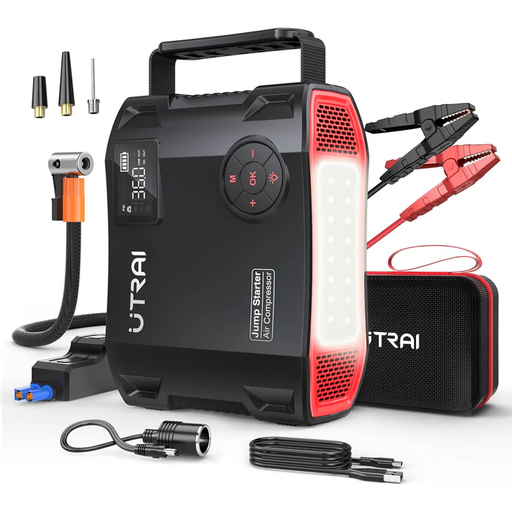
Why this product suits this type of buyer: Frequent drivers, campers and anyone who wants extra emergency cover get a combination cordless compressor, jump starter, power bank and LED light.
According to the product details, the device has automatic shut-off, preset pressure settings and several safety features. Cooling breaks are still recommended when using the compressor.
6,000 A peak current, 27,000 mAh battery capacity, 150 PSI and a stated airflow of 45 L/min. These figures are taken from the product description.
We’ve put together a complete, regularly updated list of products that fully meet these strict selection criteria and the safety regulations in force in the EU.
If a tyre is damaged, a valve is leaking or the pressure is dropping unusually quickly, have the cause checked by a professional. The compressor is for topping up tyres, not repairing tyre damage.
The correct pressure depends on the vehicle, its load and the tyre size. Follow the information on the vehicle or in its handbook, not the compressor’s maximum PSI rating.
It depends on the battery capacity, tyre size, starting pressure, target pressure and ambient temperature. Cooling breaks may be needed when inflating several tyres. Regular recharging helps keep the device ready for use.
The electricity used for individual inflation jobs is usually modest. With battery-powered models, the main consideration is the charging cycle. If you use it frequently, you should also take battery ageing, charging time and a possible 12-volt alternative into account.