
Lieferung heute & morgen

Qualitätsgarantie

Willkommens-Angebote freischalten: KOSTENLOSE Lieferung | Bis zu 80 % RABATT | Kostenlose 30-Tage-JoyPlus-Testphase
App herunterladen
A portable DAB radio with Bluetooth should let you listen to the radio while out and about, play music from your smartphone and ideally double up as an alarm clock. In practice, however, devices vary considerably when it comes to power supply, ease of use and reception. If you focus solely on design or the number of features, it is easy to overlook important details.
This buying guide from the Joybuy Product Recommendation Officer explains the key features and shows which type of device is best suited to each usage profile.
A quoted battery life does not necessarily apply to every operating mode. Bluetooth streaming, high volume and a bright colour display can increase energy consumption. You should also check whether the device has a built-in battery, replaceable AA batteries or mains-only operation.
A battery-powered radio is practical for regular use in the garden or while out and about. With a model that uses AA batteries, you can extend its power supply by carrying spare batteries. It is also important to check whether a mains adapter is included.
A DAB+ radio receives digital terrestrial stations via its aerial. No Wi-Fi connection is required. Internet radio, on the other hand, uses your home network and can provide stations from many countries as well as podcasts. Outside a Wi-Fi or hotspot range, however, this function is limited.
If you frequently use the device in the kitchen, bedroom or garden, you should therefore distinguish between DAB+, FM radio and internet radio. A combined device offers more choice, but may also require a more involved set-up.
Many devices advertise Bluetooth, presets, an alarm clock, sleep timer and streaming services. What matters is how quickly you can save stations and switch between sources. A clear display, automatic station scanning and clearly labelled controls are often more important in everyday use than additional sound modes.
Check which reception types are supported:
The number of presets is particularly relevant if several people use the device. Depending on the version, the DAB+ models featured here can store 40 or 60 stations. According to the product specifications, the IR4S has 40 presets for internet stations and 20 for FM stations.
A portable radio should not only have compact dimensions, but should also work independently of a power socket. The LEMEGA DAB Go has an integrated 2,200-mAh battery and is specified as offering up to 15 hours of battery life. The retro Class Classic model uses four AA batteries and claims up to 20 hours of battery life. Batteries are not included.
For permanent use in one place, a mains adapter is useful. When carrying the radio around, weight, the charging connection and the ability to position the device securely are more important. None of the models mentioned is waterproof. It must therefore be protected from moisture in the bathroom or outdoors.
A radio with an alarm function should offer at least two alarms, a snooze function and a sleep timer. Separate settings for weekdays and weekends are useful. A 3.5-mm headphone socket allows you to listen privately, while Bluetooth makes wireless playback easier.
You should also check whether the charging connection is compatible with your existing accessories. The DAB Go models are powered via USB-C. The Class Classic comes with a mains adapter and can also be charged via USB-C.
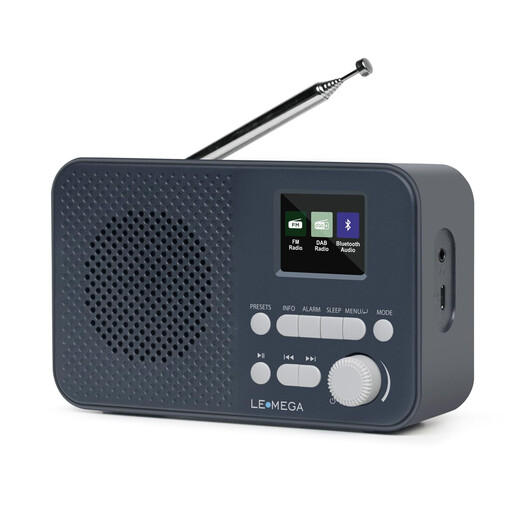
Why this product suits the profile: Weighing 375 g, this compact model offers DAB+, FM and Bluetooth. Its integrated battery means it can be used flexibly in the kitchen, bedroom or garden.
The stated battery life of up to 15 hours and the mains adapter make the power supply clear. DAB+ and FM provide additional listening options, so you are not limited to Bluetooth.
40 presets, 1.77-inch colour display, USB-C, headphone socket and two alarms with snooze function.
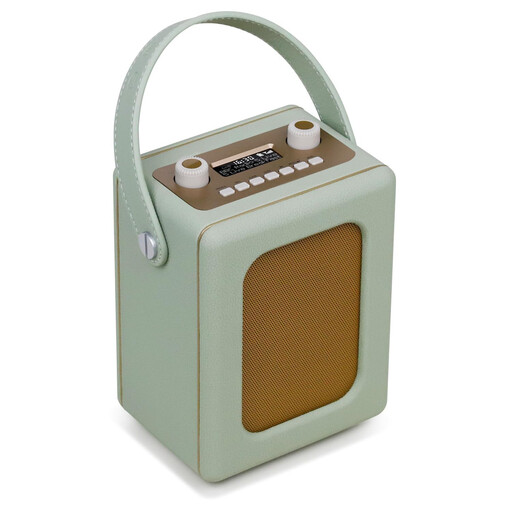
Why this product suits the profile: This retro radio combines a classic casing with a large LED display, DAB/DAB+, FM, Bluetooth and mains or battery operation.
The power supply is clearly defined: up to 20 hours with four AA batteries or operation from the mains. However, the device is not water-resistant and, at 960 g, is heavier than a very compact model.
60 presets, 5-watt speaker, two alarms, sleep timer, Bluetooth, plus music and speech modes.
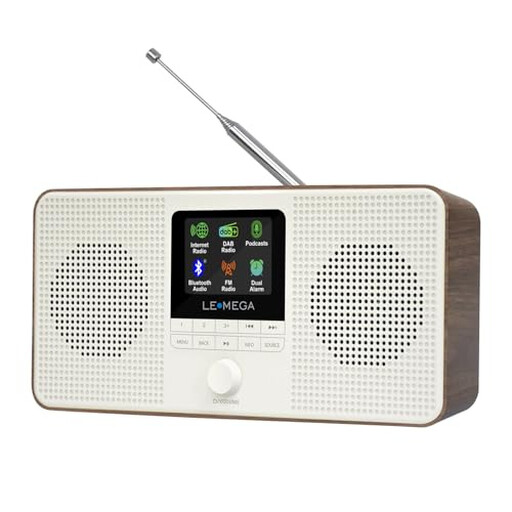
Why this product suits the profile: For households with many listening sources, this device offers internet radio, podcasts, FM, Wi-Fi, Bluetooth and Spotify Connect. It can be powered from the mains or with four AA batteries.
Reception options are versatile, but Wi-Fi is required for internet stations and Spotify Connect. If you want to listen independently of a network, you should choose a DAB+-only model.
Over 30,000 listed internet stations, podcasts, Spotify Connect, stereo speakers, 40 internet and 20 FM presets, plus two alarms.
We have put together a complete, regularly updated list of products that fully meet these strict selection criteria and the safety regulations applicable in the EU.
When starting the radio for the first time, you should run an automatic station scan. For DAB+, the aerial is all that is needed; with the IR4S, you must also select the language and connect to Wi-Fi. Bluetooth is activated by selecting the radio in your smartphone’s menu and pairing it.
Running costs depend on the power source. AA batteries result in recurring expenses if the radio is frequently used on the move. An integrated battery, on the other hand, requires regular charging and should neither be opened nor exposed to excessive heat. When operating from the mains, electricity is consumed through the power adapter; the exact cost depends on how long the radio is used and your local electricity tariff.
Yes, DAB+ and FM generally work without Wi-Fi, provided there is a strong enough signal at your location. Wi-Fi is required for internet radio, podcasts or Spotify Connect. Bluetooth also does not require Wi-Fi, but it does require a paired smartphone or another source device.
This depends on the model, volume, display and reception type. The LEMEGA DAB Go is specified as offering up to 15 hours, while the Class Classic offers up to 20 hours with four AA batteries. These figures are manufacturers’ claims and may vary in everyday use.
Yes, provided it has separate alarms, a snooze function, a sleep timer and an easy-to-read display. A headphone socket may also be useful in the bedroom. Before buying, check whether the alarm can use DAB, FM or a buzzer as the alarm sound.