
Lieferung heute & morgen

Qualitätsgarantie

Willkommens-Angebote freischalten: KOSTENLOSE Lieferung | Bis zu 80 % RABATT | Kostenlose 30-Tage-JoyPlus-Testphase
App herunterladen
A portable electric air pump can be a lifesaver in the boot, on the campsite or during a bike ride. However, not every compact battery-powered air pump delivers the right results. Many products put high PSI figures or particularly fast inflation times front and centre, while important details about battery life, connections and intended use are less visible.
Before you buy, there are three typical pitfalls to watch out for:
For car tyres, motorbike tyres and bicycle tyres, an adjustable target pressure is useful. A digital display makes control easier because you can enter the desired value directly. The specification 150 PSI describes the maximum intended pressure and should not be taken as the general operating pressure. What matters is always the value recommended by the vehicle, tyre or product manufacturer.
Alongside pressure, the airflow in litres per minute also counts. A higher airflow can help when filling larger volumes. Tyres need relatively high pressure, whereas an air mattress, an inflatable pool or an inflatable bath usually benefits from a suitable volume flow and appropriate nozzles. A compact tyre pump is therefore not automatically a fully-fledged air pump for air mattresses.
A mobile pump should suit your typical use. Look out for:
The actual run time depends on tyre pressure, ambient temperature and the size of the item being inflated. For longer trips, a 12-volt connection or an additional mains connection can be useful. A portable compressor with a built-in battery, on the other hand, is more flexible when no socket is available.
Check whether the contents match your products. For an air pump for car, bike and motorbike, a suitable tyre connector, a flexible air hose and an easy-to-read display are relevant. For balls, you will normally need a ball needle. Inflatable leisure products often require conical nozzles with a larger diameter.
Pre-set modes for car, motorbike, bike and ball are practical. However, they do not replace checking the correct target pressure. For air mattresses, pools and baths, the instruction manual for the respective product should take priority. Too much pressure can damage seams, valves or the material.
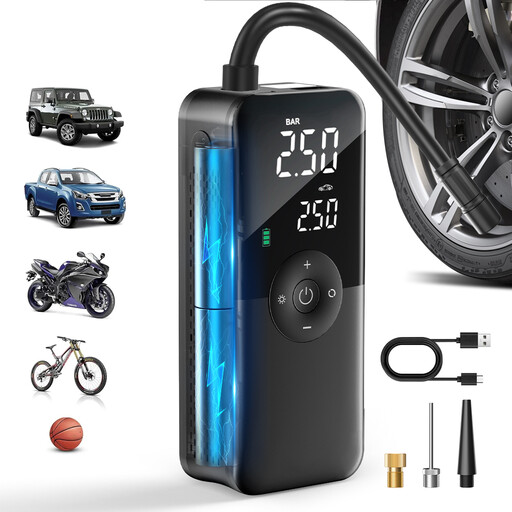
Why this product fits the profile: The cordless format is designed for occasional checks on the car, bike or motorbike. The digital operation makes pressure control easier without a permanently installed compressor.
Its design for car, bike and motorbike prevents it being used too narrowly on just one tyre type. Before buying, you should check the battery data and included connectors.
Cordless handling and, according to the product details, a fast-charge function. Suitable for users looking for a mobile compressor for top-up jobs.
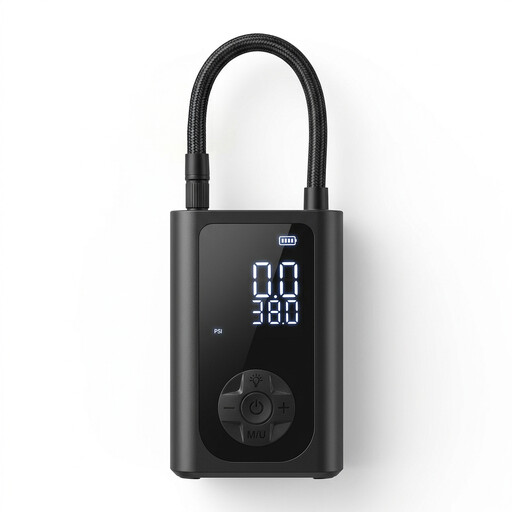
Why this product fits the profile: This model combines defined technical specifications with five pre-set modes. That makes it suitable for drivers and cyclists who want to set pressure values precisely.
The specifications separate maximum pressure, airflow and battery run time. According to the product description, the device reaches up to 150 PSI, 26 l/min and around 25 minutes of use.
4000 mAh battery, USB-C input, power bank output and LED light with constant and SOS modes. For flat car tyres, the supplier states around 7 to 8 minutes per tyre.
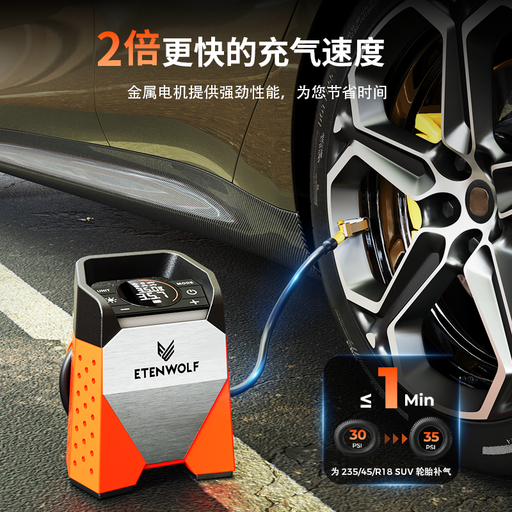
Why this product fits the profile: This model is aimed at users who regularly inflate tyres on cars, SUVs, bikes or balls and value a higher stated airflow rate.
The product data lists not only the maximum pressure of 160 PSI, but also an airflow of 1.25 CFM and a battery. That makes it easier to assess compared to purely promotional claims.
According to the product description, an air hose, Presta adapter, ball needle and conical nozzle are included. That extends the range of uses beyond car tyres.
A battery-powered air pump for tyres works with high pressure and a relatively small air volume. For a large inflatable air mattress, an inflatable pool or an inflatable bath, a device with suitable low-pressure or volume nozzles is therefore often more practical. Also check whether the leisure product expressly allows an electric pump and whether a 220–240 V mains supply is required.
For example, the INTEX Dura-Beam Deluxe Ultra Plush Airbed Twin has a built-in electric pump designed for 220–240 V. A mobile tyre pump is not automatically the right solution here. You can find this model on the product page for the INTEX Dura-Beam Deluxe Ultra Plush Airbed Twin.
We have put together a complete, regularly updated list of products that fully meet these strict selection criteria and the safety regulations in force in the EU.
That depends on capacity, tyre pressure, temperature and type of use. For the Porbi Q19, the product description states 4000 mAh and around 25 minutes of use. For several completely flat tyres, you should plan for the charge level and take breaks.
Only if the airflow, nozzle and pressure range are suitable for it. A pure tyre pump can be slow with large volumes or may not connect properly to the valve. So check the nozzle range and the air mattress instructions. Avoid using too high a pressure.
Battery-powered models mainly use electricity when charging. Consumption depends on battery capacity, charging time and frequency of use. A USB-C device can be charged via a mains adapter, a power bank or – with the right equipment – in the vehicle. For frequent use, a model with a longer run time or an additional vehicle connection can be worthwhile.