
Lieferung heute & morgen

Qualitätsgarantie

Willkommens-Angebote freischalten: KOSTENLOSE Lieferung | Bis zu 80 % RABATT | Kostenlose 30-Tage-JoyPlus-Testphase
App herunterladen
A portable electric air pump can be a handy companion in the car, on your bike, when camping or during sports. However, not every compact device automatically makes for the right purchase decision. What really matters is whether the pump is compatible with your valve type, the pressure you need and the size of your tyre.
Specifications like 150 PSI air pump or 160 PSI may sound impressive at first. But the maximum pressure alone doesn't tell you much about the actual inflation time. A device might reach a high final pressure, yet still take several minutes to inflate a large car tyre. So when choosing, you should also consider airflow rate, battery capacity and operating limits.
Many mini compressors are designed for quick top-ups. Fully inflating a flat car tyre puts much more strain on the motor, battery and casing. Pay attention to details about maximum operating time, cooling breaks and any specific limitations for SUVs, vans, trailers or lorries.
An electric bike pump needs to work with your existing valve. For bicycles, Presta and Schrader valves are the most common. Balls usually require a needle, while air mattresses or boats need a suitable cone adapter. Without the right accessories, even a pump with impressive motor specs can be impractical.
The recommended tyre pressure for cars is usually found on the door frame, inside the fuel flap or in the owner's manual. In the UK it's commonly given in bar or PSI, while many devices also show kPa or kg/cm². A digital air pump with pressure display makes it easier to keep track, provided the display is easy to read.
Automatic shut-off is also important. You set a target value, and the battery-powered air pump stops once that value is reached, according to the manufacturer. This reduces the risk of over-inflating your tyre. The pressure recommended by your vehicle manufacturer remains the key reference.
A cordless compressor offers flexibility, but it does need regular charging. A higher capacity, say 4,000 or 5,000 mAh, can allow for longer use. However, the actual runtime depends on the tyre pressure, tyre size and ambient temperature.
For everyday use, a USB-C charging port, battery level indicator and possibly a power bank function are useful. If you're looking for an air pump for car, bike and motorbike, also check whether a 12-volt connection is available or if it's battery-only.
A higher airflow rate can speed up top-ups, but it doesn't automatically mean a short inflation time for every tyre type. Compact devices fit in a glovebox or bike bag, but often have smaller cylinders and take longer with flat car tyres.
Check before you buy:
The following models differ in their intended use, features and performance data. The details correspond to the respective product descriptions.
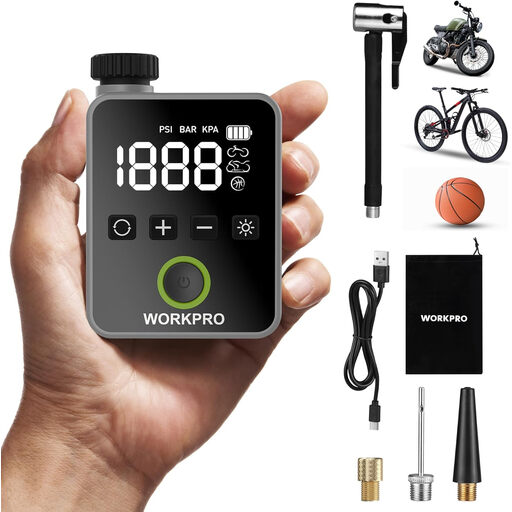
Why this product fits the profile: This compact device is designed for bike, motorbike and ball tyres, and at just 270 g it's easy to carry around.
The four modes, pressure selection from 3 to 140 PSI and automatic shut-off make the device settings clearer than a simple maximum pressure rating.
LED display, three pressure units, four nozzles and integrated lighting modes; according to the product description, not intended for lorries or trailers.
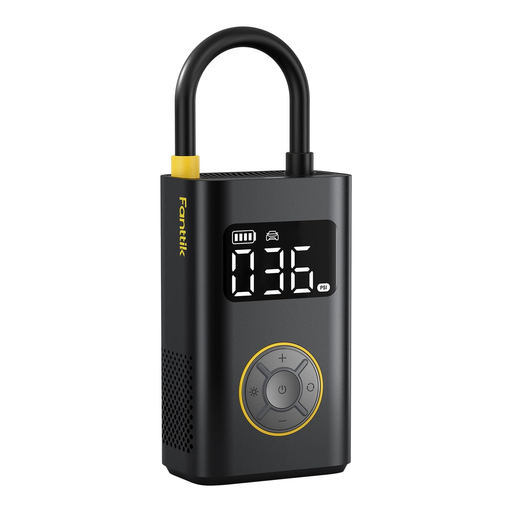
Why this product fits the profile: This battery-powered air pump is aimed at users who want to cover car, motorbike, bike and ball tyres with a single device.
The integrated hose storage reduces loose accessories. The pre-settable pressure and automatic shut-off address the common issue of incorrect operation when inflating.
According to the product description, up to 150 PSI, four automatic modes plus manual mode, and a stated operating time of up to 23 minutes.
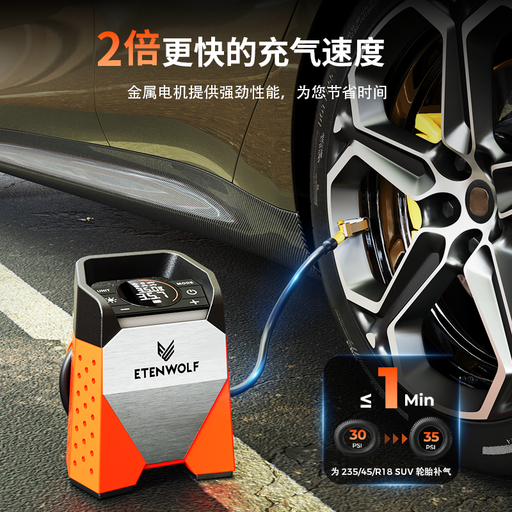
Why this product fits the profile: Its focus on cars, SUVs, bikes and balls makes it suitable for users with a variety of inflation tasks.
The product description lists specific accessories such as a car valve, Presta adapter, ball needle and cone nozzle. This makes it easier to assess what's included before you buy.
Rated at 160 PSI, with a battery, 12-volt operation and a maximum power of 132 watts; weight is 1.47 kg according to the product data.
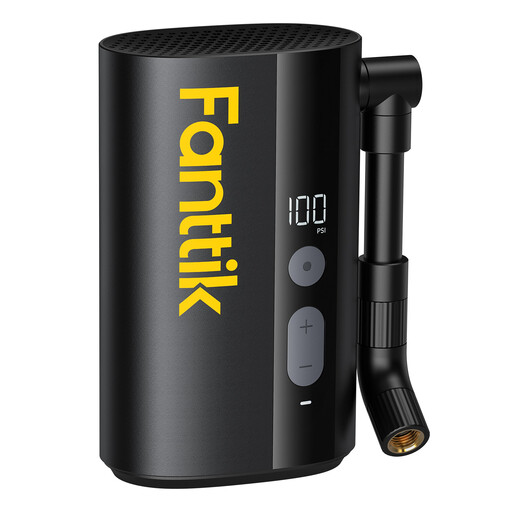
Why this product fits the profile: According to the product description, this model is designed exclusively for bicycles, making it ideal for road bike, mountain bike and e-bike riders.
The clear limitation to bicycles prevents false expectations about using it on car or motorbike tyres. Presta and Schrader valves are integrated.
Rated at 150 PSI, 10 l/min airflow, a 5,000 mAh battery and automatic shut-off when the target value is reached.
We've put together a full, regularly updated list of products that fully meet these strict selection criteria and the safety regulations in force in the EU.
The lifespan depends on the battery chemistry, charge cycles, temperature and how often you use it. Without standardised operating conditions, it's not possible to give an accurate time. Regular charging, dry storage and avoiding unnecessary continuous running can help extend its life.
That depends on the specific model. Some devices are designed for car tyres, while others are for bicycles only. Look for the explicitly stated vehicle class, airflow rate and operating time. For large tyres, trailers or commercial vehicles, a more powerful compressor may be needed.
With battery operation, the main cost is the electricity for charging. This is usually low per session, but depends on the battery capacity, charging losses and your electricity tariff. If you use it frequently, the battery lifespan is a more important cost factor than the individual charge.