
Lieferung heute & morgen

Qualitätsgarantie

Willkommens-Angebote freischalten: KOSTENLOSE Lieferung | Bis zu 80 % RABATT | Kostenlose 30-Tage-JoyPlus-Testphase
App herunterladen
A portable electric cooler can be considerably more practical on the go than a conventional cooler with ice packs. However, it requires a suitable power supply, sufficient ventilation and cooling technology that matches the intended use. The requirements for a short car journey differ from those for multi-day camping, motorhome conversions or use on a boat.
Thermoelectric models are often suitable for cooling and keeping items warm. However, their actual performance depends more heavily on the ambient temperature than that of a compressor cooler. A stated target temperature of around 4 °C should therefore not be confused with a consistently regulated refrigerator temperature.
Anyone looking to freeze food or transport frozen goods should specifically look for a cooler with a freezer function and a temperature range reaching approximately −18 or −20 °C. Compressor models are generally the more suitable design for this purpose.
A 12V electric cooler is designed for use with a car’s cigarette lighter socket. Trucks, caravans and motorhomes may also feature a 24-volt connection. For use at home, however, a 230-volt mains adapter is required.
This adapter is not included with every model. Before buying, check the following:
A multi-stage battery protection system can help prevent the vehicle’s starter battery from being excessively discharged. However, it does not replace sufficient battery capacity or regular monitoring.
Manufacturers sometimes distinguish between gross and net capacity. The compressor, inner walls, lid and dividers also take up space. As a result, a cooler with a gross capacity of 50 litres may offer considerably less usable storage space.
Capacity in litres is not the only factor to consider. Interior dimensions are also important if you need to fit 2-litre bottles, beverage cans, lunch boxes or long food items.
A thermoelectric cooler generally operates using a fan and a semiconductor module. Its design is comparatively simple, it is often lighter and, depending on the model, may also keep items warm. For drinks, snacks and day trips, this type of cooler can be perfectly adequate.
A compressor cooler works in much the same way as a compact refrigerator. Depending on the model, it can actively cool and freeze without relying on ice packs. The trade-offs are typically greater weight, a higher purchase price and more demanding requirements for stable, well-ventilated placement.
A moderate cooling range is sufficient for chilling drinks. Anyone transporting meat, fish, ice cream or frozen products should look for a clearly specified temperature range reaching at least −18 °C. A range from −20 °C to 20 °C, for example, is available on several portable compressor models.
Two-compartment units can be particularly practical when separate temperature zones are useful. Check, however, whether both zones can be controlled independently and how the usable capacity is divided between them.
Operating noise is an important consideration when spending the night in a camper or motorhome. Manufacturer specifications such as 38.5 dB, 40 dB or 45 dB are measured under specific conditions and may vary depending on the surroundings, operating mode and placement.
The ventilation openings must not be covered. Leaving space around the unit and keeping it away from walls, luggage and direct sunlight helps dissipate heat. During extended use, ECO modes, a moderate temperature differential and opening the lid as infrequently as possible can reduce energy consumption.
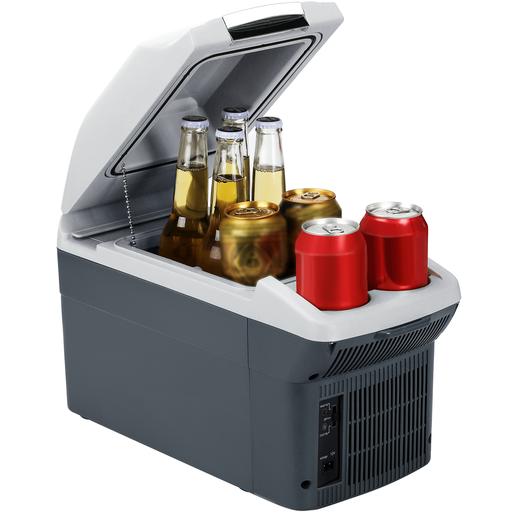
Why does it suit this profile? For car journeys, picnics, fishing trips and day outings, this compact unit offers a straightforward solution with a 12V connection.
The cooling and warming functions, along with the approximate noise level of 40 dB, are clearly specified. Home use requires an optional 220–240V adapter.
9-litre capacity, shoulder strap, two beverage holders and a seat-belt opening. This model is designed for cooling, not active deep-freezing.
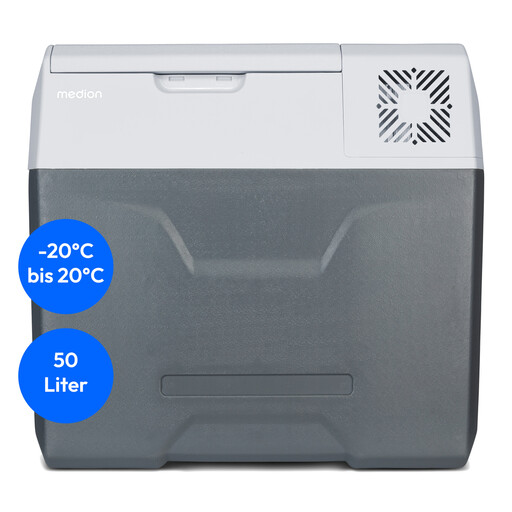
Why does it suit this profile? Combining 47 litres of usable capacity with compressor technology, this model is designed for longer trips, caravan stays and larger groups.
Gross and usable capacities are listed separately. The temperature range of −20 °C to 20 °C clearly indicates that the unit can function as both a refrigerator and freezer.
It supports 230V, 12V and 24V power supplies. A USB connection adds further versatility; the product specifications state a weight of 13.5 kg.

Why does it suit this profile? For extended road trips, boat tours, van life and off-grid camping, this unit offers multiple power options and two temperature zones.
The specifications state 45 litres of usable capacity, a temperature range reaching −20 °C and a noise level below 38.5 dB. The optional 298-Wh additional battery is not included as standard.
AC, vehicle, solar and USB-C charging are supported. App connectivity and two zones enable flexible use as a refrigerator-freezer combination.
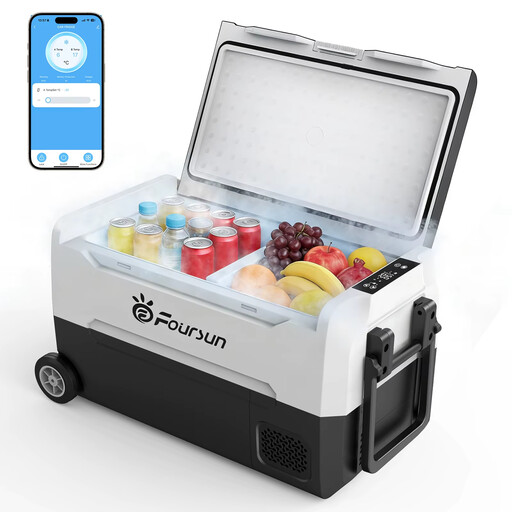
Why does it suit this profile? For camping, travel and regular use in a car or motorhome, control via the Tuya Smart app is a convenient addition.
The temperature range of −20 °C to 20 °C, ECO mode and connections for 12V/24V and 100–240V are clearly specified. The app does not replace monitoring the power supply.
35-, 45- and 55-litre versions are listed. Wheels, cup holders and a stated power consumption of 45 W support convenient mobile use.
Our selection includes more electric beverage coolers for cars, camping, motorhomes and home use. Before buying, check the temperature range, connections, usable capacity and included accessories for each model.
Yes, particularly when the vehicle is parked for extended periods with the engine switched off. An integrated battery protection system can help shut the cooler down when the voltage drops too low. For overnight use, a separate leisure battery, power station or solar solution is often more suitable than the starter battery.
Service life depends on factors including the cooling technology, operating hours, transport conditions, ventilation and maintenance. Compressor units should be protected from severe impacts and should not be operated at a permanent angle. Worn cables, damaged seals or obstructed ventilation openings can impair performance.
Running costs depend on power consumption, electricity prices, ambient temperature, the selected temperature and the operating mode. A specification such as 45 or 60 W does not automatically indicate continuous consumption, as compressors operate in cycles. For a realistic estimate, compare manufacturer figures in Wh per 24 hours or measurements taken under the intended operating conditions.