
Lieferung heute & morgen

Qualitätsgarantie

Willkommens-Angebote freischalten: KOSTENLOSE Lieferung | Bis zu 80 % RABATT | Kostenlose 30-Tage-JoyPlus-Testphase
App herunterladen
For many, a good day only starts with a freshly brewed espresso. But what do you do when you're on the move—traveling, camping, or at the office? A portable espresso maker promises a solution. However, the market is flooded with devices whose marketing promises often fall short in practice. Before you make a decision, it's crucial to understand the common pitfalls that lead to disappointment and unnecessary expense.
As your Joybuy Product Recommendation Officer, I'm here to help you cut through the noise. We'll focus on the facts and the technical features that truly matter.
The 3 Most Common Flaws in Portable Coffee Makers:
To avoid a bad purchase, you should focus your attention on three core parameters. These are the primary determinants of your device's functionality, durability, and convenience.
The choice of power source is fundamental. A manual espresso maker operates without electricity, powered by hand-pumping motions. Its advantage lies in reliability—there are no electronics to fail and no battery to run out. However, it requires some muscle and practice to generate consistent pressure.
In contrast, a battery-powered coffee maker offers maximum convenience. The brewing process starts at the touch of a button. This is especially practical as an in-car coffee maker or in the office. Here, the battery capacity, measured in milliampere-hours (mAh), is the crucial metric. It determines how many cups of coffee you can prepare before the device needs to be recharged.
This is perhaps the most critical point for anyone who wants to be truly independent. A genuine travel coffee maker for outdoor use should have an integrated heating function. Such models can heat cold water on their own to the ideal espresso temperature of about 90–95°C (194–203°F). Devices without this feature rely on an external hot water source and are better suited for use in a hotel room or office where a kettle is available.
The flexibility in your choice of coffee is another key aspect for your espresso on the go.
Instead of making a one-size-fits-all recommendation, we have identified products tailored to specific use cases.
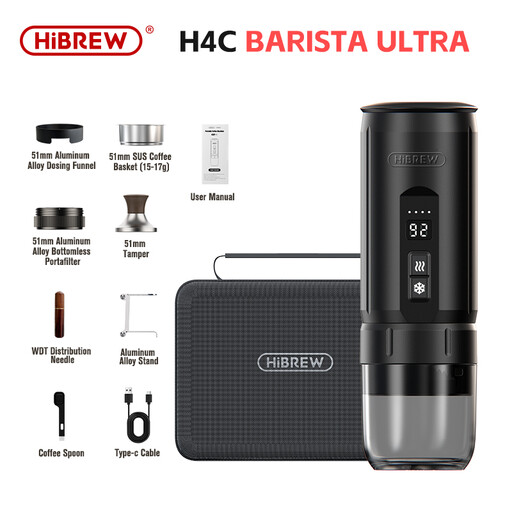
Why This Fits Their Persona: Ideal for campers and hikers who need to go for days without access to electricity or boiling water. The combination of an integrated heater, a large battery, and a robust build makes it a reliable companion in the great outdoors.
Solves the "hot water trap" with its integrated heating function. The stainless steel water tank also prevents the dreaded plastic taste.
Large 7500mAh battery with a swappable design for extended use. 20-bar pump pressure for a rich crema.
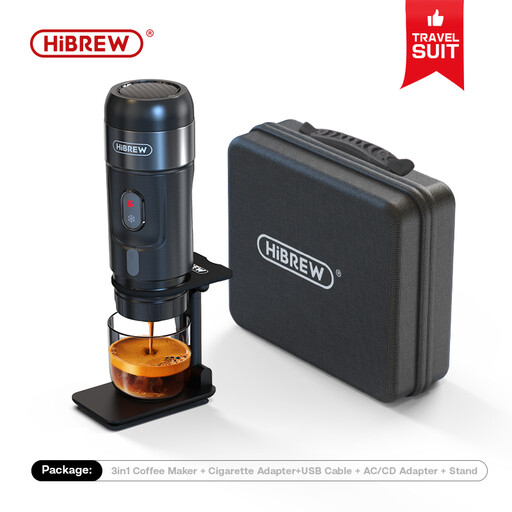
Why This Fits Their Persona: Perfect for commuters, field sales representatives, or truck drivers who want to brew a fresh espresso right in their vehicle. The focus is on simple operation and compatibility with common capsules.
This device is explicitly designed for in-car use with a DC 12V adapter. It heats the water directly in the vehicle, bypassing the need for an external hot water source.
Compatible with NS and DG capsules as well as ground coffee (via adapter). Simple one-button operation for extraction.
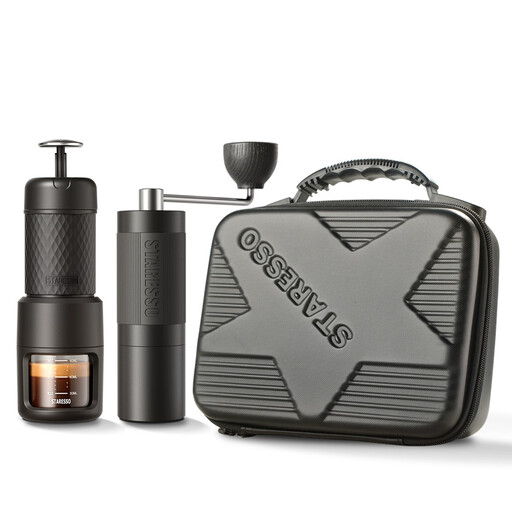
Why This Fits Their Persona: For users who make no compromises on taste and want full control over the brewing process. Manually grinding the beans right before preparation ensures maximum freshness and aroma.
As a purely manual machine, it bypasses the problem of inconsistent pressure with a robust, controllable pump mechanism. The grinder and the machine are made of stainless steel, which eliminates material defects.
Integrated stainless steel conical burr grinder with 12 grind settings. Complete independence from power sources.
We've compiled a complete, up-to-date list of products that fully meet these strict selection criteria and safety regulations.
Battery life depends heavily on capacity (mAh) and usage. The most energy-intensive function is heating cold water. A model like the HiBREW H4C with a 7500mAh battery can, according to the manufacturer, heat water for about 3–5 cups (depending on the volume). If you use pre-heated water and the battery is only used for the pumping process, you can get over 200 extractions on a single charge.
No, and this is a crucial difference between models. Devices with an integrated heating function can heat cold water themselves, making them completely self-sufficient. Others, typically simpler and more budget-friendly manual models, require an external hot water source. Pay close attention to features like "cordless heating" or a power rating in watts in the product description.
For a true espresso, a brewing pressure of around 9 bars at the coffee puck is considered ideal in professional cafés. Many portable devices advertise a pump pressure of 15 to 20 bars. This higher value acts as a buffer to ensure that even in mobile conditions and with slight variations in grind size or tamping, sufficient pressure is achieved for a good extraction and a stable crema.