
Lieferung heute & morgen

Qualitätsgarantie

Willkommens-Angebote freischalten: KOSTENLOSE Lieferung | Bis zu 80 % RABATT | Kostenlose 30-Tage-JoyPlus-Testphase
App herunterladen
As an electric car driver, you face the decision of how to charge your vehicle most efficiently, both at home and on the go. While a permanently installed wallbox is one option, a portable EV car charger, often called a portable wallbox, offers a flexible and cost-effective alternative. However, the market is overwhelming and filled with products that promise more than they deliver. This guide will help you avoid common purchasing pitfalls and make the right choice for your needs.
Many buyers invest in devices that are unsuitable, unsafe, or oversized. Watch out for these three typical traps to avoid a poor investment.
To find the right portable wallbox, focus on three core technical aspects. These determine safety, compatibility, and practical usability.
The charging power is determined by the connection and the number of phases. Check which sockets are available to you and the maximum AC charging power your vehicle can handle.
An indispensable feature is an integrated Residual Current Device (RCD). Look for a device with a Type A-EV RCD or, even better, an all-current sensitive Type B RCD. These detect not only alternating current (AC) but also direct current (DC) fault currents that can occur during EV charging. A charger without this protection should not be considered for safety reasons. Additional features like overheating and overvoltage protection are also important.
The cable length determines your flexibility. 5 metres is often too short if the socket is far from the parking spot. 7 to 10 metres offer significantly more leeway. Also, look for a high protection rating (e.g., IP54 or higher), which protects the device from dust and splashing water, ensuring safe outdoor use. The cable itself should be robust and designed for continuous outdoor operation.
Here are three recommendations tailored to different needs and budgets.
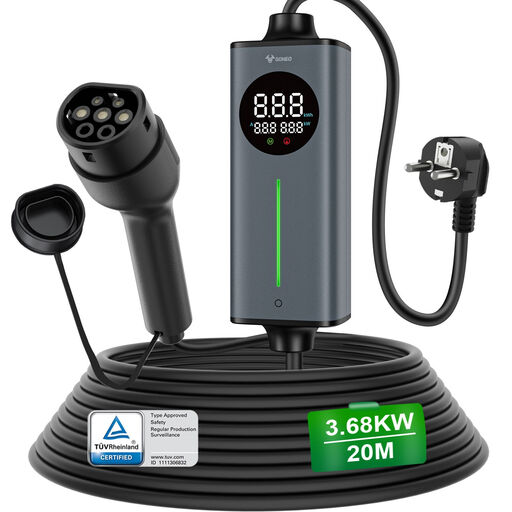
Why it's a good fit: Ideal for renters or as a secondary charger for on the go. It allows for straightforward charging from any standard Schuko socket without requiring installation. Perfect for charging your EV overnight or at a friend's house during the day.
This charger avoids the "oversized power" trap by focusing on a realistic 3.68 kW. According to the manufacturer, it includes integrated RCD protection (30mA AC + 6mA DC), addressing the safety aspect.
Plug-and-play functionality with any household socket. The adjustable current (up to 16A) and timer function allow you to adapt to the specific electrical installation and electricity tariffs.
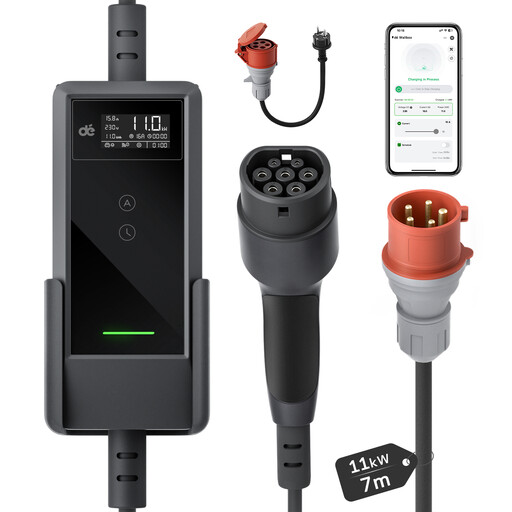
Why it's a good fit: For EV drivers who want a faster charging solution and have access to a CEE 16A high-power socket. It's an excellent solution for home charging without a fixed installation and for travelling to locations with the right infrastructure.
With 11 kW of charging power, it perfectly matches the capacity of many common EVs, avoiding the trap of an oversized 22 kW device. The app control provides the advertised smart functionality for cost management.
A balanced combination of high charging speed (up to 11 kW) and portability. The app enables scheduled charging and monitoring, which can help reduce running costs.
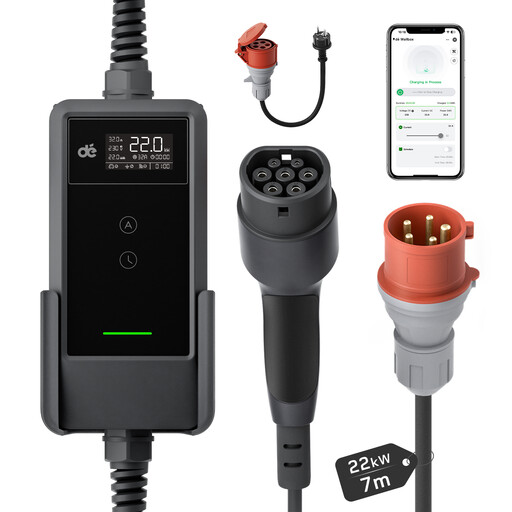
Why it's a good fit: For owners of vehicles with a 22 kW on-board charger who want to maximise their mobile charging speed. This requires access to a CEE 32A socket and the necessary approval from the grid operator.
Although it offers 22 kW of power, the charging current (6-32A) is adjustable. This allows the device to be used flexibly on lower-power connections (e.g., CEE 16A) at a reduced rate, so it's not rigidly tied to its maximum load.
Maximum charging power in a portable format. The ability to adjust the charging current via the app provides high flexibility, making the device usable at various locations with different infrastructures.
We've compiled a complete, up-to-date list of products that fully meet these strict selection criteria and safety regulations.
Can a portable wallbox completely replace a permanently installed one? For many users, yes. If you primarily charge your vehicle overnight, the charging power of a portable solution (especially an 11 kW version) is perfectly adequate. The benefits are the elimination of installation costs and the ability to take the charger with you on holiday or to a friend's house. A permanently installed wallbox offers more convenience, as the device is always mounted, and may qualify for government grants or subsidies.
How safe is charging from a normal Schuko socket? Charging from a Schuko socket is safe, provided the electrical installation is in good condition and the charger has the necessary safety features (temperature monitoring, RCD). Continuous charging at maximum current (16A) can cause an old socket to overheat. It is recommended to limit the charging current to 10A and have the socket checked by an electrician before regular use.
What is the difference between 11 kW and 22 kW charging power? A 22 kW charger can theoretically charge a vehicle twice as fast as an 11 kW one. However, this only works if both the car (the on-board charger) and the power connection (CEE 32A) are designed for 22 kW. Many EVs are limited to 11 kW AC charging. While 11 kW charging stations only need to be registered with the grid operator, 22 kW stations require formal approval. For most private users, an 11 kW solution is the more sensible and practical approach.