
Lieferung heute & morgen

Qualitätsgarantie

Willkommens-Angebote freischalten: KOSTENLOSE Lieferung | Bis zu 80 % RABATT | Kostenlose 30-Tage-JoyPlus-Testphase
App herunterladen
A portable fan provides targeted, on-the-go air circulation for your immediate personal space. With rising temperatures and a growing demand for personal comfort in various situations—whether at the office, on public transport, or during leisure activities—a wide variety of models with different technical specifications has emerged. Choosing the right device depends on your individual needs for mobility, performance, battery life, and design. This article analyses the key technical criteria and presents a selection of models for different use cases.
The decision to buy a mini fan should be based on an analysis of objective performance data. The following parameters are essential for making an informed choice.
The fan's design defines its primary purpose:
Battery capacity, measured in milliampere-hours (mAh), is a direct indicator of potential runtime. A higher capacity generally allows for longer use before a recharge is needed. Manufacturer runtime specifications often refer to the lowest power setting. It is advisable to weigh the capacity (e.g., 4000 mAh, 5000 mAh) against the power consumption (watts) and your personal usage habits.
Modern devices increasingly feature a USB-C port. Compared to the older Micro-USB standard, it often enables faster charging speeds (Fast Charging) and is also reversible. The charging time, specified in hours, indicates how quickly the battery-powered fan is ready for use again.
A fan's performance is determined by the airflow it generates. Parameters like blade rotation speed (RPM) or air velocity (m/s) provide insight into its cooling power. Multiple adjustable power levels allow for precise customisation of the airflow to suit personal preference and ambient noise levels.
For use in quiet environments like offices or bedrooms, a quiet small fan is essential. The noise level is measured in decibels (dB). Values below 30 dB on the lowest setting are considered very quiet. Manufacturer details about modified motors or special aerodynamic designs can indicate reduced noise output.
Some models offer features beyond simple air circulation:
Based on the technical criteria above, we have curated a selection of models for different use cases.
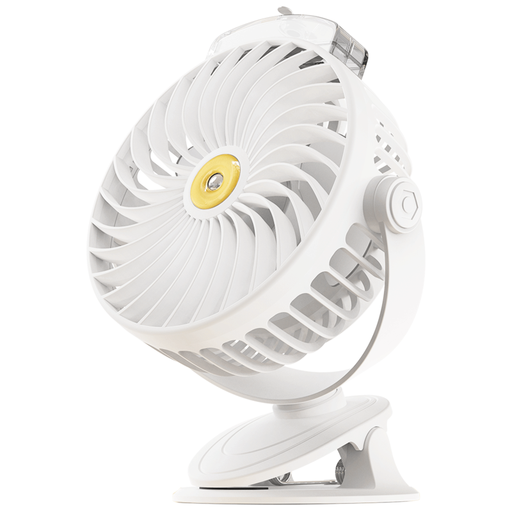
Why we recommend it: The Aigostar 6F3B stands out for its dual-use functionality. It can be attached to various surfaces with a sturdy clip or placed on a flat surface as a desk fan, thanks to its stable base. The additional misting function, with two modes, provides an enhanced cooling effect on hot days through evaporative cooling. With five speed settings and a rotation speed of 4000 RPM, it delivers an adjustable and effective airflow.
Pros:
Who it's for: This model is designed for users who need flexible positioning, for example on a desk, bed frame, or pushchair. The misting function makes it particularly appealing for use in dry, air-conditioned rooms or on hot summer days.

Why we recommend it: This neck fan offers a completely hands-free cooling solution. Its bladeless design enhances safety by preventing hair from getting caught. According to the manufacturer, 78 air outlets provide even, 360-degree air distribution around the neck. The 4000 mAh battery allows for a runtime of up to 16 hours (depending on the selected setting), and its low weight of approximately 258g ensures it is comfortable to wear.
Pros:
Who it's for: Perfect for individuals who need constant cooling on the go or during activities without restricting their freedom of movement. Commuters, athletes, and outdoor enthusiasts will benefit from its safe and comfortable design.

Why we recommend it: The JISULIFE Pro1S is a handheld fan engineered for maximum performance. Featuring turbine technology that, according to the manufacturer, reaches a rotation speed of up to 9700 RPM, it generates an exceptionally powerful airflow. A standout feature is its stepless control dial, offering 100 speed levels for extremely fine-tuned adjustment. The integrated LED display provides precise information on the current setting and the 5000 mAh battery level.
Pros:
Who it's for: This on-the-go fan is aimed at users who prioritise maximum cooling power and precise control. It is an excellent choice for use in extreme heat, at outdoor events, or for anyone who prefers a noticeably strong breeze.
If you are looking for an alternative to traditional fan blades, models without visible blades could be an interesting option. These designs often offer a different aesthetic and unique airflow dynamics. Discover more designs in our category for bladeless fans.
1. How long does a portable fan's battery last? The battery life depends directly on the battery capacity (in mAh) and the selected power setting. Models with 4000–5000 mAh can often run for 10 to 16 hours or more on the lowest setting. At maximum power, the runtime is significantly reduced, often to between 3 and 5 hours.
2. Are neck fans safe? Modern neck fans are generally designed to be safe. Many models use a bladeless design where air is drawn in by internal turbines and expelled through narrow vents. This minimises the risk of hair, clothing, or jewellery getting caught in the device.
3. What does RPM mean for a fan? RPM stands for "Revolutions Per Minute" and indicates how fast the fan's blades or turbine rotate. A higher RPM number typically results in a stronger airflow and, consequently, greater cooling performance.