For cooks making several batches
If you’re preparing several batches, your pan base, cooking zone and available worktop space all need to work together. Manufacturers specify different heating areas and size ranges for different models.


Start by choosing a hob that suits your pan base and the cooking area you need. Induction is an option if your pan is compatible; for other pans, a cast-iron hotplate or radiant ceramic hob may be a better fit. The German Environment Agency points out that induction requires suitable cookware. Neither the wattage nor the number of heat settings tells you how evenly breadcrumbs will brown in your pan.
If you’re preparing several batches, your pan base, cooking zone and available worktop space all need to work together. Manufacturers specify different heating areas and size ranges for different models.
If you want to keep using your pan, first check whether it’s suitable for induction. Rommelsbacher specifies a ferromagnetic pan base as a requirement for the CT 2010/IN.
If you want to adjust the heat while toasting, compare the controls and temperature regulation on the specific appliance. The number of settings alone won’t tell you how evenly the breadcrumbs will brown.
A good fit if: Your pan is specifically stated to be induction-compatible and its base suits the hob’s size range.
Keep in mind: You can’t simply continue using a pan that isn’t suitable for this type of heating.
A good fit if: You want to use a suitable pan without an induction-compatible base; Rommelsbacher specifies a 220 mm cast-iron plate for the THS 2022/E.
Keep in mind: Rommelsbacher says cast iron heats up more slowly and retains heat for longer, which matters when adjusting the temperature.
A good fit if: You use a pan that isn’t induction-compatible and switch between different base sizes.
Keep in mind: According to the manufacturer, the Rommelsbacher CT 2200/E uses switchable 140 and 210 mm radiant heating circuits, not induction.
A good fit if: You genuinely want to heat two pans at once while batch cooking, or cook another dish at the same time.
Keep in mind: According to the manufacturer, the Severin DK 1031 has two induction zones and a total output of 3400 W. Check the available space and connection requirements for the specific appliance.
| Priority | What to check before buying | Who should pay particular attention? |
|---|---|---|
| Pan size and batches | Compare the pan base with the cooking zone’s size range. Also consider the space available and room for the handle. | If I’m toasting several batches, the pan base needs to suit the cooking zone and the appliance must stand securely. That’s why around 33% of consumers prioritise having the right-sized cooking area for several batches. |
| Pan you already own | Check the manufacturer’s guidance on induction compatibility and the permitted base diameter for the specific appliance. | If you want to keep using your pan, check that it’s suitable before choosing a heating method. For around 27% of consumers, compatibility with their existing pan comes first. |
| Heat control when browning | Compare the controls and temperature regulation. Don’t assume the settings correspond to a measured food temperature. | If I want to adjust the heat while toasting, easy-to-use controls between batches matter most to me. Around 27% of consumers prioritise heat that’s easy to adjust. |
| Available space and connection | Check the appliance dimensions, that it stands securely and the connection requirements for the specific model. | If space is limited, I want a suitable extra cooking spot without making room for a second zone I won’t use. Around 13% of consumers focus mainly on a compact option and a suitable connection. |
A ceramic surface doesn’t mean an appliance uses induction. According to the manufacturer, the Rommelsbacher CT 2200/E is heated by HiLight radiant elements.
Check the stated heating method and pan-base requirements before choosing a model.
The rated power and appliance settings don’t tell you whether your pan is the right size or guarantee a particular result when toasting breadcrumbs.
Compare the pan base with the cooking zone, and consider whether the controls make it easy to adjust the heat between batches.
Rommelsbacher notes that cast iron heats up more slowly and retains heat for longer. So, even when switched off, the hotplate won’t cool down straight away.
Stay nearby while toasting and bear in mind that the hotplate will continue to give off heat when you turn down the power or remove the pan.
A second cooking zone won’t give you any extra cooking space if you’re only using one pan, and it takes up room.
Choose two zones only if you’ll genuinely be cooking with two pans at the same time, and check the connection requirements.
These models illustrate how induction, cast iron and HiLight radiant heating use different heating methods.
The Touch 2000 is a specific portable single induction hob option for a compatible pan.
The KP 1071 is a single induction hob, while the DK 1031 is a double induction hob.
The EKI 3569 is another single induction hob with touch controls.
This selection includes portable single hobs, including induction models and an electric hotplate. The key considerations are a compatible pan, the size of the cooking zone and controls that let you manage several batches of toasted breadcrumbs.
 No image available
A single electric cooking zone with infinitely variable temperature control is an option if you want to adjust the heat between batches.
The stated diameter of the heating surface is 18 cm, and the model has a rotary control.
 No image available
This single induction hob is worth considering if your pan is induction-compatible and its base falls within the stated size range.
The description specifies magnetic cookware with a diameter of 12–26 cm, nine heat settings, touch controls and an 8-hour timer.
 No image available
A single induction cooking zone may suit you if your pan is compatible and you’re looking for a compact tabletop appliance.
The model is listed as having five heat settings; the stated dimensions are 21,5 × 21,5 × 4,7 cm.
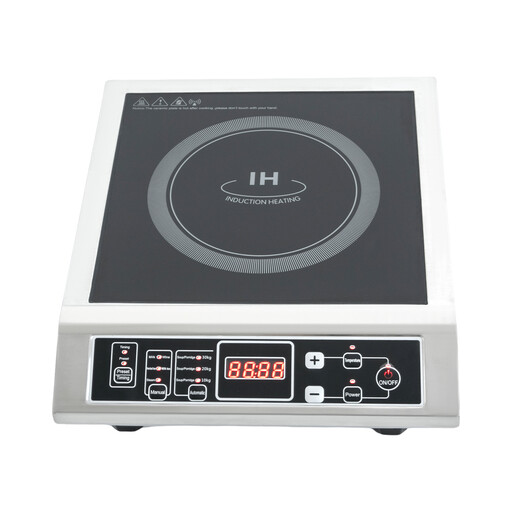 No image available
This portable induction hob is an option for a single pan made from suitable cookware.
The specifications list ten power settings and ten temperature settings, as well as a timer and reservation function.
 No image available
This portable single induction hob is worth considering if your pan is induction-compatible and you want to adjust the temperature.
Ten temperature settings are specified; the description also lists ten power settings and a timer.
Check the manufacturer’s guidance on induction compatibility, then compare the diameter of the pan base with the hob’s stated size range. Rommelsbacher specifies a ferromagnetic base and a cooking zone range of 120–230 mm for the CT 2010/IN. These specifications don’t automatically apply to other models.
No. A timer is no substitute for keeping an eye on the toasting. The German Fire Service Association identifies food left unattended or forgotten on the hob as the most common cause of kitchen fires. This is general fire safety advice, not a claim about how effective any particular timer is.
Follow the cleaning and cooling instructions in your model’s manual. Rommelsbacher notes that cast iron retains heat for longer; according to the manufacturer, the CT 2200/E has a residual heat indicator.
No. According to the German Federal Institute for Risk Assessment, cooking or baking does not make mould toxins harmless. Don’t use mouldy ingredients, and store food in clean, dry conditions.
Your statutory rights are separate from a warranty, which is an additional voluntary promise. The consumer advice centre recommends checking with the seller and reading the specific warranty terms, rather than treating a manufacturer’s warranty as the same thing as your statutory rights.
Check the product labelling, the manufacturer’s information and the instructions for use supplied for Germany. The European Union describes CE marking as the manufacturer’s declaration that the product meets the relevant requirements, not as a central EU approval certificate. The German Federal Network Agency lists product labelling, manufacturer details and German-language instructions among the aspects considered in market surveillance.