Careful cream-makers
You want to control the heat as the mixture thickens and keep an eye on it while stirring. Compare the lower settings and controls on the specific model, rather than focusing only on its maximum wattage.


Choose a portable hob based first on the pan you already own and the space available: induction requires a suitable magnetic pan base, while radiant and cast-iron hobs can also be used with pans that aren’t induction-compatible. Easy-to-reach settings can help when thickening a cream, but they don’t guarantee a consistent temperature in the mixture, so stirring and keeping an eye on it are still important. In a shared kitchen, you’ll also need a suitable socket, a safe place to leave the hob and a plan for residual heat after switching it off.
You want to control the heat as the mixture thickens and keep an eye on it while stirring. Compare the lower settings and controls on the specific model, rather than focusing only on its maximum wattage.
You’d like to keep using your pan. With induction, the material and base diameter are key; otherwise, a radiant or cast-iron hotplate may be an option.
You’ll need a safe place to set the hob down, and you’ll need to let the cooking surface cool after use and protect others from residual heat. Remember to plan for the socket and cable route too.
A good fit if: Your pan has a suitable magnetic base and its diameter is compatible with the model. For example, Caso specifies 12–22 cm for the ProSlim 2000.
Consider: You’ll need to use an induction-compatible pan, and the way the hob regulates heat at a low setting can vary between models.
A good fit if: You want to keep using a pan that isn’t induction-compatible on a smooth cooking surface. According to the manufacturer, the Rommelsbacher CT 2200/E lets you choose heating zones with diameters of 140 or 210 mm.
Consider: The cooking surface stays warm after the hob is switched off. You’ll also need to allow for the 30.50 × 41.00 cm footprint of the model mentioned.
A good fit if: You’re looking for a straightforward hotplate for your existing cookware and can allow for longer heating and cooling times.
Consider: You can’t stop the stored heat immediately after switching it off, so make sure you have a safe place for the hotplate to cool.
This guide focuses on choosing a portable single hob for thickening a cream in a shared kitchen.
| What matters to you | What to check before buying | Who is it most relevant to? |
|---|---|---|
| Controlling the heat as the mixture thickens | Check the lower settings and controls on the specific model. A temperature setting doesn’t measure the temperature of the cream. | If I want to adjust the heat easily while stirring, I’ll look at the lower settings rather than just the maximum power. Around 36% of consumers say controllable heating is their top priority when buying. |
| Using a pan you already own | For induction, check the material and base diameter against the model’s specifications. | If I don’t want to buy another pan, I’ll first check whether the one I have is compatible with the hob. Around 29% of consumers say pan compatibility is their top priority. |
| A safe space in a shared kitchen | Check the appliance dimensions and available worktop space; allow for residual heat and the cable route. | If several people use the kitchen, I need somewhere safe for the appliance and pan to cool down. Around 21% of consumers say a safe space that can be shared is their main concern. |
| Upfront and ongoing costs | Factor in the pan you already own, and don’t estimate electricity use from the maximum wattage alone. | If I’m weighing up the overall cost, I’ll also consider whether I might need a new pan and how long I’ll actually use the hob for. Around 14% of consumers give this cost consideration the highest priority. |
Maximum power doesn’t tell you how a low setting will heat the contents of your pan. A displayed temperature may not match the temperature of the cream either.
Compare the lower settings on each model and plan to keep an eye on the cream as you stir.
Induction requires a suitable pan base, and the diameter must also match the hob’s specifications.
Check the base and size of your pan before buying. If it isn’t compatible, compare radiant and cast-iron hotplates.
Ceramic glass and cast-iron surfaces can retain heat after being switched off. In a shared kitchen, someone could accidentally touch or cover the hot surface.
Make sure you have a safe place for it to cool and check for a residual heat indicator, if there is one. It doesn’t replace the need to handle the surface carefully.
The CT 2020/IN and CT 2200/E represent different cooking technologies in the range.
The ProSlim 2000 is a portable single induction hob for use with compatible pans.
The EKP 3582 is a cast-iron single hotplate with a rotary control, offering an alternative to induction.
The KP 1071 and KP 1092 models offer a choice between induction and cast iron.
This selection includes portable cast-iron and induction hobs. For induction, your pan needs to be compatible with the hob.
 No image available
An option if you’re looking for a cast-iron hotplate with variable temperature control for a flat, stable pan base.
The heating ring has a diameter of 18 cm. The hotplate may be hot during use and immediately afterwards.
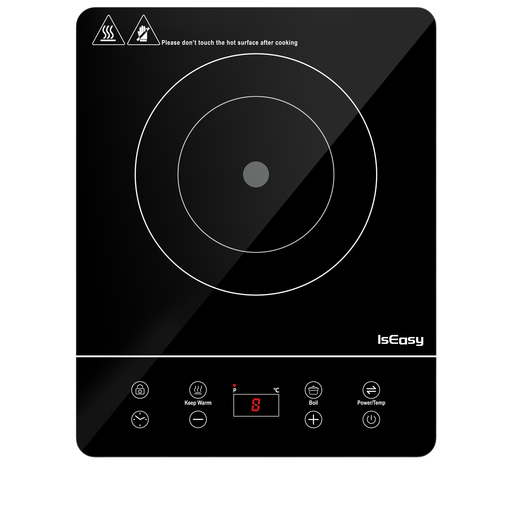 No image available
Worth considering if your pan is magnetic and has a diameter of 12–26 cm.
This model lists nine power levels, nine temperature settings, 28 cm, an 8-hour timer and a child lock. The displayed settings don’t measure the temperature inside the pan.
 No image available
An option if you’re looking for a portable induction hob with five power levels.
This model is designed for induction-compatible cookware; the specified levels don’t guarantee a particular rate of heating for the cream.
 No image available
Could be a good fit if you’d like an induction hob with several temperature and power settings and have compatible magnetic cookware.
The description lists ten temperature and power settings and a smooth glass surface. These specifications don’t tell you what temperature the cream will reach.
 No image available
An option if you’re looking for an induction hob with eight temperature and power settings and have a compatible pan.
The description lists a smooth glass surface, a timer, an automatic porridge and soup mode, and automatic switch-off. These features don’t guarantee a particular temperature when thickening a cream.
No. The pan base must be suitable for induction and compatible with the hob. For example, Caso specifies 12–22 cm for the ProSlim 2000; check the specifications for the model you’re considering. A radiant or cast-iron hotplate may be an alternative if you want to keep using a pan that isn’t induction-compatible.
No. Appliance settings don’t show the measured temperature of the pan’s contents. Stir the cream and keep an eye on it. Rommelsbacher specifically describes pulsed operation at lower settings for the CT 2010/IN model, not for all hobs.
Leave the appliance and pan to cool in a safe place, and check for a residual heat indicator if there is one. Rommelsbacher lists an indicator for the CT 2200/E, but it doesn’t make the surface safe to touch straight away. The German Federal Institute for Risk Assessment recommends keeping perishable foods as cold as possible until they’re eaten or processed.
You can’t determine this from the type of hob alone. Check the instructions and the socket’s permitted load, and consider which other appliances are plugged in and running at the same time. The German Fire Service Association illustrates how the power ratings of kitchen appliances add up when they’re used at the same time.
Electrical equipment covered by the Low Voltage Directive must meet the relevant EU conformity requirements, including CE marking. EUR-Lex explains the voltage range covered by the directive, while Your Europe explains that CE marking is the manufacturer’s declaration that the product meets the relevant EU requirements. It isn’t an independent quality mark, so check the marking and instructions for the specific appliance.