For cooks making curry in one pan
Fry your ingredients after a trip to the market, then let the potato curry simmer gently under control. You don’t necessarily need a second cooking zone for that.


For a one-pot potato curry, a single hob with good temperature control is usually the obvious place to start. A double hob is mainly useful if you regularly cook rice or a side dish at the same time. With induction, the base of your pan must be ferromagnetic and match the stated diameter range; otherwise, consider a radiant ceramic-glass or cast-iron hob. Also check that the heat can be turned down low enough to simmer, and that the hob will fit your available space and socket.
Fry your ingredients after a trip to the market, then let the potato curry simmer gently under control. You don’t necessarily need a second cooking zone for that.
If you want to keep using your own pan, check its base material and diameter first, then choose between induction and a heated hob.
If you regularly need to cook in two pans at once, you’ll need two usable cooking zones, as well as enough space and a suitable socket.
First, check that your pan is compatible with the heating technology. Then consider temperature control, the number of cooking zones you need and the space available to find the right hob.
| What matters | What to check before buying | Who it matters most to |
|---|---|---|
| Controlling the heat | Check the lower power settings and how the specific model is operated. | If I’m frying the curry first and then letting it simmer gently, I want to be able to control the heat precisely; around 36% of consumers make temperature control their top priority. |
| Using a pan you already own | For induction, test the pan with a magnet and compare its diameter with the model specifications. | If you want to keep using your own curry pan, check that it’s induction-compatible before choosing a hob; around 29% of consumers prioritise pan compatibility. |
| Cooking two dishes at once | Check the dimensions, total power, pan sizes and connection requirements. | If I want to cook curry and rice at the same time, I need two usable cooking zones; around 21% of consumers prioritise cooking in parallel. |
| Space and socket | Check the appliance dimensions and instructions, as well as the required connection. | If I have limited worktop space or a particular socket location, I want to know in advance whether the appliance will fit and can be connected where I plan to use it; around 14% of consumers prioritise space and connection requirements. |
Induction requires a ferromagnetic pan base. The hob’s stated size range must also suit your pan.
Test the base of your pan with a magnet and compare its diameter with the specifications for the model you’re considering.
If you only use one curry pan, the second zone will go unused. A double hob also takes up more space; the manufacturer lists the Severin DK 1031 as measuring 59 × 35,5 cm, with a total power output of 3400 W.
Consider two zones mainly if you regularly cook rice or a side dish at the same time, and check the connection requirements for the specific model.
A test of how quickly water boils, as described by F.A.Z. Kaufkompass, doesn’t show how well a model can simmer potato curry on a low setting.
When comparing hobs, check the lower settings and how easy it is to switch from frying to simmering.
Model examples include single and double induction hobs, as well as a single cast-iron hob.
Model examples include a single induction hob and a single radiant ceramic-glass hob.
Portable single induction is an option if your curry pan is compatible.
An example of a single induction hob with touch controls.
A single induction model that can serve as a reference when comparing controls.
The Joybuy products below are portable single induction hobs for cooking in one pan. They’re only suitable if your curry pan is induction-compatible; the stated power and temperature settings alone don’t guarantee an even simmer.
 No image available
A portable single hob for curry, letting you adjust the heat as you switch from frying to simmering.
Nine heat settings, an 8-hour timer and 2100 W.
For magnetic cookware with a diameter of 12–26 cm; check that your pan is compatible.
Dimensions: 35 × 28 × 4,4 cm; weight: 1,9 kg.
 No image available
A single hob for making curry when you’d like to choose from several heat settings.
Five heat settings and 1000 W.
Dimensions: 21,5 × 21,5 × 4,7 cm. As an induction hob, it requires suitable magnetic cookware.
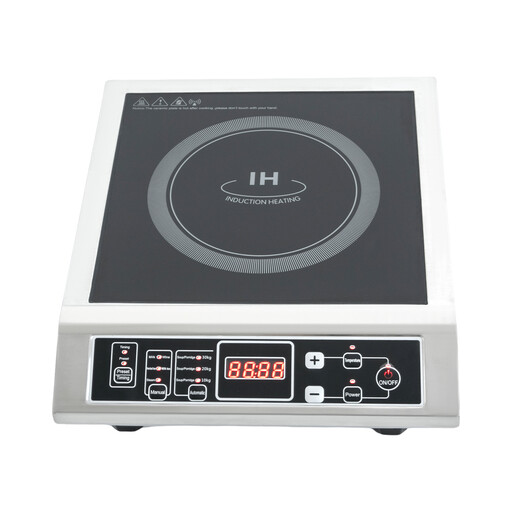 No image available
A portable single hob for cooking curry in a pan; choose a suitable setting for simmering once it’s cooked.
3500 W, ten temperature and power settings, a timer and a reservation function.
Induction requires suitable magnetic cookware.
 No image available
A portable single hob for a compatible induction pan and a dish where you’d like to set the temperature.
3500 W, ten temperature settings, a 3-hour timer and a soup function.
Your pan must be induction-compatible.
 No image available
A portable single hob for making curry in an induction-compatible pan.
3500 W, eight temperature settings, a timer and automatic porridge and soup functions.
Before choosing, check that your existing pan is induction-compatible.
Hold a magnet against the base of the pan and compare its diameter with the hob’s specifications. A pan isn’t automatically induction-compatible just because it’s made of stainless steel.
Once you’ve fried the ingredients, you can turn the setting down to continue cooking, keeping an eye on the curry and stirring as needed. Follow the instructions before cleaning, and check the residual-heat indicator on a heated ceramic-glass hob. Don’t continue using an appliance with a damaged cable or casing.
Compare the total power output with the intended connection and follow the instructions for the specific model. Rommelsbacher advises against using a multi-socket extension lead with its high-powered double hobs; this manufacturer’s advice isn’t a general statutory limit for all hobs.
If there’s a defect, the seller is generally responsible for statutory warranty claims, not automatically the manufacturer. Electrical appliances must not be put in household waste; local collection points accept them free of charge. Retailers have take-back obligations subject to the applicable requirements.
Check the labelling, instructions for use and warnings for the specific product. The German Federal Network Agency lists CE marking, product identification, manufacturer details and instructions as criteria in its market surveillance. The CE mark isn’t an independent endorsement of cooking performance.