Making soup with a suitable induction pot
If you’re making potato soup with limited worktop space, check the base of your pot and the size range specified for the model. Rommelsbacher and CASO Design list model-specific requirements and size ranges.


If your soup pot has an induction-compatible base, a single-zone induction hob with a suitable pot-size range and easily adjustable power is a good place to start. For pots without an induction-compatible base, consider a ceramic glass radiant hob or a cast-iron hotplate. Compare the footprint, residual heat and cleaning requirements of the specific model.
If you’re making potato soup with limited worktop space, check the base of your pot and the size range specified for the model. Rommelsbacher and CASO Design list model-specific requirements and size ranges.
If you want to keep using your existing pot, consider a radiant hob or a cast-iron hotplate. Rommelsbacher describes both HiLight radiant heating and a cast-iron hotplate as different cooking technologies.
When every centimetre counts, check the appliance dimensions, cable routing and where you’ll place it. CASO Design lists dimensions of 280 × 60 × 365 mm for the ProMenu 2100; Severin gives dimensions of 8.5 × 25.5 × 28.8 cm for the KP 1091.
A good fit if: Your pot has a ferromagnetic base and falls within the size range for your chosen model. You can turn the power down to a gentle simmer once the soup has come to the boil.
Things to consider: Induction requires compatible cookware, and the fan on a freestanding appliance may be audible.
A good fit if: You want to keep using a pot that isn’t induction-compatible and prefer a smooth cooking surface. According to the manufacturer, you can choose between heating zones with diameters of 140 and 210 mm on the Rommelsbacher CT 2200/E.
Things to consider: The cooking surface heats up and stays warm after the hob is switched off. Check that your pot is the right size and take residual heat into account.
A good fit if: You want to use a pot you already own and would rather have a simple cooking surface than a smooth one that’s easy to clean.
Things to consider: Rommelsbacher says cast-iron hotplates take longer to heat up and retain heat for longer. You should also consider the care they require.
First check that your soup pot is suitable for the heating technology, then compare the appliance dimensions, controls and cleaning requirements with your kitchen.
| Consideration | What to check when buying | Who it matters most to |
|---|---|---|
| Pot and heating technology | For induction, check that the base of your pot is magnetic and that its diameter is within the range permitted for the specific model. | If I want to keep my soup pot, I’ll first check whether it works with the hob I’ve chosen. Around 34% of consumers are primarily concerned about cookware compatibility. |
| Worktop space and safe operation | Compare the appliance dimensions, cable route, rating plate and location with the available space and power socket. | In a small kitchen, I need a suitable, safe place for the hob and pot. Around 27% of consumers are most concerned about where to position the appliance and connecting it safely. |
| Bringing to the boil and simmering | Check the power settings and, where applicable, the timer on the specific model. Settings don’t guarantee a particular temperature in the soup. | If I want my soup to simmer after it comes to the boil, easy-to-use power controls are important to me. Around 26% of consumers are primarily concerned about being able to control how their soup cooks. |
| Cleaning and additional costs | Compare the surface and care instructions with your existing cookware. Don’t assume that a particular wattage will save you electricity or money. | If I want to wipe away splashes easily and avoid replacing a pot unnecessarily, I’ll compare cleaning requirements and cookware compatibility together. Around 13% of consumers are primarily concerned about cleaning and the potential extra cost of buying a new pot. |
A smooth ceramic glass surface can be found on either a radiant hob or an induction hob. The key factor for your existing pot is the heating technology, not just the surface material.
Check the heating technology and the requirements for the pot base separately. Choosing an unsuitable hob may mean you need to buy additional cookware.
The rated power alone won’t tell you whether the pot size, controls, footprint and other features are right for making potato soup.
Compare the pot-size range, appliance dimensions and power settings together. Don’t assume that one particular wattage will always save electricity.
According to Rommelsbacher, a cast-iron hotplate retains heat for longer; the fan on a freestanding induction hob may also be audible. Both could affect how you use the appliance in a small kitchen.
Weigh these features against cookware compatibility, footprint and the cleaning requirements of the specific model.
The ProMenu 2100 and ProSlim 2000 are portable single-zone induction hobs designed for different amounts of worktop space and different pot-base sizes.
The range includes portable induction, radiant and cast-iron hobs. The right choice depends, among other things, on the pot you already own.
The KP 1091 is a compact single cast-iron hotplate and is worth considering if your existing pot isn’t suitable for induction.
The Kult X Mono is a portable single-zone induction hob with touch controls and pre-set programmes.
The products below include portable single-zone induction hobs and an infrared hotplate. For induction, check your pot base and the stated size range. For the infrared hotplate, follow the guidance for the specific model to check whether it’s suitable for your pot.
 No image available
For an induction-compatible soup pot with a base diameter of 12–26 cm, as stated in the product description.
The specifications list nine heat settings, a timer of up to eight hours and dimensions of 35 × 28 × 4.4 cm, with a weight of 1.9 kg.
 No image available
The stated footprint of 21.5 × 21.5 cm may be useful when measuring up a small worktop.
The product description lists five heat settings and a rotary control. The hob requires induction-compatible cookware.
 No image available
The product description lists a soup function for making potato soup. This induction model also requires suitable cookware.
Specifications include ten temperature levels, power settings from 400 W to 3,500 W and a timer of up to three hours. The dimensions are 16.54 × 13.78 × 4.33 inches.
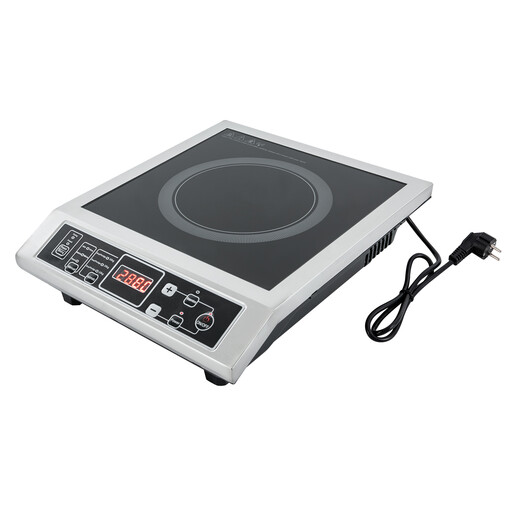 No image available
The product description lists a soup function and several power and temperature settings. The appliance is designed for use with induction-compatible cookware.
Specifications include eight power levels, eight temperature settings and a timer of up to three hours. The description also lists a pre-set function.
 No image available
As an alternative to induction, this appliance is described as an infrared hotplate with a ceramic glass surface. Check whether your pot is suitable by following the guidance for this specific model.
The product description lists a soup mode, a timer, and touch and rotary controls.
Only if the base is suitable for induction and its diameter is right for your chosen model. CASO Design lists a pot-size range of 12–24 cm for the ProMenu 2100; this figure doesn’t apply to all hobs.
A ceramic glass radiant hob or a cast-iron hotplate could be an alternative. Check the pot size, footprint and controls for the specific model. Radiant surfaces may stay warm after being switched off, while Rommelsbacher says cast iron retains heat for longer.
Position the appliance according to its instructions and use a suitable power socket. Unplug it before cleaning and let the cooking surface cool down. The Severin instructions for the KP 1091 warn against immersing the appliance in water. Don’t continue using an appliance with a damaged cable or casing.
Electrical equipment within the scope of the EU Low Voltage Directive must carry the CE marking. According to the Federal Network Agency, the manufacturer applies it under its own responsibility; it isn’t proof of independent testing. Also check the specific product identity and that the safety instructions are clear.
No. Your statutory rights cover faulty goods and are enforceable against the seller; a guarantee is an additional voluntary promise with its own terms. When you buy at a distance, you’ll generally also have a 14-day right to cancel, subject to the relevant requirements and exceptions in each case.