If you already have a soup pot
If you want to keep using your own pot or one you share, first check whether its base is suitable for induction and fits the cooking zone.


If your soup pot has a ferromagnetic base and its diameter falls within the appliance’s specifications, a portable induction hob is a suitable option for bringing it to the boil and then simmering. Bosch home appliances lists a magnetic base as a requirement for induction. If your pot isn’t suitable for induction, consider a radiant ceramic-glass hob or a cast-iron hotplate. Compare the cooking zone, controls, footprint and connection requirements of the specific model before deciding.
If you want to keep using your own pot or one you share, first check whether its base is suitable for induction and fits the cooking zone.
For potato soup that continues cooking over a lower heat after coming to the boil, ease of use and the ability to adjust the heat are important things to consider.
As well as the hob’s dimensions, allow space for the pot and cable, and leave a safe spot for the hob to cool down.
A good fit if: your soup pot has a ferromagnetic base and its diameter falls within the appliance’s specifications.
Bear in mind: induction won’t work without a suitable pot. Depending on the model, you may hear the fan, as Rommelsbacher notes for its induction appliances.
A good fit if: you want to keep using a pot that isn’t suitable for induction and prefer a smooth cooking surface. The Rommelsbacher CT 2200/E has heating zones with diameters of 140 or 210 mm.
Bear in mind: ceramic glass doesn’t automatically mean induction. The heated surface retains residual heat, which matters when sharing the hob and putting it away later.
A good fit if: your existing pot isn’t suitable for induction and the cooking zone matches its base.
Bear in mind: Rommelsbacher says cast-iron hotplates take longer to heat up and retain heat for longer. A small cooking zone may not suit a large soup pot.
When choosing a hob for potato soup in a shared kitchen, consider how well it suits your pot and how easy it is to adjust, as well as the space available and safe use.
| What matters | What to check before buying | Who should pay particular attention? |
|---|---|---|
| A suitable soup pot | For induction, check that the base is magnetic and that the pot’s diameter is within the permitted range. Bosch home appliances lists a ferromagnetic base as a requirement. | If I want to keep using my existing pot, I’ll check that its base and diameter are a match for the hob. Around 31% of consumers put pot compatibility first. |
| Adjusting the heat while simmering | Compare the controls and power settings. Keep an eye on the soup when turning the heat down after bringing it to the boil, and adjust it further if needed. | If I want to simmer the soup after bringing it to the boil, I’ll look for easy-to-adjust heat settings. Around 31% of consumers prioritise control from boiling through to simmering. |
| Space and safe use | Check the appliance’s dimensions, the pot’s stability, the cable route and the setup instructions. The German Fire Services Association lists unattended or forgotten food as a common cause of fires. | In a shared kitchen, I’ll also allow space for the hob to cool down and won’t leave it unattended while cooking. Around 23% of consumers put available space and safe use first. |
| Changing pots and repair service | Find out whether you’d need a different pot for induction, and check the repair service details for the specific model. | If my pot isn’t suitable for induction, I’ll check in advance whether I want to change my cookware and what repair service is available for the model. Around 15% of consumers prioritise these follow-up considerations. |
The Rommelsbacher CT 2200/E has a ceramic-glass surface, but according to the manufacturer it is heated by HiLight radiant elements, not induction.
Check the heating technology and cookware requirements for the full model, not just the surface material.
Tristar describes the KP-6185’s 15-cm cooking zone as designed for smaller pots, so it won’t necessarily suit a larger soup pot.
Check your pot’s base against the cooking zone and make sure it will sit securely.
A timer and indicator don’t replace supervision while cooking. The Federal Institute for Occupational Safety and Health also points out that CE is not an independent safety certification mark.
Keep an eye on your soup and remember that surfaces can remain hot after the hob is switched off.
The Touch 2000 is a portable single-zone induction hob for use with a compatible pot.
The CT 2010/IN is a portable induction hob, while the CT 2200/E is a radiant ceramic-glass alternative.
The KP 1071 is a portable induction hob, while the KP 1092 is a traditional single-zone cast-iron hotplate.
The KP-6185 is a compact, single-zone cast-iron hotplate for smaller pots.
This selection includes portable single-zone cast-iron and induction hobs for cooking with one soup pot.
 No image available
An option if your pot isn’t suitable for induction and its base matches the heating ring.
18 cm heating ring, 1500 W and continuously adjustable temperature control. Compact dimensions of 25 × 28,5 × 8 cm.
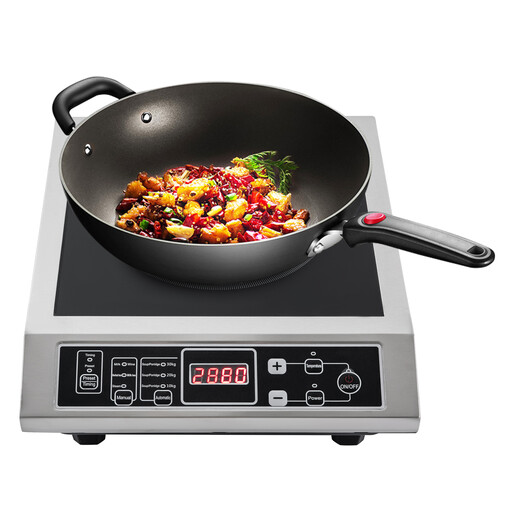 No image available
An option if your soup pot is suitable for induction and you want to adjust the heat as you switch to simmering.
The product description lists 8 temperature and 8 power settings, a timer of up to 3 hours and automatic pot detection. Suitable cookware is required for induction.
 No image available
An option if your induction-compatible pot falls within the stated diameter range.
The specifications list 9 heat settings, an 8-hour timer and compatibility with cookware measuring 12–26 cm in diameter. It measures 35 × 28 × 4,4 cm and weighs 1,9 kg.
 No image available
An option for an induction-compatible pot if choosing from five power settings suits the way you cook.
The product title lists 1000 W and 5 power settings. An induction-compatible pot base is required for use.
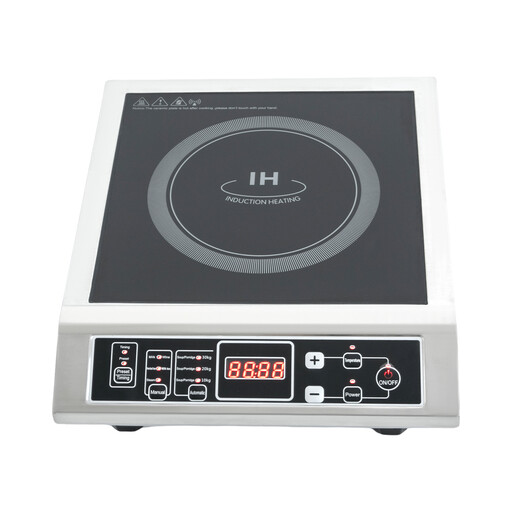 No image available
An option if your pot is induction-compatible and you want to adjust the power when switching from boiling to simmering.
The product description lists 10 power settings ranging from 400 to 3500 W, as well as a timer and a reservation function. Use induction-compatible cookware.
Only if it has a magnetic base that’s suitable for induction. Also check the pot size range specified for the particular appliance. Bosch home appliances suggests using a magnet as a practical way to check suitability.
Not for every model: Severin specifies a Schuko plug for the KP 1071, while CASO describes the Touch 2000 as suitable for use with a standard socket. Check the plug type, rated power, setup instructions and existing electrical installation for the specific appliance.
Rommelsbacher advises against using a multi-socket extension lead with its powerful double hobs and recommends checking the permitted total load. This is a manufacturer-specific safety recommendation, not a general statutory wattage limit.
The seller is generally responsible for the statutory guarantee, which is separate from a voluntary manufacturer’s warranty, as explained by the Consumer Advice Centre. It also explains that for sales contracts dated 31 July 2026 or later, the guarantee period can be extended once by twelve months if you choose repair instead of replacement when a fault occurs.
No. The Federal Institute for Occupational Safety and Health describes the GS mark as a safety mark that manufacturers can apply for voluntarily. It’s different from CE, which is not an independent safety certification mark. For electrical products covered by low-voltage regulations, the Federal Institute and the 1. ProdSV explain the applicable conformity requirements.