Households with staggered mealtimes
If people eat a pot of broccoli soup at different times, you need a safe plan for keeping it hot or cooling and reheating it. The BfR sets out specific temperatures for the food itself.


A single induction hob with adjustable settings is suitable for a soup pot if its base is ferromagnetic. For cookware that is not induction-compatible, consider a cast-iron hotplate; if you need to heat two vessels at once, choose a double hob. But the hob alone is not what matters when serving portions later: the German Federal Institute for Risk Assessment (BfR) recommends keeping food at a minimum of 60 °C throughout when holding it hot. For longer storage, it recommends cooling food quickly to below 7 °C and reheating it to at least 70 °C throughout for two minutes. A setting on the appliance does not prove that the soup has reached these temperatures.
If people eat a pot of broccoli soup at different times, you need a safe plan for keeping it hot or cooling and reheating it. The BfR sets out specific temperatures for the food itself.
If you want to keep using your existing pot, check that its base is ferromagnetic and suitable for the stated cooking zone before buying an induction hob. The manufacturer’s guidance on cookware and cooking zones can help you check compatibility.
If you occasionally need to heat a second vessel alongside the soup, two cooking zones and enough worktop space are important. The base of each pot must still be suitable for the type of hob.
Right for you if: you use one pot at a time with a ferromagnetic base and want to adjust the cooking power.
Things to consider: the pot base and diameter must suit the specific model. Power levels or temperature presets do not measure the soup itself.
Right for you if: your existing pot is not induction-compatible and you usually heat one vessel at a time.
Things to consider: the hotplate and the space it occupies must suit your pot and the space available.
Right for you if: you regularly heat soup and a second vessel at the same time, and have room for both cooking zones.
Things to consider: the hob type and your cookware must be compatible. A second zone does not replace a plan for storing leftover soup.
The BfR recommends keeping heated food at a minimum of 60 °C throughout when holding it hot. For longer storage, it recommends cooling food quickly to below 7 °C and reheating it to at least 70 °C throughout for two minutes.
| Priority | What to check before buying | Who is this important to? |
|---|---|---|
| Serve soup safely later | Check the keep-warm function and time limit. Check the temperature of the food itself, or plan to cool and reheat it. | If we eat our portions at different times, I want to know how to keep the soup safely hot or cool and reheat it later. Around 36% of consumers put a safe process for serving later first. |
| Use an existing pot | Check that the base is ferromagnetic and compare the pot’s diameter with the manufacturer’s guidance for the cooking zone. | If I want to keep my soup pot, I first check that it suits the hob type and cooking zone. Around 29% of consumers prioritise compatibility with their existing pot. |
| Control boiling and simmering | Compare the power settings, controls and shut-off times of the specific model. | When bringing the soup to the boil and then simmering it, I want to be able to adjust the power without assuming that an appliance setting corresponds to a measured soup temperature. Around 21% of consumers focus mainly on adjustable cooking controls. |
| Use one or two vessels | Check how many vessels you actually need to use at once, the appliance’s width and whether your pot bases are suitable. | If I want to heat soup and a second vessel at the same time, I need two usable cooking zones and enough space. Around 14% of consumers prioritise using two vessels at once. |
The BfR recommends a minimum of 60 °C throughout the food, not a particular setting on the hob. A keep-warm function alone does not prove that the soup in the pot is at this temperature.
For portions to be served later, either plan to check the food’s temperature or cool and reheat it quickly.
Checking the temperature or cooling and reheating the soup takes extra time and requires an additional step.
An induction model needs a suitable ferromagnetic pot base. The diameter must also suit the cooking zone on the specific appliance.
Check the pot base and diameter against the manufacturer’s guidance before choosing induction.
If your existing pot is not suitable, you may need to buy a compatible one.
A double hob is designed for two vessels to be used at once. It does not automatically solve the question of how to store leftover soup safely.
Choose two zones only if you really do cook with two vessels at the same time. Otherwise, first consider a suitable single hob.
A double hob takes up more worktop space than a single cooking zone.
According to the manufacturer, the CT 2010/IN and CT 3410/IN ranges offer portable single and double induction options respectively.
According to the manufacturer, the KP 1091 and DK 1014 are cast-iron hotplates with one and two cooking zones respectively. They are options for cookware that is not induction-compatible.
According to the manufacturer, the ProChef 3500 is a portable single induction model with a keep-warm function.
According to the manufacturer, the EKI 3569 is a portable single induction hob with pot detection and several settings.
The SIKP 2200 B1 is one example of a portable single induction hob.
This selection includes portable single induction hobs for one soup pot, as well as models with two cooking zones if you want to heat a second vessel at the same time.
 No image available
Described as a portable single induction hob for one pot; according to the product description, it is designed for magnetic cookware with a diameter of 12–26 cm.
Nine heat settings, a timer of up to eight hours, touch controls and a glass surface.
 No image available
Designed for using two vessels at the same time; check that your pots are suitable before buying.
Five temperature settings. The product title says it is suitable for keeping food warm, but this does not prove the temperature of the soup in the pot.
 No image available
Described as a portable single hob for one pot; check that the pot base is suitable for induction.
Five power levels.
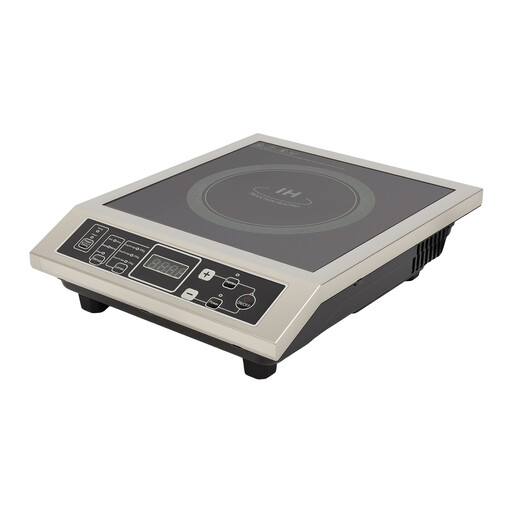 No image available
Described as a tabletop induction hob for cooking on one zone; check that the pot base is suitable before use.
Ten power levels, a timer, preset function and EU plug.
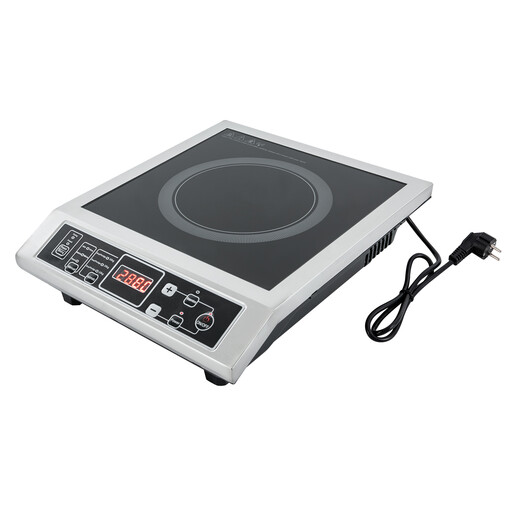 No image available
Described as an induction hob for one pot; check that your cookware is suitable for this specific model.
Eight power levels and eight temperature settings, a timer, preset function and EU plug.
No. The appliance setting alone is not enough to prove that the soup is at the right temperature. CASO lists a 70 °C setting for the ProChef 3500; the BfR recommends keeping food at a minimum of 60 °C throughout when holding it hot. Check the temperature of the soup itself rather than relying on the display.
For longer storage, the BfR recommends cooling hot food quickly to below 7 °C. Its kitchen hygiene guidance recommends reheating food to at least 70 °C throughout for two minutes. An appliance timer does not replace these steps.
Check whether the pot base is ferromagnetic, then compare its diameter with the manufacturer’s guidance for the cooking zone. For example, the Rommelsbacher CT 2010/IN lists a cooking zone of 120–230 mm. If your pot is not suitable, a non-induction hotplate is another option.
The statutory warranty provided by the seller is different from a voluntary guarantee, as explained by the Verbraucherzentrale. According to the German Environment Agency, old electrical appliances must not go in household waste. Options include recycling centres and returning appliances to retailers.
Subject to certain conditions, the EU Low Voltage Directive covers electrical equipment with an AC voltage of 50 to 1,000 V. According to the German Federal Network Agency, the manufacturer uses the CE marking to declare, on its own responsibility, that the product complies with the relevant requirements. The CE mark is not independent proof that a hob can keep soup safely hot.