Chutney makers who need to simmer
If you bring your tomato chutney to the boil before reducing it, compare the controls and how the hob switches off rather than looking only at its maximum wattage.


Choose a single hob and measure the space with your chutney pan and its handle in place. Also check the set-up instructions for the specific appliance. Induction only works with a suitable magnetic pan base, while radiant and cast-iron hobs are alternatives for other pans. With radiant and cast-iron hobs, bear in mind that they retain heat after being switched off. Power settings do not tell you the actual temperature of the chutney.
If you bring your tomato chutney to the boil before reducing it, compare the controls and how the hob switches off rather than looking only at its maximum wattage.
Measure the available space with the pan and handle you’ll be using. The appliance’s width alone won’t tell you whether it can be set up safely where you want it.
If you want to keep using your pan, check its base and compare its diameter with the specifications for the appliance you’re considering.
A good fit if: Your pan has a suitable magnetic base and its size and weight are within the model’s specifications.
The trade-off: You can’t use a pan that isn’t suitable for induction. Power settings don’t measure the temperature of the chutney.
A good fit if: You want to keep using a pan without an induction base and prefer controls operated by a dial.
The trade-off: The surface may remain hot after the hob is switched off. According to the manufacturer, the Rommelsbacher CT 2200/E requires a 30.5 × 41 cm space.
A good fit if: You want to use a flat-bottomed pan that isn’t suitable for induction.
The trade-off: Rommelsbacher says cast-iron hobs heat up more slowly and retain heat for longer than induction hobs. Factor in the residual heat when reducing your chutney.
| Priority | What to check when buying | Who might value this? |
|---|---|---|
| Adjustable simmering | Compare the power controls, shut-off functions and residual heat of the specific model. | When I reduce chutney after bringing it to the boil, I want to be able to adjust the heat as needed. Around 36% of consumers might put controllability first. |
| Space and storage | Measure the available worktop space with the pan and handle in place; check the appliance dimensions and set-up instructions. | When space is limited, I need a hob that I can safely set up with the pan and put away afterwards. Around 29% of consumers might prioritise saving space. |
| Using an existing pan | Check the pan base and diameter against the appliance requirements; if you’re making a large batch, check the stated weight limit. | If I want to keep using my chutney pan, its heating requirements must match the appliance. Around 21% of consumers might give the suitability of their existing pan top priority. |
| Safe use and cleaning | Check the instructions, ensure the appliance is stable, and allow for residual heat and cooling time before cleaning. | When stirring and filling jars in a confined space, I want to be able to spot hot surfaces and clean the appliance safely. Around 14% of consumers might consider safe handling particularly important. |
The appliance dimensions don’t account for the space needed for the pan and handle, or for setting it up as instructed.
Measure the intended cooking area with the pan you’ll actually use, and check the model’s instructions.
The pan and handle may need extra room, making a spot that initially seemed suitable unsuitable for setting up the hob.
Glass-ceramic surfaces are also used on radiant hobs. Only induction requires a suitable magnetic pan base.
Check the heating technology and the pan requirements for the specific model before choosing based on its surface.
The rated power and settings don’t tell you the temperature of the chutney. Cast-iron hobs also retain heat after being switched off.
Keep an eye on the chutney as it reduces, adjust the heat and allow for residual heat.
The German Federal Centre for Nutrition distinguishes between bottling and preserving by heat-processing jars; the German Federal Institute for Risk Assessment warns of the risks of preserving food incorrectly.
Choose your hob and preservation method separately. If you’re storing food, follow a tried-and-tested guide for the specific recipe.
Incorrect preservation can lead to food loss and pose a health risk.
The Touch 2000 is a portable single induction hob. You can check its space requirements against your pan size and the stated weight limit.
The CT 2010/IN and CT 2200/E use different heating technologies, so don’t judge one model by the features of the other.
The KP 1092 is a single cast-iron hob that could be an option for a pan that isn’t suitable for induction.
The Kult X Mono is a portable single induction hob with direct-selection programmes.
The SIKP 2200 B1 is a tested portable single induction hob and a point of comparison, not a general buying recommendation.
The portable single hobs below offer different ways to control the heat and use the pans you already own. Before choosing, check the appliance specifications, your pan base and the space where you plan to set it up.
 No image available
A single cast-iron hob for anyone who wants to keep using a flat-bottomed pan that isn’t suitable for induction.
The heating ring has a diameter of 18 cm and the heat is adjusted steplessly. The cooking surface gets very hot during use and must cool completely before cleaning.
This model is listed as measuring 25 × 28.5 cm.
 No image available
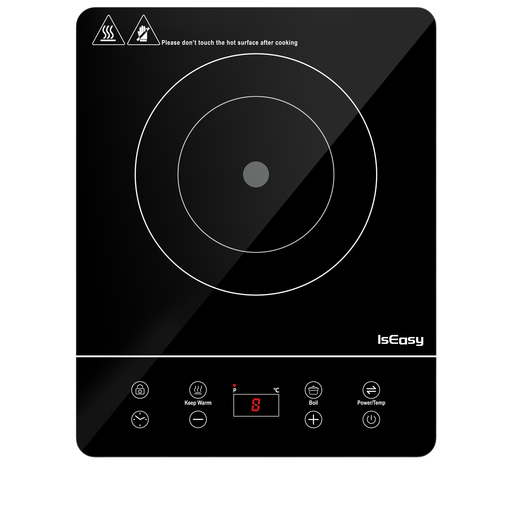
An option if your pan is suitable for induction and you want a choice of power and temperature settings.
The product lists 9 power levels, 9 temperature settings, an 8-hour timer and a child lock. According to the description, it’s designed for magnetic cookware with a diameter of 12–26 cm; 28 cm is also given in the product title.
The product is described as having a glass surface, a black finish and a 220–240 V power supply.
 No image available
A single hob for anyone using a suitable induction pan and looking for an appliance with a rotary control.
The title lists 5 power levels; the description gives dimensions of 21.5 × 21.5 cm.
 No image available
An alternative if you’re looking for a single hob with infrared heating and adjustable heat for suitable cookware.
The product title lists a timer, touch controls and a rotary control. According to the description, a slight smell and a little smoke may occur the first time you use it; if so, use the appliance in a well-ventilated area.
 No image available
A portable induction hob for anyone whose cookware has a suitable magnetic base and who wants a choice of power levels.
The title lists 10 power levels and 6 functions; the description mentions a glass surface and an especially slim design. According to the product information, it can only be used with pans suitable for induction.
No. A hob setting doesn’t tell you the temperature of the food or prove that a preservation method is suitable. The German Federal Centre for Nutrition distinguishes between cooking chutney and filling jars afterwards, and heating jars that have already been sealed. For storing food, follow a tried-and-tested guide for the specific recipe and method; the German Federal Institute for Risk Assessment warns against preserving food incorrectly.
Only if the pan base isn’t suitable for induction, or if the size or weight limit doesn’t match the model you’ve chosen. For the CASO Touch 2000, for example, CASO Design lists a pan size of 12–24 cm and a maximum load of 6 kg. Radiant and cast-iron hobs use different heating technologies and are alternatives if you want to keep using a pan that isn’t suitable for induction.
Compare the available space, including the pan and handle, with the set-up instructions in the manual for the specific model. Switch the appliance off before cleaning, and take care around hot surfaces and residual heat. Even an induction cooking surface can get hot from the pan.
No. Statutory consumer rights apply when you make a claim against the seller for a fault; a guarantee is an additional voluntary offer with its own terms. The Verbraucherzentrale distinguishes between the two. When choosing a particular hob, also check whether a repair service is available.
Electric hobs sold in the German market should have the required CE marking and German-language instructions with usage information and warnings. The German Federal Network Agency lists these points in connection with market surveillance. A CE mark alone is not an independent test result or quality assessment of the specific appliance.
If you have a pacemaker or another electronic implant, ask your doctor about possible interference in your individual case and follow the guidance for the specific appliance. The German Federal Office for Radiation Protection notes that susceptibility depends, among other things, on the type of implant and its programming; there is no single safe distance that applies to everyone.