Households eating at different times
If you make a pan of soup but won't serve every portion at the same time, you'll need to decide whether to keep it hot safely or chill the portions you plan to serve later and reheat them before eating.


The right portable hob depends first on whether your soup pan is suitable for induction: induction is an option if the pan has a compatible base; otherwise, consider a radiant ceramic glass or cast-iron hotplate. To keep food hot, the German Federal Institute for Risk Assessment (BfR) recommends a temperature of at least 60 °C throughout. A setting on the appliance does not confirm that the soup has reached this temperature. If you cannot check it reliably, cool the soup, keep it in the fridge until you are ready to reheat it, then heat it thoroughly before serving.
If you make a pan of soup but won't serve every portion at the same time, you'll need to decide whether to keep it hot safely or chill the portions you plan to serve later and reheat them before eating.
If you want to keep using your current pan, check that its base is suitable for induction and meets the appliance's requirements before choosing a heating type.
If you need an extra cooking zone, choose between a single and double hotplate based on whether you'll genuinely use two pans at once and how much space you have available.
When meals are served at different times, the key considerations are the right heating type, the soup's actual temperature, the pan you already own and how many cooking zones you need to use at once.
| What matters to you | What to look for | Who this matters to |
|---|---|---|
| Keeping food hot or serving it later | For keeping food hot, the BfR recommends a temperature of at least 60 °C throughout. A function or setting on the appliance does not automatically measure the temperature of the soup throughout. Otherwise, cool and chill it, then reheat it before eating. | If I'm serving portions at different times, I want to either keep the soup sufficiently hot or chill the later portions and reheat them. Around 36% of consumers say this is their main consideration. |
| Using your existing pan | Check that the pan is suitable for induction and compare its base diameter with the specifications for the particular appliance. If you're using a full pan, also check any stated weight limit. | If you want to keep your current soup pan, you mainly need to make sure its base and dimensions are compatible with the hotplate you choose. Around 29% of consumers focus on whether their pan is compatible. |
| One or two cooking zones | Consider whether you regularly use two pans at once, and compare the appliance's dimensions and connection requirements with the space where you plan to use it. | If I need to heat another pan alongside the soup, I want to know whether a double hotplate will fit on the available worktop. Around 21% of consumers focus on the number of cooking zones and the space required. |
| Controls and cleaning | Compare the controls, timer, surface and residual heat indicator. ROMMELSBACHER says that, compared with flat glass hotplates, cast-iron hotplates take longer to heat up and are harder to clean. | If I need to adjust the heat while cooking and wipe away splashes afterwards, the controls and surface are important to me. Around 14% of consumers prioritise ease of use and cleaning. |
An appliance setting does not prove that the food has reached the recommended temperature throughout.
If you keep the soup hot, check its temperature. If you're serving it later, you can cool it, keep it in the fridge and reheat it before serving. The BfR recommends keeping food at a temperature of at least 60 °C throughout.
A pan with an unsuitable or oversized base may not meet the hotplate's requirements. If you decide on induction, you may also need to buy suitable cookware.
Check that your pan is suitable for induction and compare its base diameter with the specifications for the appliance. If you want to keep using your pan, consider radiant ceramic glass or cast iron as well.
If your existing pan isn't suitable for induction, choosing an induction hob may mean you need to buy suitable cookware too.
A second cooking zone takes up extra space but offers no benefit if you only use one pan at a time.
Check whether you regularly need to use two pans at once, and compare the appliance's dimensions with the space where you plan to use it.
The COMFORT C2000 portable single induction hob is aimed at buyers with a suitable pan who want to compare a stated keep-warm function and a timer.
The CT 2203/TC TM with radiant heating element and the AK 1599/E with cast-iron hotplate are alternatives if you don't want to rely on having a pan suitable for induction.
The DK 1014 double hotplate is worth considering if you want to use two pans at once on a portable hob.
The IK 35 portable single induction hob is an option for buyers with a soup pan suitable for induction who want to compare power settings and timers.
The Silvercrest SIKP 2200 B1 was included as a comparison model in a F.A.Z. Kaufkompass test of portable induction hobs. The article was updated on 4 August 2026.
The products below are portable single or double induction hobs for making soup. Before buying, check that your pan is suitable for induction and that its dimensions are compatible with the particular model. A keep-warm function is no substitute for measuring the food's temperature.
 No image available
A portable single induction hob is an option if your soup pan is suitable for induction and you want to adjust the heat setting.
Specifications include eight temperature settings, 800–3,500 W, a timer and overheat protection.
 No image available
This portable single hob is suited to a household that heats one pan at a time and wants to use heat settings and a timer.
Specifications include nine heat settings, nine temperature settings and a timer of up to 8 hours. For induction use, the product description specifies magnetic cookware with a diameter of 12–26 cm.
 No image available
Two cooking zones are useful if you regularly want to heat a second pan alongside your soup.
Specifications include two independently controlled cooking zones and five temperature settings. The listed cooking modes include simmering and keeping food warm.
 No image available
This single hob is an option if you want to make soup on a portable induction hob and use an automatic soup function.
Specifications include ten temperature settings, a timer of up to 3 hours and a pre-set function.
 No image available
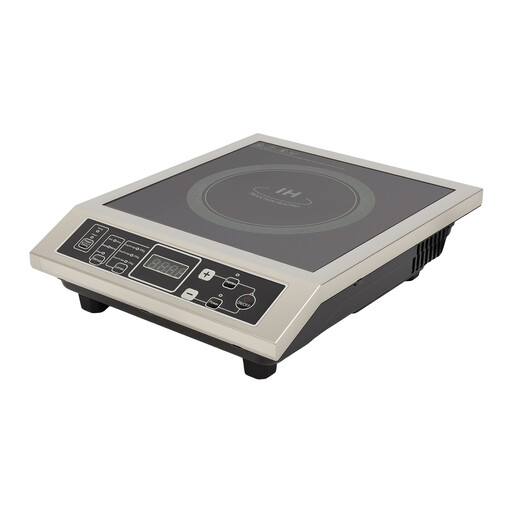
This tabletop hob works as a portable single cooking zone if you want to choose different power settings for different stages of cooking.
Specifications include 3,500 W, ten power settings, a timer and a pre-set function. The description lists simmering and boiling among the cooking modes.
No. It does not confirm the temperature of the soup throughout. The BfR recommends keeping food at a temperature of at least 60 °C throughout. If you cannot check this reliably, cool the soup, keep it in the fridge until you are ready to reheat it, then heat it thoroughly before serving later.
Check for an induction symbol or see whether a magnet sticks to the flat base of the pan, then compare the base diameter with the instructions for the specific appliance. For example, the Steba IK 35 instructions specify a minimum of 12 cm; this does not automatically apply to other models.
Follow the rating plate and instructions for the model. Among other things, the Steba IK 35 instructions require a properly earthed, easily accessible socket and checks of the appliance and cable before use. Don't assume that the same requirements apply to other models without checking.
The German Federal Network Agency says that market surveillance checks include the CE marking, product identity and manufacturer details, as well as German-language instructions with the necessary warnings. The consumer advice centre notes that statutory consumer rights are separate from a voluntary guarantee.