
Lieferung heute & morgen

Qualitätsgarantie

Willkommens-Angebote freischalten: KOSTENLOSE Lieferung | Bis zu 80 % RABATT | Kostenlose 30-Tage-JoyPlus-Testphase
App herunterladen
A portable ice maker can significantly reduce the wait for fresh ice. Many compact models produce their first bullet ice cubes within just a few minutes and do not require a fixed water connection. At the same time, unclear performance specifications, small collection containers or hard-to-reach interior areas can quickly lead to disappointment.
This selection guide from the Joybuy Product Recommendation Officer explains which specifications really matter when buying an ice maker for home, the office, motorhome or camping.
Specifications such as “12 kg per day” or “up to 20 kg in 24 hours” describe theoretical production capacity under certain conditions. The machine will not normally store this amount all at once. You should therefore also consider:
An ice maker producing 12 kg per day may be sufficient for everyday drinks. For a larger party, however, the ice will need to be removed regularly and, if necessary, kept chilled in a separate container.
Depending on the model, the first batch may be produced after six to ten minutes. After that, the cycle duration is affected by the water temperature, room temperature and selected ice cube size. Bullet ice cubes are often hollow and should not be compared with solid ice cubes made in a freezer.
For this reason, look for specific details such as “9 ice cubes per cycle” or “24 ice cubes in approximately 13 minutes”, rather than relying solely on a general advertising claim about speed.
An ice maker with a self-cleaning function usually runs a time-limited rinsing programme. The water tank, ice basket and removable accessories still need to be emptied regularly and cleaned with a soft cloth. Residue in the water or stagnant residual water can affect the machine’s operation.
Use only clean drinking water and follow the operating instructions. The appliance, mains plug and power cable must not be immersed in water.
A bullet ice maker typically produces hollow, rounded pieces of ice. This shape can be practical for soft drinks, coffee, cocktails or beer. Models offering two sizes provide more choice for different drinks.
Check the following:
The daily output should match your usage pattern. For occasional drinks, a compact model with a stated output of around 10 to 12 kg should be sufficient. For regular events, a model with a larger water tank and higher daily output may be more suitable.
An integrated water tank means the machine does not need a water connection. A capacity of around 1.2 to 1.5 litres is common for compact models, while larger models may offer more than three litres. A larger tank reduces the need for refilling, but it often also increases the appliance’s dimensions and weight.
The ice basket is equally important. A daily output of 12 kg does not mean that 12 kg can be stored in the basket at the same time. Look for “add water” and “ice full” sensors. These indicators make the machine easier to operate and prevent unnecessary idle periods.
For a portable ice maker, the external dimensions and weight are crucial. Measure your worktop and leave enough space at the sides and rear for ventilation. Ventilation openings must not be covered.
A noise level of around 40 to 50 dB may be relevant for use in a kitchen, office or motorhome. However, the perceived noise will depend on where the appliance is placed and on the room acoustics. When using the machine in a motorhome or while camping, you should also check that a suitable power supply is available. A standard household socket is not automatically compatible with every portable power system.
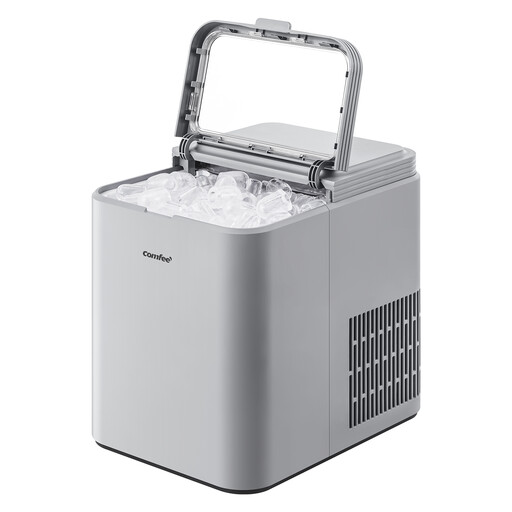
Why this product suits this profile: This compact model is designed for everyday drinks in the kitchen, office or motorhome and offers two ice cube sizes.
The specifications state both that the first ice is produced after around six minutes and that the daily output is up to 12 kg. This makes it easier to compare the advertising claims with the intended use.
1.3-litre water tank, self-cleaning function, removable ice basket and ice scoop.
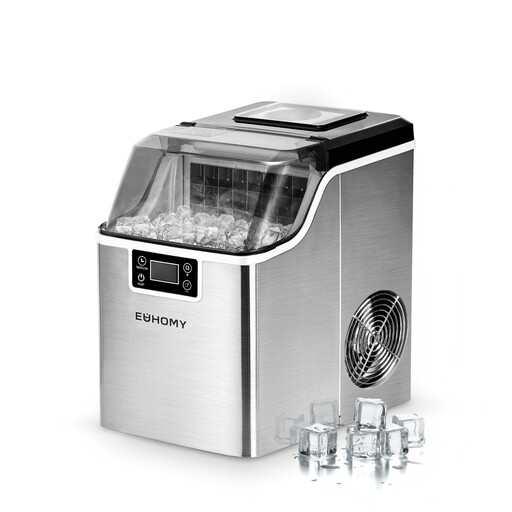
Why this product suits this profile: The larger tank and stated production capacity make this model suitable for families, hosts and anyone who regularly needs ice.
The product description points out that the 24 ice cubes produced per cycle may be connected to one another. They may therefore need to be separated using the supplied accessory before serving.
3.2-litre water tank, automatic cleaning, transparent viewing window and a stated noise level of around 45 dB.
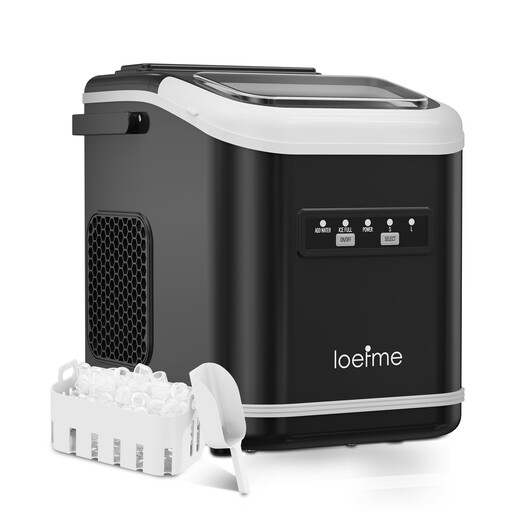
Why this product suits this profile: The integrated carry handle, compact design and 1.4-litre water tank make this model appealing to anyone who wants to move an ice maker around flexibly for camping, motorhome trips or parties.
The description provides specific dimensions, a weight of 6.4 kg, two ice cube sizes and a noise level of 40 dB. These details make it easier to assess whether the machine is suitable for mobile use.
Up to 12 kg of production capacity in 24 hours, automatic cleaning, carry handle and a collection container for up to 110 ice cubes according to the product specifications.
Power consumption depends on the output, operating time and ambient temperature. A machine using 120 to 150 watts will consume the corresponding amount of electricity while running; the actual cost depends on the operating time and your electricity tariff. For a rough calculation:
Power in kilowatts × operating hours × electricity price per kilowatt-hour = electricity costs
To extend the service life of your portable ice maker, you should:
For appliances intended for the German market, there should also be a CE marking, clear safety information, details of the responsible person in the EU and instructions on disposing of electrical appliances. Check for this information in the product description or on the appliance before buying.
We have put together a complete, regularly updated list of products that fully meet these strict selection criteria and the safety regulations applicable in the EU.
Depending on the model and conditions, the first bullet ice cubes are ready after approximately six to ten minutes. Room temperature, water temperature and the selected size can extend the cycle duration. The stated time usually refers to the first individual batch, not the total daily output.
This depends on how frequently it is used and on the manufacturer’s instructions. The water tank and ice basket should be emptied and cleaned regularly. An ice maker with a self-cleaning function makes rinsing easier, but it does not replace drying the appliance or manually cleaning accessible surfaces.
For households, offices, parties or motorhomes, buying one can be worthwhile if you regularly need ice at short notice and have limited freezer space. Before placing your order, however, check that the tank size, output, noise level, footprint and power connection suit your everyday needs.