
当日/次日达

品质保障

开启新人专享福利: 全场免邮 | 低至 2 折 | 免费试用 30 天 JoyPlus 会员
下载 Joybuy
A portable ice maker can make drinks, parties, the office and camping much more convenient. Instead of preparing ice cubes in the freezer, a compact ice maker produces fresh bullet-shaped ice cubes directly on your worktop. However, the machines differ considerably in tank size, production capacity, cleaning and genuine portability.
Anyone who focuses only on claims such as “ice cubes in 6 minutes” or “12 kg per day” may overlook important details. The following criteria will help you assess marketing claims objectively and choose the right ice maker for home, your kitchen or your motorhome.
The claim “12 kg per day” generally describes a calculated production capacity under specific conditions. It does not mean that 12 kg of ice will be in the basket at the same time. Many compact machines store only around 0.4 to 1 kg of ice. For a party, the basket therefore needs to be emptied regularly, with the ice placed in temporary storage if necessary.
The ambient temperature also affects performance. In warm room air or with insufficient ventilation, a cycle may take longer. An ice maker producing 12 kg per day is therefore primarily suitable for regular smaller quantities, not automatically for continuous use in a catering business.
“Ice cubes in 6 minutes” usually refers to the first batch or favourable operating conditions. Further cycles may take longer, particularly if the water is warm or the machine needs to release heat after several cycles. Buyers should therefore also check the cycle duration, water tank and ice compartment.
An ice maker with self-cleaning makes regular cleaning easier, but it does not automatically remove every residue. The water tank, ice compartment, scoop and drain should be cleaned and dried according to the manufacturer’s instructions. The self-cleaning function is a convenience feature, not a replacement for clean drinking water and regular manual checks.
For households, a first batch after around 6 to 13 minutes and a stated daily capacity of approximately 12 kg are often sufficient. Check whether “per 24 hours” is expressly stated and how many ice cubes are produced per cycle. The moulds are often hollow and bullet-shaped. They cool drinks quickly, but depending on their size and the drink, they may melt at different rates.
A larger water tank reduces the need for refilling, but it often makes the machine heavier. Depending on the version, the models in this selection have tanks holding approximately 1.2 to 3.2 litres. A carry handle is also useful for mobile use. A drain hole makes it easier to remove residual water after use.
The ice compartment should not be confused with a freezer compartment. Portable machines generally keep ice frozen for only a limited time. For longer storage, place it in a freezer or an insulated cool box.
Measure the available surface area, including the required ventilation clearance. Compact machines are often around 22 to 36 cm wide and approximately 29 to 33 cm high. Ventilation openings must not be covered. For offices, motorhomes or sleeping areas, the stated noise level may also be relevant; some of the models featured are specified at below 45 to 50 dB.
Before buying, you should also check the mains plug, operating voltage, cable length and instructions for use in a vehicle. A household appliance is not automatically suitable for every camping power supply.
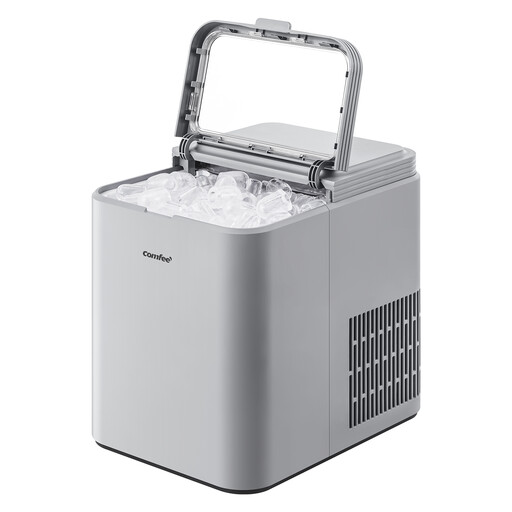
Why this product suits this profile: Its compact design is intended for daily drinks, smaller households and limited worktop space in the kitchen or office.
The product details state 6 minutes for the first ice cubes, up to 12 kg per 24 hours, two sizes and a self-cleaning function. However, daily capacity should not be confused with the capacity of the ice container.
1.3-litre water tank, two ice cube sizes, removable container and ice scoop.
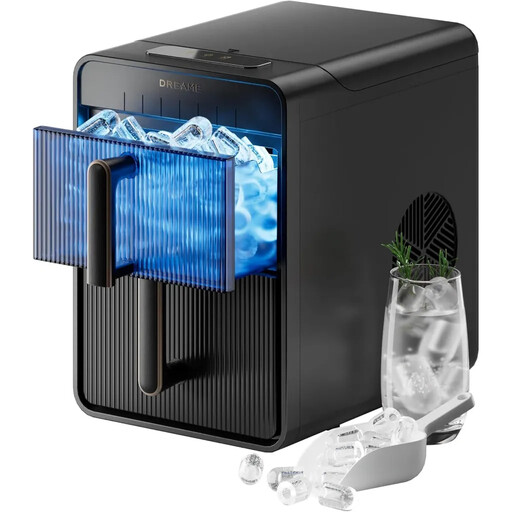
Why this product suits this profile: The touch display, sensors for the water level and full ice compartment, and stated capacity of up to 15 kg per 24 hours will appeal to users who prioritise ease of use and greater capacity.
The product description distinguishes between the first batch after around 6 minutes and a regular cycle time of 7 to 9 minutes. This makes it easier to put the quick marketing claim into context.
2.0-litre water tank, 1-kg ice container, two bullet ice sizes and a 30-minute self-cleaning programme.
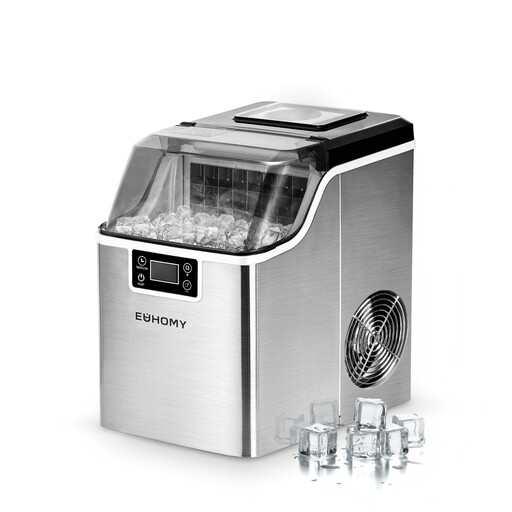
Why this product suits this profile: Its larger design is suitable for parties, frequent drink preparation, and use in the kitchen, office, bar or motorhome, provided there is enough available space.
The description notes that the 24 ice cubes produced per cycle may be joined together and need to be separated before use. It also states a variable cycle time of approximately 13 to 25 minutes.
3.2-litre water tank, automatic cleaning, timer function and stated daily capacity of up to 20.5 kg.
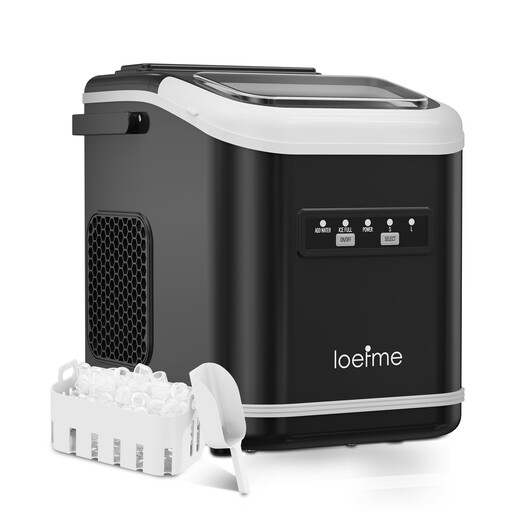
Why this product suits this profile: The integrated handle, 6.4 kg weight and compact dimensions make it easier to move between the kitchen, a party, the motorhome and the campsite.
The specifications explicitly state a cycle range of 6 to 13 minutes rather than just a single best-case figure. This makes planning easier when outdoor temperatures vary.
Up to 12 kg of ice per 24 hours, two sizes, 1.4-litre water tank and stated noise level of 40 dB.
We have put together a complete, regularly updated list of products that fully meet these strict selection criteria and the safety regulations applicable in the EU.
The ongoing costs of a portable ice maker consist of electricity, water and, where applicable, replacement parts. A short production cycle can increase electricity consumption when the machine is used frequently. For a reliable estimate, you should consider the power consumption in watts, daily operating time and your local electricity tariff.
Use only clean drinking water and place the machine on a level, stable surface. After use, it is advisable to drain any remaining water and clean the tank and ice container with a soft cloth. Mains plugs, cables and the housing must not be immersed in water. The ventilation openings must remain clear.
Their service life depends on care, operating conditions and the quality of the components. Regularly emptying, drying and descaling the machine according to the manufacturer’s instructions can help reduce deposits. If you notice unusual noises or problems with the cooling system, do not open the machine yourself.
This depends on the rated power and actual running time. A machine rated at 120 to 150 watts theoretically uses 0.12 to 0.15 kWh per hour while operating. Actual daily consumption may be lower or higher, depending on how long the machine runs and how often it needs to cool down again.
Many compact models are designed for use in the kitchen, office, while camping and in motorhomes. However, a suitable power supply, sufficient ventilation and a stable, level position are essential. Before using the machine in a vehicle, check the manufacturer’s information on voltage, ambient temperature and transport.