
Lieferung heute & morgen

Qualitätsgarantie

Willkommens-Angebote freischalten: KOSTENLOSE Lieferung | Bis zu 80 % RABATT | Kostenlose 30-Tage-JoyPlus-Testphase
App herunterladen
A portable ice maker can provide drinks with ice at short notice during barbecues, parties, in the office or when camping. However, compact ice makers vary considerably when it comes to water tank capacity, ice production, noise levels and cleaning. Anyone who focuses only on claims such as “fast ice cubes” or “up to 12 kg in 24 hours” may overlook important details.
This buying guide from the Joybuy Product Recommendation Officer explains which technical specifications matter before you buy and which appliance is best suited to each usage profile.
The specification 12 kg of ice cubes in 24 hours describes theoretical production under certain conditions. It does not mean that the appliance can store 12 kg at the same time. Compact ice makers often have a much smaller ice basket that needs to be emptied regularly.
For one person or a typical household, a small supply is usually sufficient. For parties, cocktail evenings or larger barbecues, users should check how quickly new ice cubes are produced and whether the machine stops automatically when the basket is full.
The description quiet ice maker alone says very little. A specific decibel value is more informative. An appliance rated at 40 dB or below 45 dB may be more comfortable in a kitchen, office or motorhome than a model with no noise specification. Placement also affects how the noise is perceived: a hard worktop can amplify vibrations and operating sounds.
An ice maker with self-cleaning makes regular internal cleaning easier, but it does not eliminate the need to empty, dry and wipe the appliance. Any remaining water should be removed after use. A drain plug, accessible water tank and removable parts are therefore at least as relevant for everyday use as an automatic cleaning programme.
Many portable ice makers produce so-called bullet ice cubes. These hollow, rounded pieces of ice can generally be made relatively quickly and are suitable for soft drinks, iced coffee or cocktails. If you need ice as quickly as possible, check the time per cycle. According to the product specifications, each of the appliances presented here produces nine ice cubes in approximately 6 to 13 minutes.
The shape of the ice is not the same as classic cubes made in a freezer drawer. Bullet ice cubes may melt more quickly, but they cool drinks immediately after being dispensed.
A tank with a capacity of 1.2 to 1.4 litres provides a useful indication of how often it needs to be refilled. The capacity of the ice basket is also important. An appliance may produce a large quantity each day, but if the basket is small, it will need to be emptied in between cycles.
Water-level and full-basket sensors are useful. They can stop production automatically and prevent the machine from continuing to operate without enough water.
An ice maker with two ice cube sizes adapts to different drinks. Small bullet ice cubes are suitable, for example, for smaller glasses or rapid cooling. Large pieces of ice may remain visible for longer in certain drinks. Being able to choose between S and L is therefore more practical than having an appliance with just one fixed size, provided both settings are useful in everyday use.
Measure the available space before buying. A portable ice maker needs a stable, level surface, sufficient clearance for ventilation and an accessible socket. For camping or use in a motorhome, weight and a carrying handle are also important. Most appliances in this category are designed to operate from a standard household socket; check the information in the instruction manual before use.
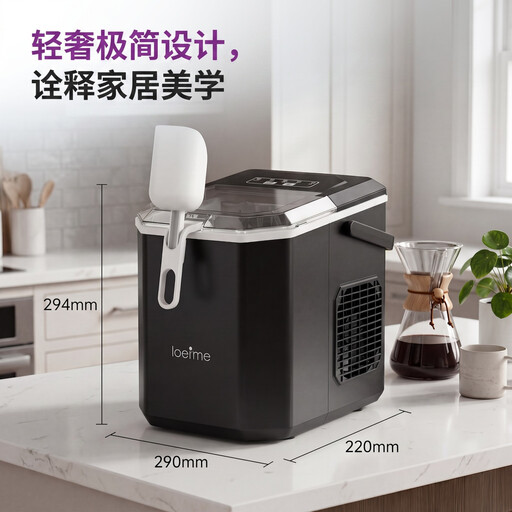
Why this product suits the profile: This compact machine has a 1.2-litre water tank, two ice cube sizes and, according to the product specifications, produces nine ice cubes per cycle in 6 to 13 minutes. This makes it suitable for occasional use at home or at small gatherings.
The stated production capacity of up to 12 kg in 24 hours is supplemented by specific cycle information. Automatic shut-off when the basket is full limits unnecessary continuous operation.
Two sizes, automatic cleaning, carrying handle and an ice basket with a capacity of 0.6 kg.
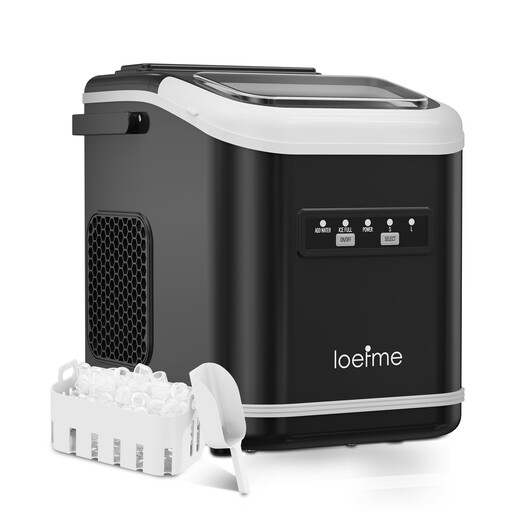
Why this product suits the profile: This model combines a 1.4-litre water tank with a basket that holds up to 110 ice cubes. The stated noise level of 40 dB and weight of 6.4 kg are useful comparison figures for open-plan kitchens, offices and mobile use.
The decibel rating makes the noise description easier to verify. In addition, the automatic self-cleaning function means that internal care does not have to be carried out entirely by hand.
40 dB according to the product specifications, two ice cube sizes, carrying handle and automatic shut-off when the ice basket is full.
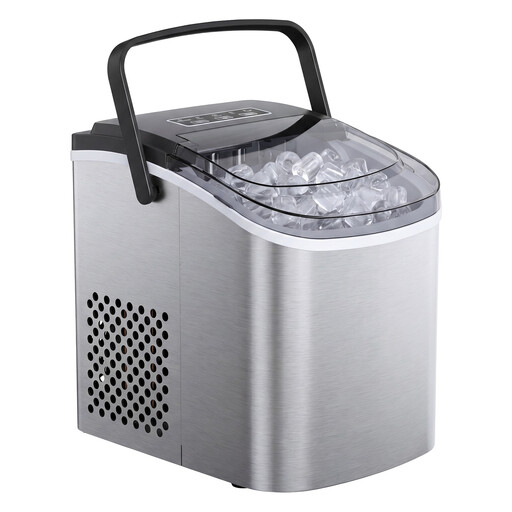
Why this product suits the profile: For regular use at parties, in the office, in the kitchen or when camping, the stated production capacity of 12 kg per 24 hours, carrying handle and compact dimensions of 31 × 25 × 32 cm are all useful features.
The machine specifies both its production capacity and its 0.6 kg basket capacity. A drain plug and a 30-minute self-cleaning cycle make emptying and maintenance easier.
Two ice cube sizes, three control buttons, water- and ice-level indicators, and a stated noise level below 45 dB.
We have put together a complete, regularly updated list of products that fully meet these strict selection criteria and the safety regulations applicable in the EU.
For hygienic operation of an ice maker at home, we recommend the following routine:
For an ice maker for camping or a motorhome, you should also check the space required, weight, carrying handle and available power supply. For longer periods when the appliance is not in use, the tank should be completely empty and dry.
This depends on the model, room temperature, water temperature and fill level. According to the product specifications, the LOEFME and JOYFURNOS models mentioned produce nine bullet ice cubes in approximately 6 to 13 minutes. The daily production capacity of up to 12 kg should be considered separately.
Running costs mainly consist of electricity, water and, where applicable, cleaning products. For a realistic estimate, users should consider the power consumption shown on the rating plate, the daily operating time and the local electricity price. Switching the appliance on frequently for many hours will naturally use more energy than producing small quantities as needed.
It is not possible to give a reliable general lifespan. This depends, among other things, on how intensively the appliance is used, water quality, cleaning, storage and how moving parts are handled. Emptying and drying the appliance regularly and following the manufacturer's instructions can help support reliable operation. Before buying, you should also check the warranty, returns policy and available support information.