
Lieferung heute & morgen

Qualitätsgarantie

Willkommens-Angebote freischalten: KOSTENLOSE Lieferung | Bis zu 80 % RABATT | Kostenlose 30-Tage-JoyPlus-Testphase
App herunterladen
A dead car battery or a flat tire rarely happens at a convenient time. A jump starter with a compressor promises to be a multifunctional solution for these exact breakdowns. However, the market is flooded with devices whose advertised performance specs often promise more than they deliver in practice. Many drivers invest in a unit that fails at the critical moment.
This guide, created by the Joybuy Product Recommendation Officer, will help you identify the crucial features. We'll highlight two common pitfalls that can lead to a bad purchase and show you what really matters when making your choice.
Pitfall 1: Misleading Peak Current Ratings Manufacturers often advertise extremely high ampere (A) figures, such as 4000 A or more. However, this "peak current" is only available for a fraction of a second. For the actual starting process, especially in cold temperatures or when using a jump starter for a diesel engine, the continuous cranking current is what's crucial. This value is less frequently advertised, leading to situations where a supposedly powerful device fails on a larger engine.
Pitfall 2: The Underpowered, Token Compressor Many combo units integrate a compressor whose performance is inadequate for an emergency. A low air flow rate (measured in liters per minute) results in extremely long inflation times. A device that takes 15 minutes to only slightly increase tire pressure is more of an annoyance than a help during a breakdown. Furthermore, they often lack an automatic shut-off function, which creates a risk of over-inflating the tire.
To make an informed decision, you should focus on objective technical parameters rather than marketing buzzwords.
The peak current is an indicator of the maximum power the device can deliver for a short burst. More important, however, is its compatibility with your engine. Pay close attention to the manufacturer's specifications for the maximum supported engine displacement (in liters) for gasoline and diesel engines.
A useful jump starter with an air pump is defined by two key metrics:
The capacity of the internal battery, often stated in milliampere-hours (mAh), determines how many start attempts are possible or how many times you can charge your smartphone. However, high capacity is useless without the right technology. Look for modern lithium-polymer batteries and integrated protection circuits. Essential safety features include protection against reverse polarity, short circuits, overcharging, and overheating. A display that clearly shows the charge level and operating status is preferable to simple LED lights. Many devices also serve as a power bank with jump start capability and offer USB ports for charging mobile devices.
Here are some recommendations tailored to specific user profiles that avoid the pitfalls mentioned above.

Why This Fits Their Persona: Ideal for drivers of standard passenger cars (gas or diesel) who want a reliable and straightforward all-in-one solution to keep in the trunk. The device offers balanced performance for everyday breakdowns.
The manufacturer specifies clear engine compatibility (up to 9.0L Gas / 8.0L Diesel), which makes assessment easier. The 150 PSI compressor with auto shut-off prevents over-inflation and is adequately sized for standard tires.
Great value for money with 5-in-1 functionality. The LCD screen clearly displays all relevant information, such as tire pressure and battery level.
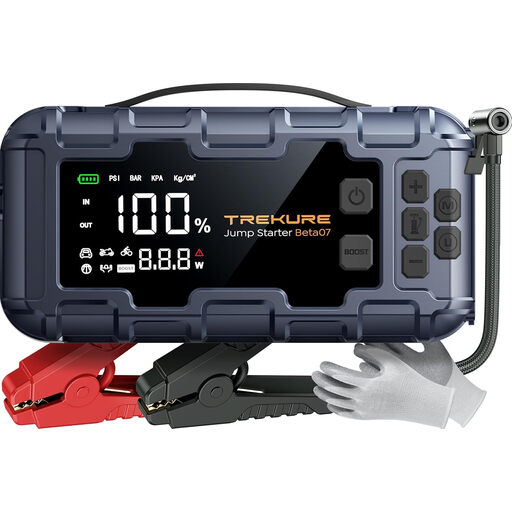
Why This Fits Their Persona: Designed for demanding use with large SUVs, vans, RVs, or boats. The high power output and fast compressor are built for large engines and tires.
The high peak current of 6000 A is specified for engines up to 12L. The compressor avoids the slow-performance trap with a stated air flow rate of 45 L/min, which speeds up the inflation of large tires.
Very high starting power and a fast compressor. The large 3.3-inch display and 45W PD fast charging (Input/Output) offer superior convenience and flexibility.
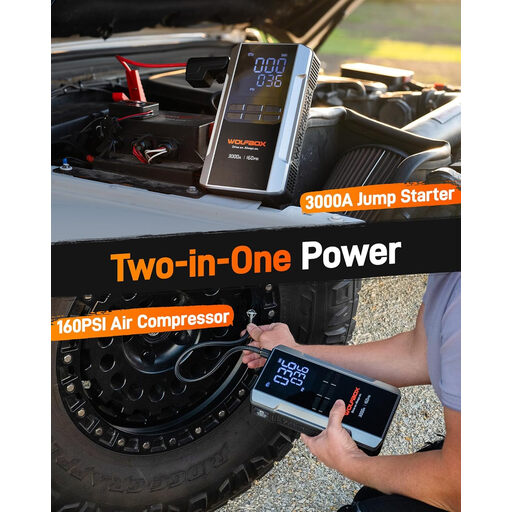
Why This Fits Their Persona: Perfect for users who value modern technology and fast charging speeds. This device can not only start the car but also rapidly charge laptops and other devices thanks to 65W Power Delivery.
The 3000 A peak current is sufficient for common engines (8L Gas / 6L Diesel). The 65W fast charging function directly addresses a weak point of many power banks: the long recharge time of the device itself.
The 65W PD fast charging is a clear unique selling point, enabling rapid recharging of the unit and powering laptops. The compressor delivers up to 160 PSI.
We have compiled a complete, up-to-date list of products that fully meet these strict selection criteria and safety regulations.
1. How often do I need to charge a jump starter with a compressor? Even when not in use, the battery will slowly self-discharge. It is recommended to fully charge the device every 3 to 6 months to maintain battery health and ensure it is ready for an emergency. Please refer to the specific manufacturer's instructions.
2. Is a higher peak current always better? Not necessarily. The crucial factor is that the device's power matches your vehicle's engine. An oversized battery booster pack for a small car offers no practical advantage but is typically more expensive and larger. Use the manufacturer's engine displacement recommendations for gasoline and diesel engines as your guide.
3. Can I use one of these devices to inflate a completely flat tire? Technically, it is possible to inflate a tire from 0 Bar. However, this process can take a long time depending on the tire size and compressor performance, and it can consume a significant portion of the battery's capacity. These devices are primarily designed to correct tire pressure or to inflate a slowly leaking tire enough to get you to the nearest service station.