
Lieferung heute & morgen

Qualitätsgarantie

Willkommens-Angebote freischalten: KOSTENLOSE Lieferung | Bis zu 80 % RABATT | Kostenlose 30-Tage-JoyPlus-Testphase
App herunterladen
A dead car battery or a flat tire always happens at the worst possible time. A jump starter with an air compressor promises a quick fix for both problems, combining a jump starter with an electric tire inflator. But the market is flooded with devices boasting impressive specs and bold claims. In practice, many of these products prove to be unreliable, leading to frustration instead of the roadside assistance you need.
As your Joybuy Product Recommendation Officer, I'm here to help you separate the wheat from the chaff. We'll shine a light on the most common pitfalls of buying one and show you which technical specs truly matter, so you can make an informed decision.
Many devices look good on paper but fail when you need them most. Pay close attention to these three points to avoid a bad purchase:
To ensure your battery booster works at the critical moment, you should check three core parameters. These determine the device's performance, compatibility, and reliability.
The peak current, measured in Amps (A), indicates the maximum power the device can deliver in a short burst. More importantly, however, this value must match your vehicle's engine.
The performance of the integrated 12V car compressor is indicated in Bar or PSI (Pounds per Square Inch). For car tires, pressures up to 3.5 Bar (approx. 50 PSI) are typical.
The battery's capacity, specified in milliamp-hours (mAh), determines how many times you can provide a jump-start or charge your devices.
Instead of making a one-size-fits-all recommendation, we have identified products tailored to specific user profiles.
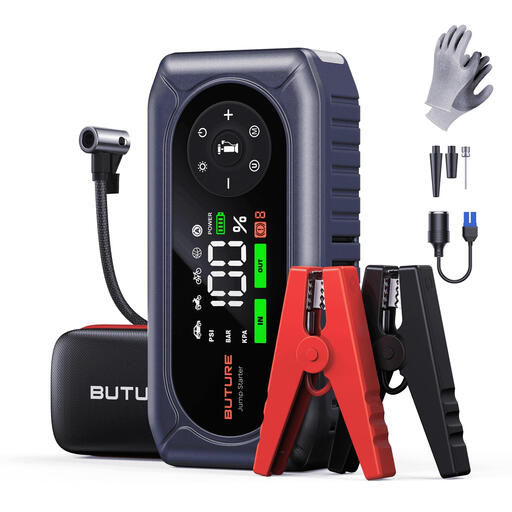
Why it's a good fit: Ideal for drivers of standard cars and SUVs (gas or diesel) who are looking for a reliable all-in-one solution for daily family use and road trips. The high power output provides ample reserve for a wide range of vehicles.
The 150 PSI compressor with a digital display and auto-shutoff prevents inaccurate inflation. Its broad compatibility (up to 9.0L Gas / 8.0L Diesel) is based on stable power delivery, not just a brief peak value.
5-in-1 Functionality: Jump starter, compressor, power bank, LED light, and 10 safety protection features in one device. Wide Vehicle Coverage: Suitable for most cars, SUVs, motorcycles, and even trucks.
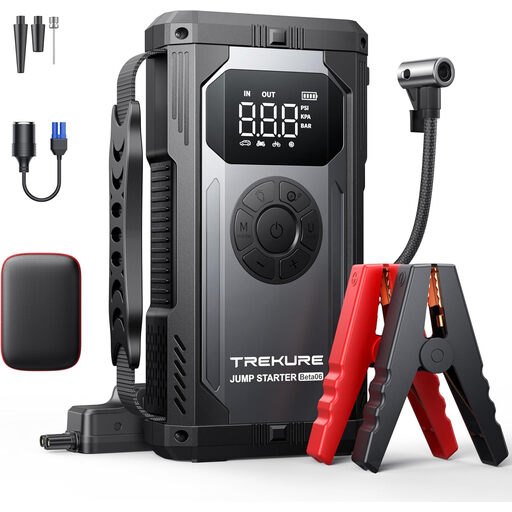
Why it's a good fit: Designed for owners of large SUVs, vans, RVs, or vehicles with large-displacement diesel engines who need maximum starting power and don't want to compromise on reliability.
With 5500A of peak current and suitability for diesel engines up to 10.0L, it directly addresses the pitfall of insufficient power. The high-quality 23800mAh lithium-polymer battery ensures low self-discharge and a long cycle life.
Extreme Starting Power: Reliably starts all gasoline engines and large diesel engines. Fast Compressor: The air compressor, with an inflation speed of 35 L/Min and an LCD display, is optimized for rapid use.
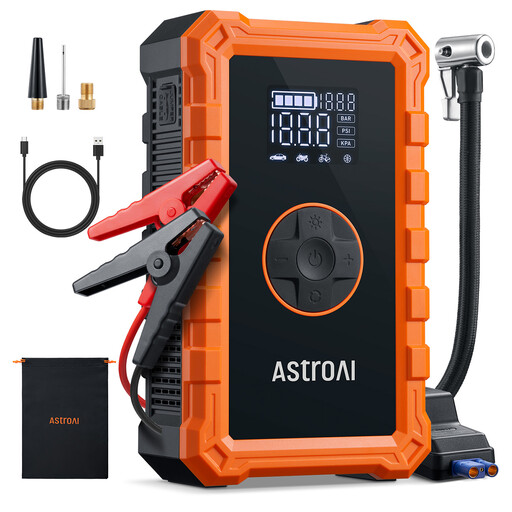
Why it's a good fit: Perfect for drivers of small and compact cars who need a space-saving, lightweight, and easy-to-use device for urban driving and occasional longer trips.
The compact design doesn't sacrifice functionality. The 150 PSI compressor with presets and the large 2.4-inch display ensure simple, error-free operation, a common problem with many cheap, compact devices.
Compact and Lightweight: Fits easily in the glove box or under a seat. Intuitive Operation: The large display clearly shows all relevant information, such as battery level and tire pressure.
We've compiled a complete, up-to-date list of products that fully meet these strict selection criteria and safety standards.
It is recommended to fully charge the device every 3 to 6 months, even if it has not been used. This compensates for the battery's natural self-discharge and ensures that full power is available in an emergency. You can find the exact intervals in the respective manufacturer's user manual.
Yes, many modern jump starters feature a "Boost" or "Force Start" function. This allows you to jump-start batteries with very low or even no remaining voltage. On standard devices without this feature, the battery often needs to have a small amount of residual voltage for the safety electronics to detect the vehicle.
No. While peak current is an indicator of maximum power, other factors are just as important. These include the quality of the battery cells, the build quality of the jumper cables and clamps, and the intelligent safety circuits (e.g., reverse polarity protection, short-circuit protection). A well-balanced overall package is more crucial than a single, high marketing number.